Wheel Alignment vs Wheel Balancing in Tractors: Key Differences, Benefits, Symptoms and Maintenance Guide for Indian Farmers (2026)
 Add CMV360 on Google
Learn the difference between tractor wheel alignment and wheel balancing, their benefits, warning signs, maintenance tips, tyre wear causes, and how they improve fuel efficiency, steering, safety, and tractor lifespan.

By Robin Kumar Attri

A tractor is one of the biggest investments for any farmer. Whether it is preparing fields, transporting crops to the mandi, operating a rotavator, pulling a trailer or handling heavy loader work, every task depends on one thing, a tractor that runs smoothly and efficiently. While most farmers focus on engine servicing, engine oil and hydraulic maintenance, many overlook two equally important aspects: wheel alignment and wheel balancing.
Although these terms are often used together, they serve completely different purposes. One ensures that your tractor moves in a straight line with minimum tyre wear, while the other ensures the wheels rotate smoothly without vibrations. Ignoring either can lead to faster tyre wear, poor fuel efficiency, steering problems, expensive axle repairs and even transmission damage over time.
Whether you own a Mahindra, Swaraj, John Deere, Massey Ferguson, New Holland, Farmtrac, Powertrac, Sonalika, Kubota, Eicher, ACE, Indo Farm or Solis tractor, understanding the difference between wheel alignment and wheel balancing can significantly reduce maintenance costs and improve overall performance.
So, how do you know whether your tractor needs wheel alignment or wheel balancing? And which one should you choose if your tractor starts pulling to one side or begins vibrating on the road? Let's understand everything in detail.
Also Read: Incorrect Tractor Wheel Alignment Can Destroy Tyres Faster: Warning Signs, Causes and Easy Fixes
What is Wheel Alignment in a Tractor?
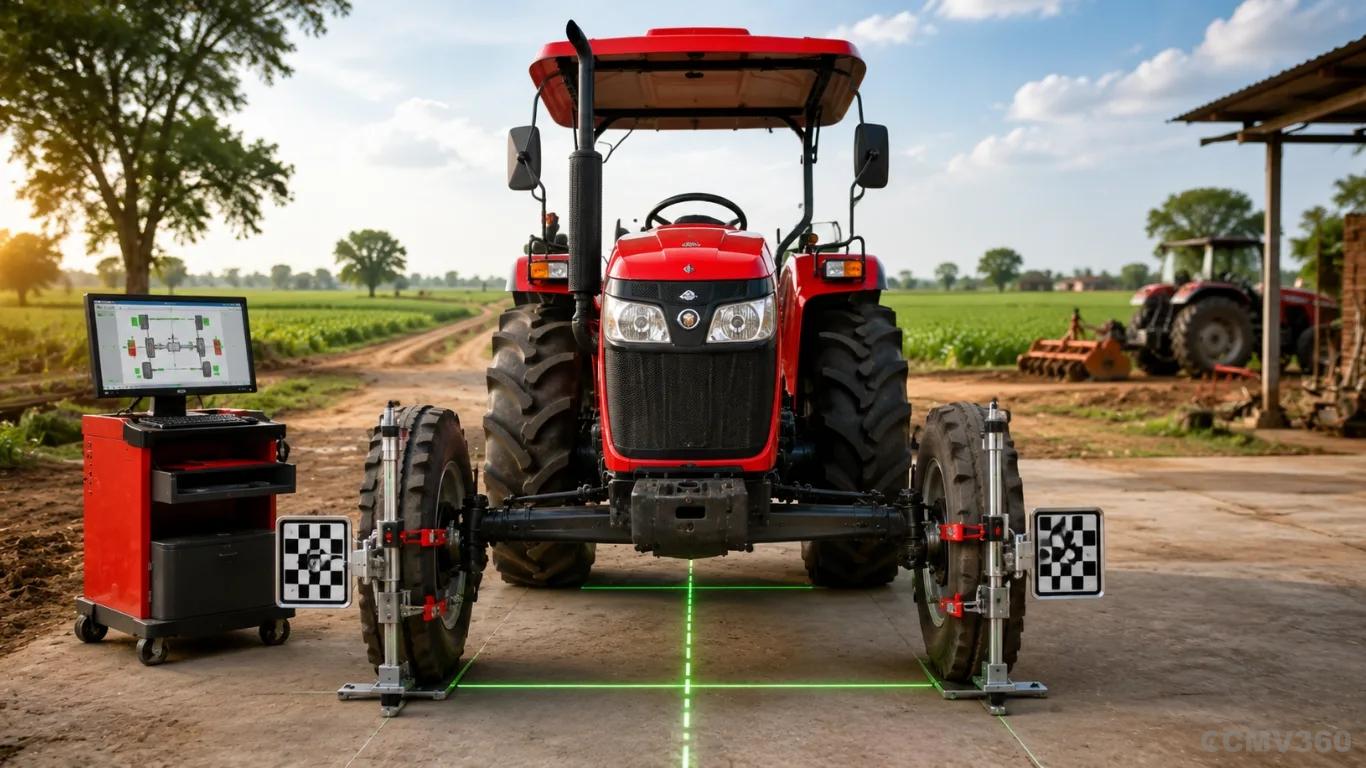
Wheel alignment refers to adjusting the position and angles of the tractor's wheels so they remain parallel to each other and perpendicular to the ground. The objective is to ensure the tractor moves straight without unnecessary sideways drag.
Unlike balancing, alignment mainly focuses on the steering geometry of the tractor's front axle.
The alignment process involves adjusting three important wheel angles:
Toe: Whether the front edges of the tyres point slightly inward or outward.
Camber: The inward or outward tilt of the wheel when viewed from the front.
Caster: The steering axis angle that helps the steering naturally return to the centre after turning.
These settings are controlled through components such as tie rods, steering joints, steering arms, front axle pivots and linkages.
What is Wheel Balancing in a Tractor?
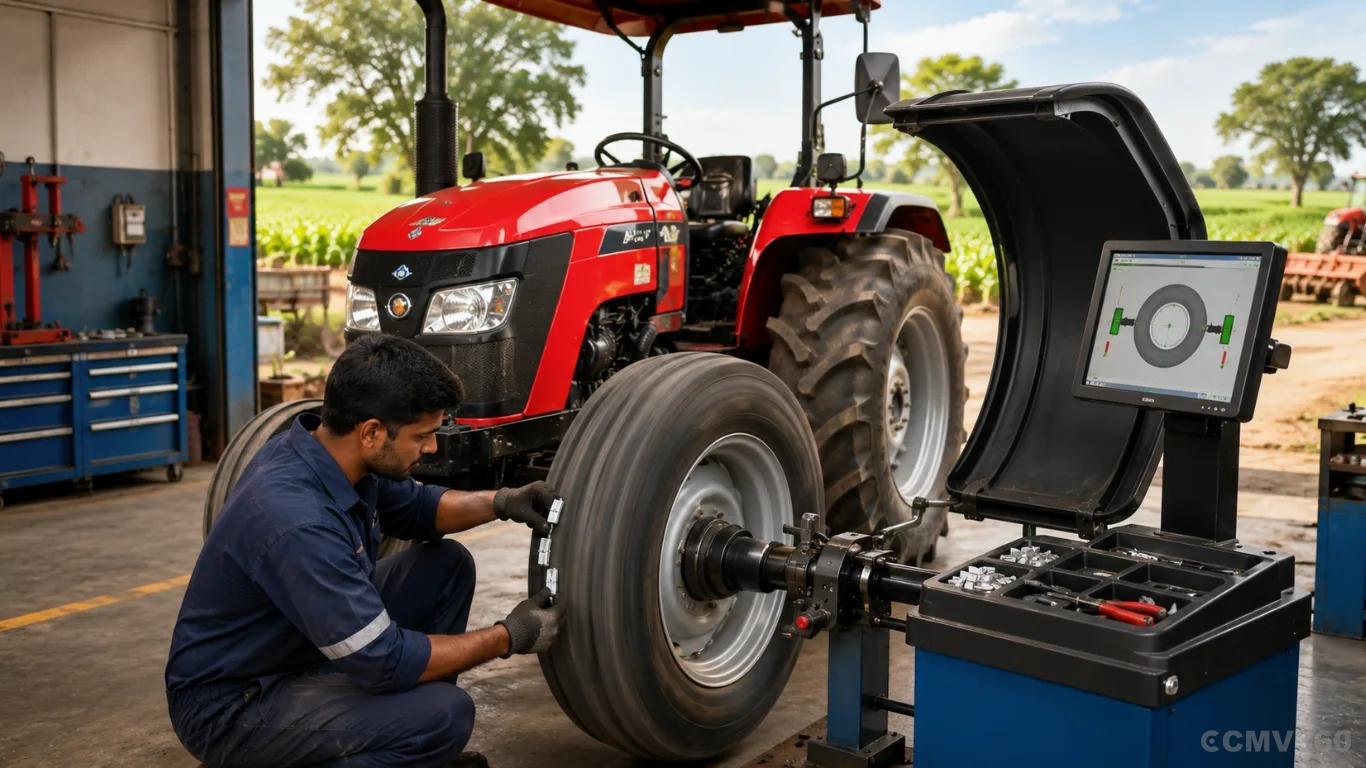
Wheel balancing is the process of correcting uneven weight distribution in the tyre and wheel assembly. Even a small difference in weight around the tyre or rim can create vibrations while the tractor is moving, especially during road transport.
During balancing, the complete tyre-wheel assembly is placed on a balancing machine. Sensors identify heavier areas, after which technicians attach calibrated balancing weights to the rim until the wheel rotates evenly.
Unlike alignment, balancing does not change the direction of the wheels. Instead, it ensures smooth and vibration-free wheel rotation.
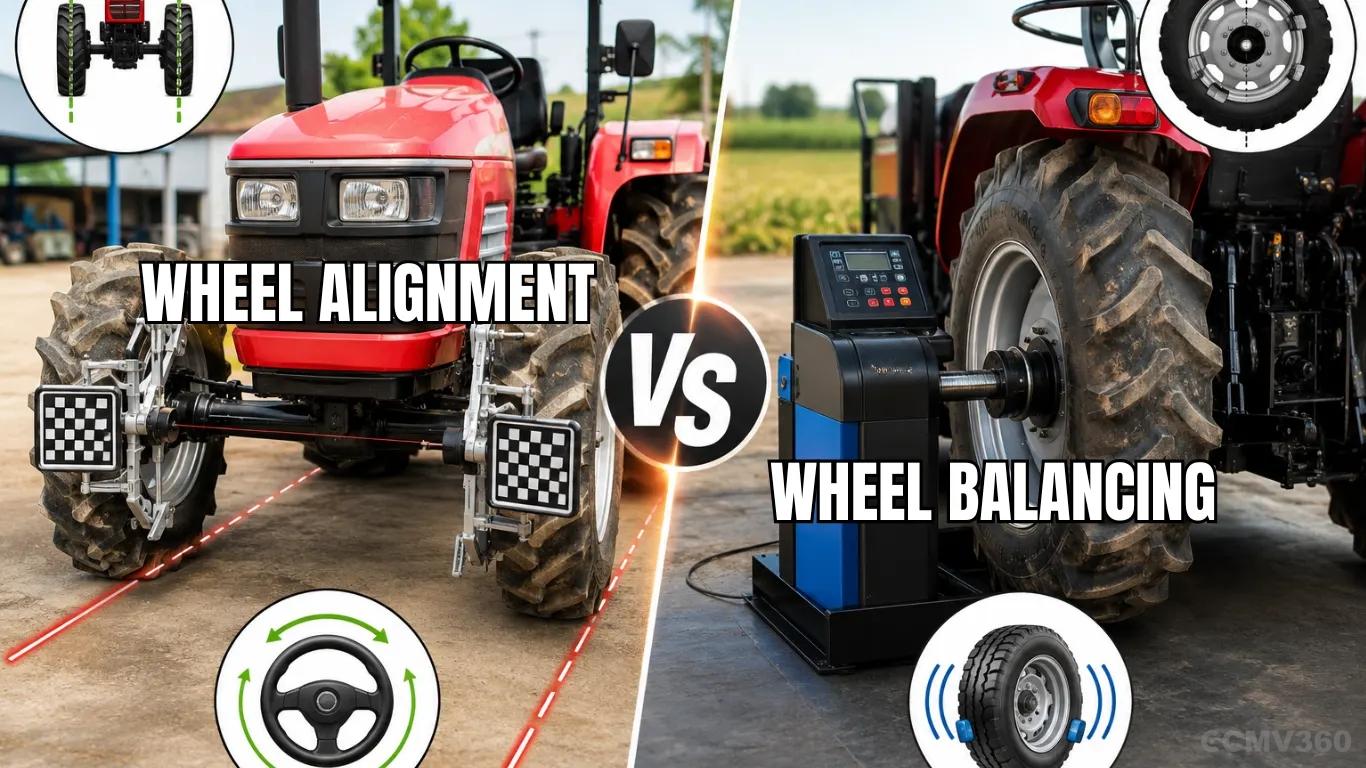
Wheel Alignment vs Wheel Balancing: Key Differences
Feature | Wheel Alignment | Wheel Balancing |
Purpose | Corrects wheel angles | Corrects weight distribution |
What it adjusts | Toe, camber and caster | Heavy and light spots in tyre-rim assembly |
Main symptom | Tractor pulls left or right | Steering or cabin vibrates |
Affected components | Steering joints, tie rods, front axle | Bearings, hubs, rims and steering brackets |
Main benefit | Longer tyre life and easier steering | Smooth ride and reduced vibrations |
Best time to perform | After impacts, uneven tyre wear or front-end repairs | After fitting new tyres, adding ballast or vibration issues |
Benefits of Proper Wheel Alignment
A correctly aligned tractor offers much more than straight steering. It directly improves overall operating efficiency.
Longer Tyre Life
When wheel angles are incorrect, tyres scrub sideways instead of rolling naturally. This abnormal friction causes rapid tread wear, especially on expensive front tyres. Proper alignment reduces unnecessary wear and significantly extends tyre life.
Better Fuel Efficiency
Misaligned wheels create additional rolling resistance. The engine has to work harder to move the tractor forward, increasing diesel consumption. Proper alignment helps reduce this drag and improves fuel efficiency.
Easier Steering
A properly aligned tractor naturally tracks in a straight line. The operator no longer needs constant steering corrections, reducing fatigue during long working hours.
Better Safety
Stable steering improves control during road transport, especially while carrying heavy trailers or implements.
Benefits of Proper Wheel Balancing
Balanced wheels contribute to smoother operation and reduce stress on several mechanical components.
Reduced Vibrations
Wheel balancing eliminates shaking of the steering wheel and cabin, especially while travelling between villages, fields and mandis.
Longer Bearing Life
Continuous vibrations place additional stress on wheel bearings, hubs and steering assemblies. Balanced wheels reduce this stress and help these parts last longer.
Better Driving Comfort
Operators experience a smoother ride, making long-distance transport much more comfortable.
Slight Improvement in Fuel Economy
Balanced tyres roll more smoothly with lower rolling resistance, reducing engine load during transport operations.
Common Signs Your Tractor Needs Wheel Alignment
Several warning signs indicate alignment issues.
Tractor continuously pulls towards one side.
Steering wheel remains off-centre while driving straight.
Front tyres wear unevenly.
One tyre wears much faster than the other.
Steering requires constant correction.
Tractor feels unstable on flat roads.
Common Signs Your Tractor Needs Wheel Balancing
Balancing problems produce an entirely different set of symptoms.
Steering wheel vibrates during road travel.
Cabin shakes noticeably at certain speeds.
Tractor bounces rhythmically even on smooth roads.
Tyres develop patchy or cupped wear patterns.
Vibrations continue despite maintaining correct tyre pressure.
Symptoms of Tractor Tyre Wear Caused by Misalignment
Misalignment creates distinctive tread wear patterns that are easy to identify.
One-Sided Shoulder Wear
One edge of the tyre wears much faster than the other. This usually indicates incorrect toe or camber settings.
Feathered Tread Blocks
Running your hand across the tread reveals sharp edges in one direction and rounded edges in the other. This happens due to sideways scrubbing caused by improper alignment.
Rapid Front Tyre Wear
Front tyres reach the end of their service life much earlier than expected because they constantly drag instead of rolling smoothly.
Diagonal or Step Wear
Some tractors develop diagonal wear marks or stepped tread patterns when the wheels are no longer parallel to the tractor's centreline.
Constant Steering Corrections
Uneven tyre wear is often accompanied by a tractor that drifts off course and requires continuous steering input.
Industry guidance suggests that even minor misalignment can increase tyre wear by 12-15%, while severe misalignment may raise tyre wear by up to 40%, making regular inspections a cost-effective preventive measure.
How to Check Tractor Front-End Steering Components for Wear
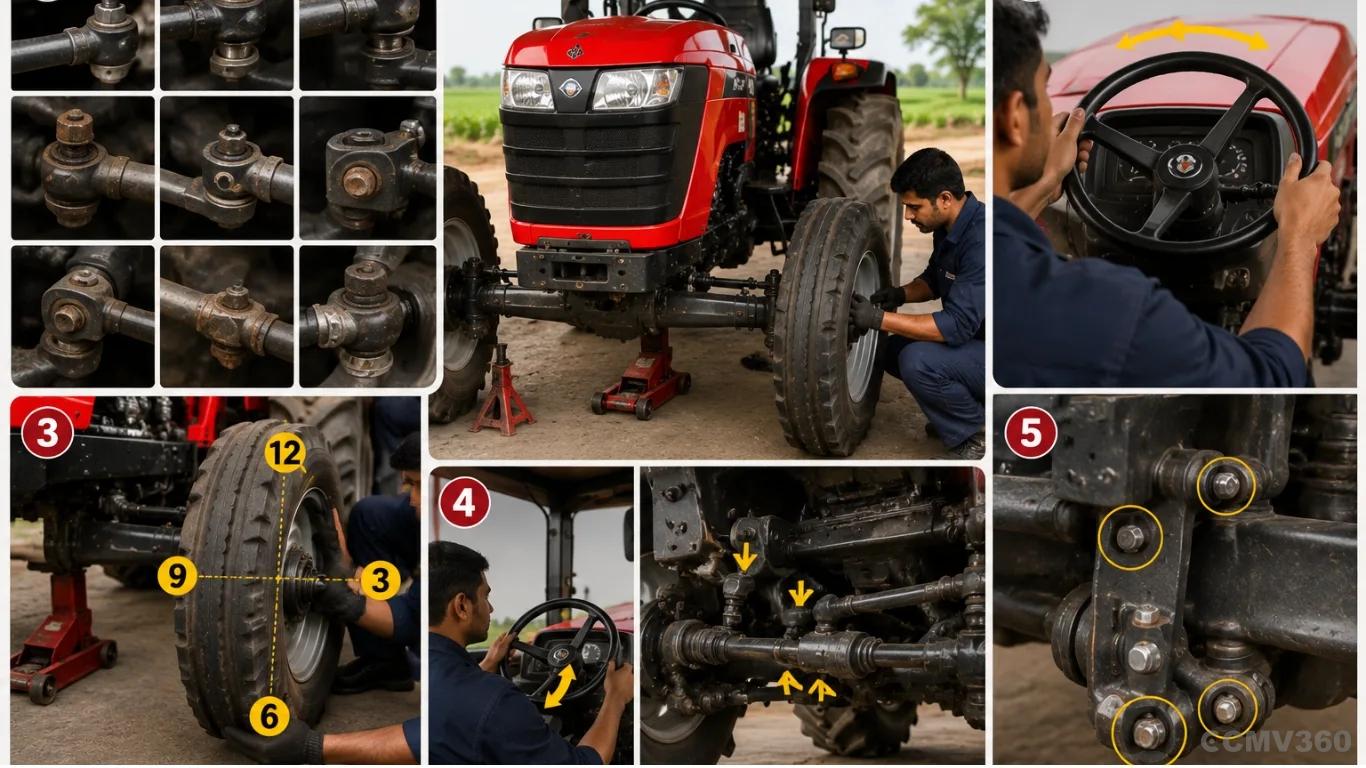
Before adjusting wheel alignment, technicians always inspect the steering system. Worn components can quickly throw the alignment out again.
Step 1: Perform a Visual Inspection
Park the tractor safely on level ground, apply the parking brake and secure the rear wheels.
Inspect:
Tie-rod ends
Steering arms
Drag links
Steering joints
Front axle pivots
Bushings
Fasteners
Look for cracked boots, rust marks, loose bolts or grease leakage.
Step 2: Check Steering Wheel Free Play
Start the tractor and gently rotate the steering wheel.
If the steering wheel moves significantly before the front wheels respond, excessive free play may indicate wear in the steering box, drag links or tie rods.
Step 3: Jack Up Each Front Wheel
Lift one front wheel at a time safely.
Grip the tyre at:
12 and 6 o'clock to check wheel bearing or kingpin wear.
3 and 9 o'clock to inspect tie-rod ends, steering arms and steering linkage.
Any noticeable looseness requires further inspection.
Step 4: Observe Steering Linkages
Have another person slowly turn the steering wheel while you observe the linkage underneath.
Watch for:
Delayed movement
Loose joints
Knocking sounds
Uneven movement between components
Any worn parts should be replaced before wheel alignment.
Step 5: Inspect Axle Mountings
Check:
Axle brackets
Pivot points
Bushings
Mounting bolts
Loose mounting points can shift the axle and affect alignment even when steering components appear normal.
When Should Tractor Owners Check Wheel Alignment?
Indian operating conditions make alignment checks especially important after:
Driving through deep potholes or trenches.
Hitting large rocks on village roads.
Extensive front-loader operations.
Heavy front-mounted implement work.
Uneven front tyre wear despite correct tyre pressure.
Major steering repairs.
When Should Tractor Wheels Be Balanced?
Wheel balancing is recommended:
After installing new front or rear tyres.
After fitting premium radial tyres.
After adding liquid ballast inside tyres.
When persistent steering vibrations occur.
Following major tyre repairs.
During frequent highway or mandi transport operations.
Impact of Wheel Vibration on Tractor Transmission and Axle Life
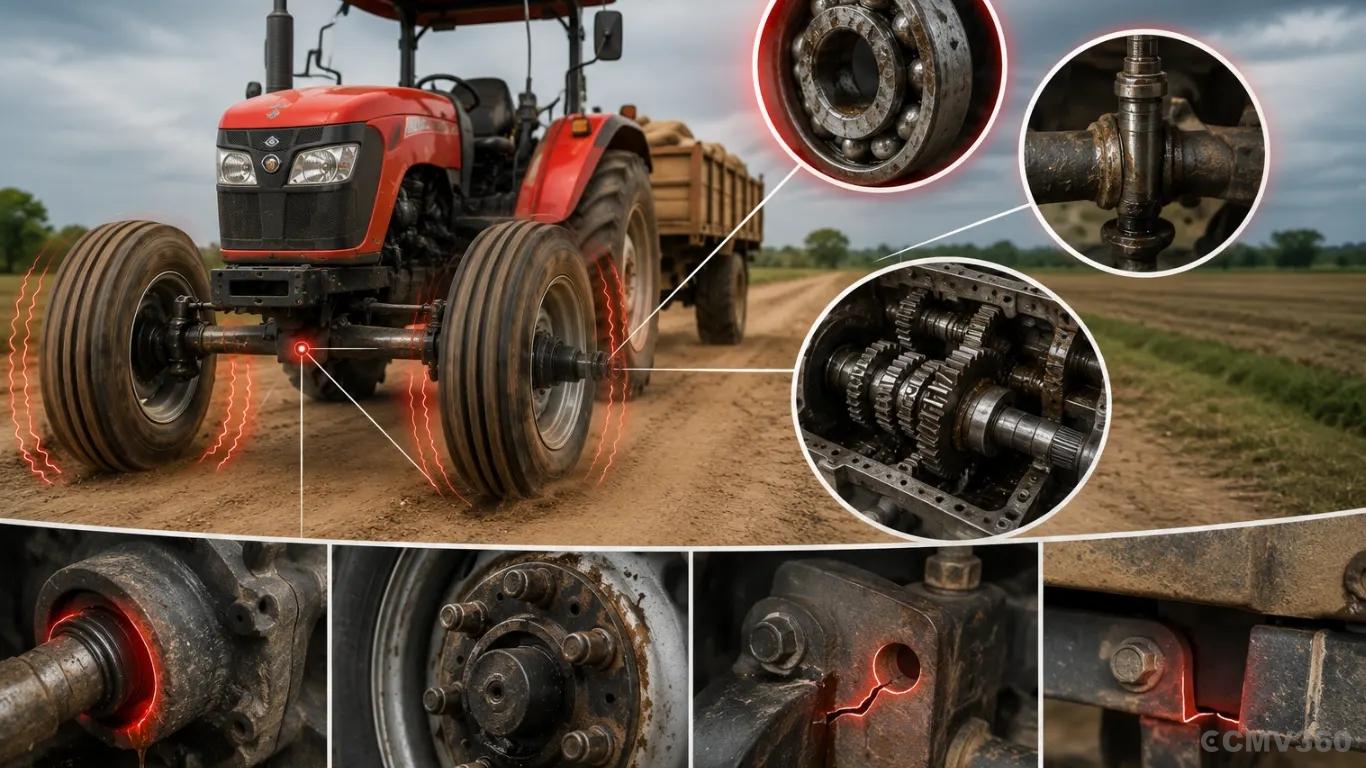
Ignoring wheel vibration can lead to expensive repairs beyond the tyres.
Faster Wheel Bearing Wear
Continuous vibration creates uneven loading on bearings, increasing heat and causing premature failure.
Damage to Hubs and Kingpins
Repeated shaking stresses kingpins, steering knuckles and wheel hubs, gradually wearing these components.
Increased Transmission Stress
Vibrations travel through the axle into the final drive and transmission. Over thousands of operating hours, these cyclic forces can fatigue gears, shafts and splines.
Seal Failure
Excessive movement damages oil seals around bearings and hubs, allowing dust and moisture to enter while lubricant escapes.
Structural Fatigue
Persistent vibration loosens fasteners and can eventually crack mounting brackets, cab mounts and axle supports.
For tractors operating under heavy agricultural loads, unresolved wheel vibration not only reduces tyre life and fuel efficiency but can also shorten the service life of hubs, axles and drivetrain components.
Wheel Alignment or Wheel Balancing: Which Problem Does Each Solve?
Tractor Problem | Solution |
Tractor pulls left or right | Wheel Alignment |
Uneven edge tyre wear | Wheel Alignment |
Steering wheel off-centre | Wheel Alignment |
Steering wheel vibration | Wheel Balancing |
Cabin shaking at speed | Wheel Balancing |
Tyre cupping or patchy wear | Wheel Balancing |
Rhythmic bouncing | Wheel Balancing |
Best Maintenance Practices for Indian Tractor Owners (2026)
Modern tractor manufacturers and agricultural experts recommend including wheel inspections as part of routine servicing. During every scheduled maintenance interval, typically around 500 operating hours, owners should inspect tyre condition, wheel bearings, steering linkages, hubs and axle components along with engine oil, filters, cooling and hydraulic systems.
India's operating conditions make these checks even more important. High summer temperatures, rough farm roads, overloaded trailers and long-distance trips to mandis place additional stress on tyres and steering systems. Maintaining correct tyre pressure, periodically checking alignment and balancing the wheels whenever necessary can help reduce operating costs and prevent unexpected breakdowns.
Also Read: Drip Irrigation vs Sprinkler Irrigation: Which Irrigation System Is Better for Indian Farmers?
CMV360 Says
Wheel alignment and wheel balancing may sound similar, but they solve two completely different problems. Alignment ensures your tractor travels straight, protects tyres and improves steering, while balancing eliminates vibrations and protects bearings, hubs and drivetrain components.
If your tractor drifts to one side, inspect the alignment. If it vibrates on the road, balancing should be your first priority. In many cases, professional service centres inspect both together during tyre replacement or major servicing, ensuring the tractor delivers maximum performance, better fuel economy and a longer service life.
For Indian farmers investing in premium tractor tyres and modern machinery, these simple maintenance checks can save thousands of rupees in repair costs while keeping the tractor productive throughout every farming season.

Robin Kumar Attri is a content and video professional with 2.7 years of experience in the commercial vehicle d .....