What Is Soil Aeration? Importance, Benefits, Methods and Best Practices for Better Crop Growth
 Add CMV360 on Google
Learn what soil aeration is, its benefits, methods, best practices, and how proper aeration improves root growth, nutrient uptake, water infiltration, soil health, and crop productivity.

By Robin Kumar Attri

Healthy Soil Starts with Healthy Breathing: Why Soil Aeration Matters More Than You Think
Every farmer wants higher yields, healthier crops, and lower input costs. Most attention is usually given to better seeds, fertilizers, irrigation, and crop protection. However, one of the most important factors behind productive farming often remains unnoticed, soil aeration.
Just like humans need oxygen to survive, plant roots also need oxygen for proper respiration and growth. If the soil cannot "breathe," even the best-quality seeds, fertilizers, and irrigation cannot deliver their full potential. Poorly aerated soil restricts root growth, reduces nutrient absorption, increases waterlogging, and ultimately lowers crop productivity.
Healthy soil is not simply about nutrients, it is about maintaining the right balance of air, water, and organic matter. When this balance is disturbed due to soil compaction, heavy machinery, repeated tillage, or excessive rainfall, the soil loses its natural ability to support healthy crop development.
One of the biggest advantages of proper soil aeration is that it benefits almost every aspect of farming. It encourages stronger root systems, improves water infiltration, boosts microbial activity, increases fertilizer efficiency, reduces runoff, and even helps crops withstand drought and disease more effectively. Whether you grow cereals, vegetables, fruits, fodder crops, or maintain lawns and pastures, proper soil aeration can significantly improve long-term soil health and productivity.
But what exactly is soil aeration? Why is it considered one of the foundations of healthy farming? What happens when soil is not properly aerated, and how can farmers improve it using simple management practices? Let's understand everything in detail.
Also Read: Drip Irrigation vs Sprinkler Irrigation: Which Irrigation System Is Better for Indian Farmers?
What Is Soil Aeration?
Soil aeration is the natural or mechanical process through which air moves between the soil and the atmosphere. During this process, oxygen enters the spaces between soil particles while carbon dioxide and other gases produced by roots and microorganisms escape into the atmosphere.
These tiny air spaces, known as soil pores, are essential because they provide oxygen to plant roots and beneficial soil organisms. When these pores remain open, roots can breathe, absorb nutrients efficiently, and grow deeper into the soil.
However, when soil becomes compacted, these air spaces shrink or disappear completely. As a result, oxygen supply decreases, carbon dioxide accumulates, and root development slows down significantly.
In simple words, soil aeration allows the soil to breathe, creating an ideal environment for healthy crop growth.
Why Is Soil Aeration Important in Farming?
Healthy soil is much more than a medium that holds plants upright. It is a living ecosystem filled with roots, bacteria, fungi, earthworms, insects, and countless microorganisms that constantly work together.
All these living organisms require oxygen to survive.
When oxygen levels decrease due to soil compaction, root respiration slows down, microbial activity reduces, and nutrient cycling becomes less efficient. Eventually, crop growth suffers even if farmers apply sufficient fertilizers and irrigation.
Proper soil aeration ensures that:
Plant roots receive enough oxygen.
Carbon dioxide does not accumulate around roots.
Water moves efficiently through the soil profile.
Beneficial microorganisms remain active.
Nutrients become more available to crops.
This is why soil aeration is considered one of the key pillars of sustainable agriculture.
How Does Soil Aeration Benefit Crops?
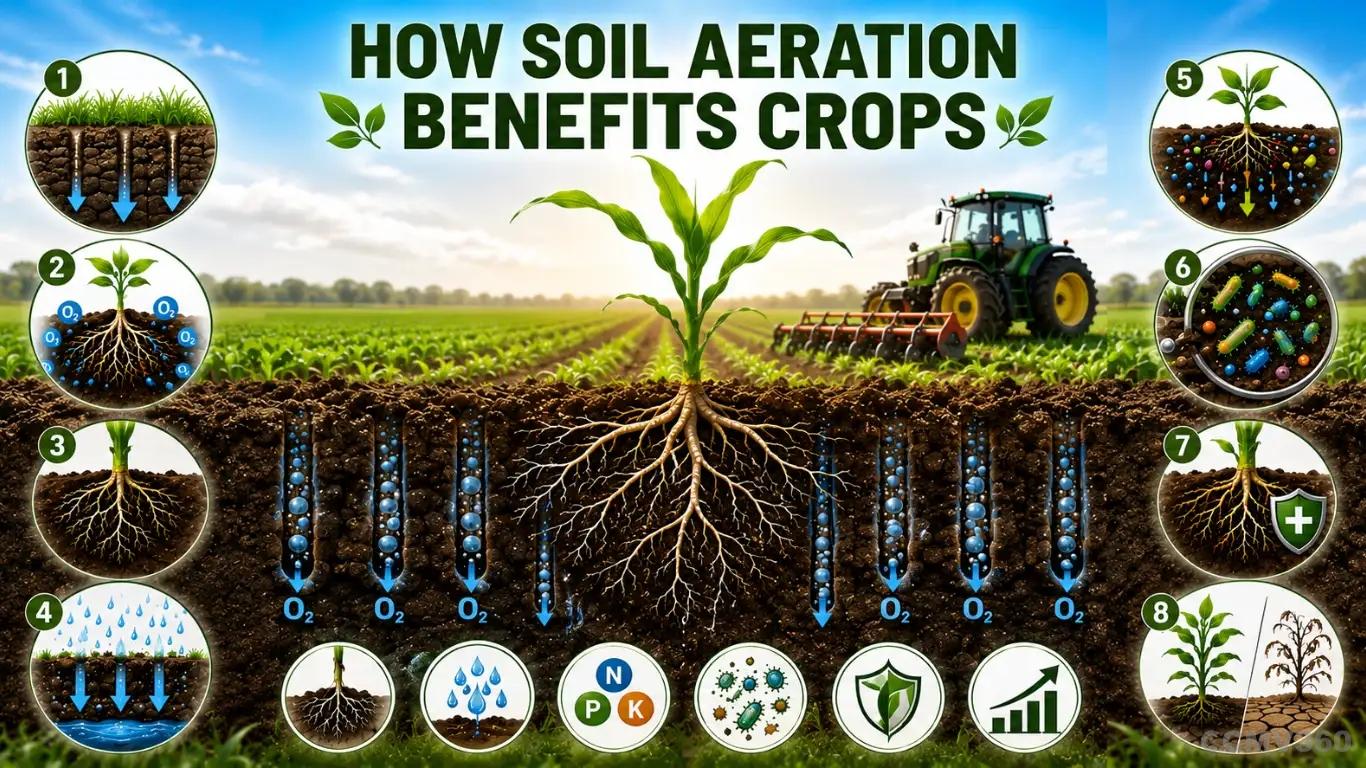
Proper soil aeration improves nearly every aspect of crop development. Instead of solving one problem, it creates a healthier growing environment that supports the entire crop cycle.
1. Relieves Soil Compaction
Even a compacted layer as thin as one-quarter to half an inch can significantly restrict the movement of air, water, and nutrients.
Aeration creates channels within the soil that break this compacted layer and restore natural movement.
As a result, roots can penetrate deeper and develop stronger anchorage.
2. Improves Oxygen Supply to Plant Roots
Roots require oxygen for respiration, which produces the energy needed for growth and nutrient absorption.
Without adequate oxygen, roots become weak, nutrient uptake decreases, and crops struggle to reach their full potential.
Proper aeration prevents oxygen deficiency and supports continuous root activity throughout the growing season.
3. Encourages Deeper Root Development
One of the biggest advantages of well-aerated soil is the development of stronger and deeper root systems.
Deep roots can access water and nutrients from lower soil layers, making crops more tolerant to drought, heat, and environmental stress.
Healthy root systems also improve overall crop stability and productivity.
4. Improves Water Infiltration and Drainage
Compacted soils often cause irrigation water or rainfall to remain on the surface.
This leads to:
Waterlogging
Surface runoff
Soil erosion
Nutrient loss
Aerated soil allows water to move evenly into the root zone, improving moisture availability while reducing runoff.
5. Improves Fertilizer Efficiency
When soil is compacted, fertilizers often remain near the surface and may be washed away during rainfall or irrigation.
Proper aeration allows nutrients to penetrate deeper into the root zone, where plants can absorb them efficiently.
Research has shown that compacted soils may experience over 50% higher fertilizer runoff, which proper aeration can significantly reduce.
6. Boosts Beneficial Microbial Activity
Healthy soil contains millions of beneficial microorganisms that decompose organic matter and convert nutrients into plant-available forms.
Most of these microbes require oxygen.
Good aeration creates an ideal environment for these organisms, improving nutrient cycling, organic matter decomposition, and overall soil fertility.
7. Reduces Disease Risk
Poorly aerated soils often become anaerobic, creating favourable conditions for root rot and other soil-borne diseases.
By improving oxygen availability, aeration helps reduce disease pressure while promoting healthier root systems.
8. Supports Better Crop Recovery
Healthy roots recover faster from environmental stress.
Well-aerated soils help crops withstand drought, excessive rainfall, temperature fluctuations, and mechanical stress more effectively.
Major Advantages of Soil Aeration
Benefit | How It Helps Farmers |
Better root growth | Stronger and deeper roots |
Improved oxygen supply | Healthy root respiration |
Better water infiltration | Less runoff and waterlogging |
Improved nutrient uptake | Higher fertilizer efficiency |
Increased microbial activity | Better soil fertility |
Reduced soil compaction | Easier root penetration |
Lower disease risk | Healthier root zone |
Improved drought tolerance | Better moisture access |
Reduced erosion | Conserves topsoil |
Higher crop productivity | Better overall yields |
Unique Advantages of Soil Aeration
Apart from improving crop growth, soil aeration offers several long-term advantages that make it an important soil management practice.
Fast Visible Results
When performed at the right time, improvements in crop vigour, soil condition, and water movement often become noticeable within a few weeks.
Works Better with Other Farming Practices
Aeration enhances the effectiveness of:
Fertilizer application
Irrigation
Organic manure
Cover cropping
Overseeding
This means farmers get better returns from inputs they are already using.
Prevents Expensive Soil Problems
Regular aeration helps avoid severe soil compaction, reducing the need for costly soil renovation and excessive fertilizer or irrigation use later.
Environment-Friendly Practice
Proper aeration reduces nutrient runoff into nearby water bodies while improving water infiltration.
It also reduces irrigation demand by allowing water to penetrate more efficiently.
What Causes Poor Soil Aeration?
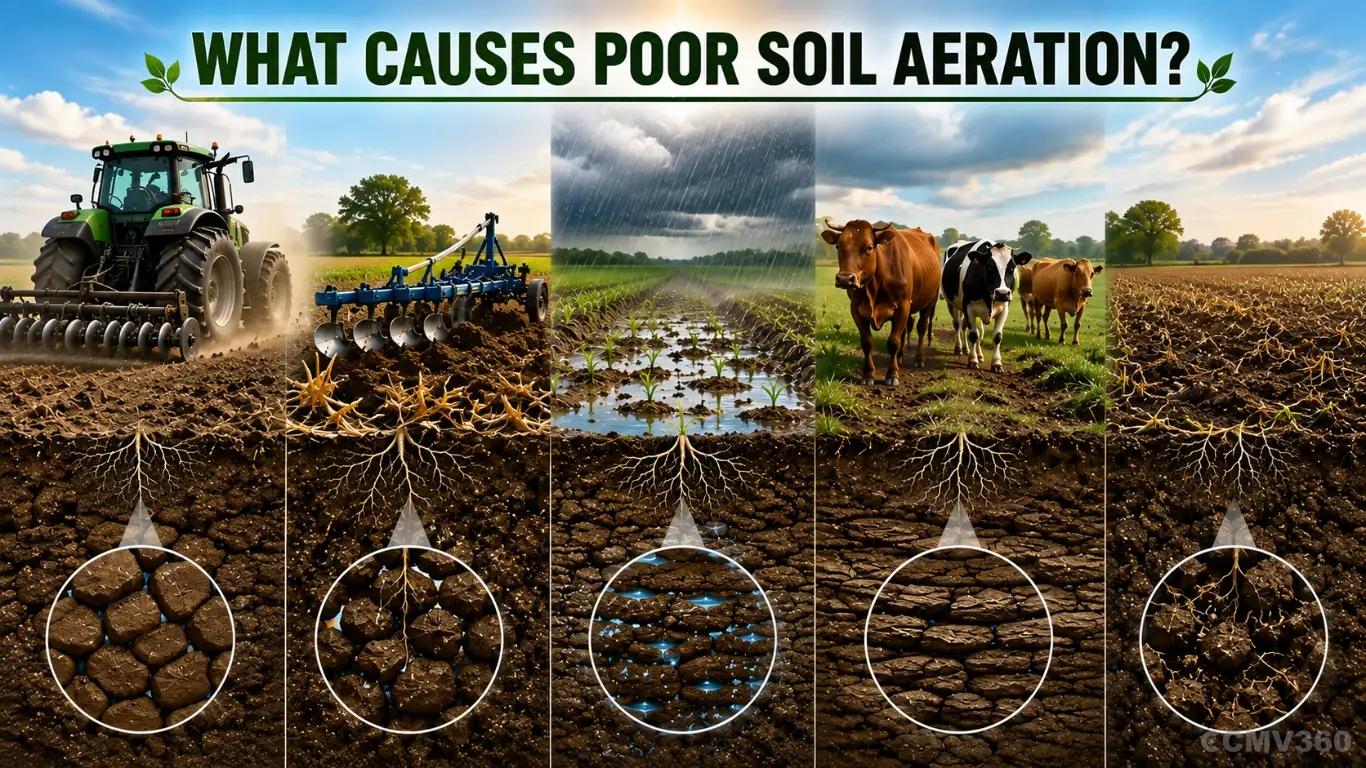
Several farming practices gradually reduce soil pore spaces.
Cause | Effect on Soil |
Heavy machinery | Compresses soil particles |
Repeated tillage | Weakens soil structure |
Continuous rainfall | Compacts fine-textured soils |
Excess livestock movement | Reduces pore spaces |
Low organic matter | Weak soil aggregation |
Understanding these causes helps farmers prevent long-term soil degradation.
Signs of Poor Soil Aeration
Farmers should regularly inspect their fields for symptoms of compaction.
Common warning signs include:
Water standing in fields after irrigation or rainfall
Hard soil that is difficult to till
Slow or uneven crop growth
Weak or shallow root systems
Reduced earthworm activity
Poor fertilizer response
Lower crop yields despite proper management
Early identification allows corrective measures before crop performance declines significantly.
What Happens If Soil Aeration Is Not Done Properly?
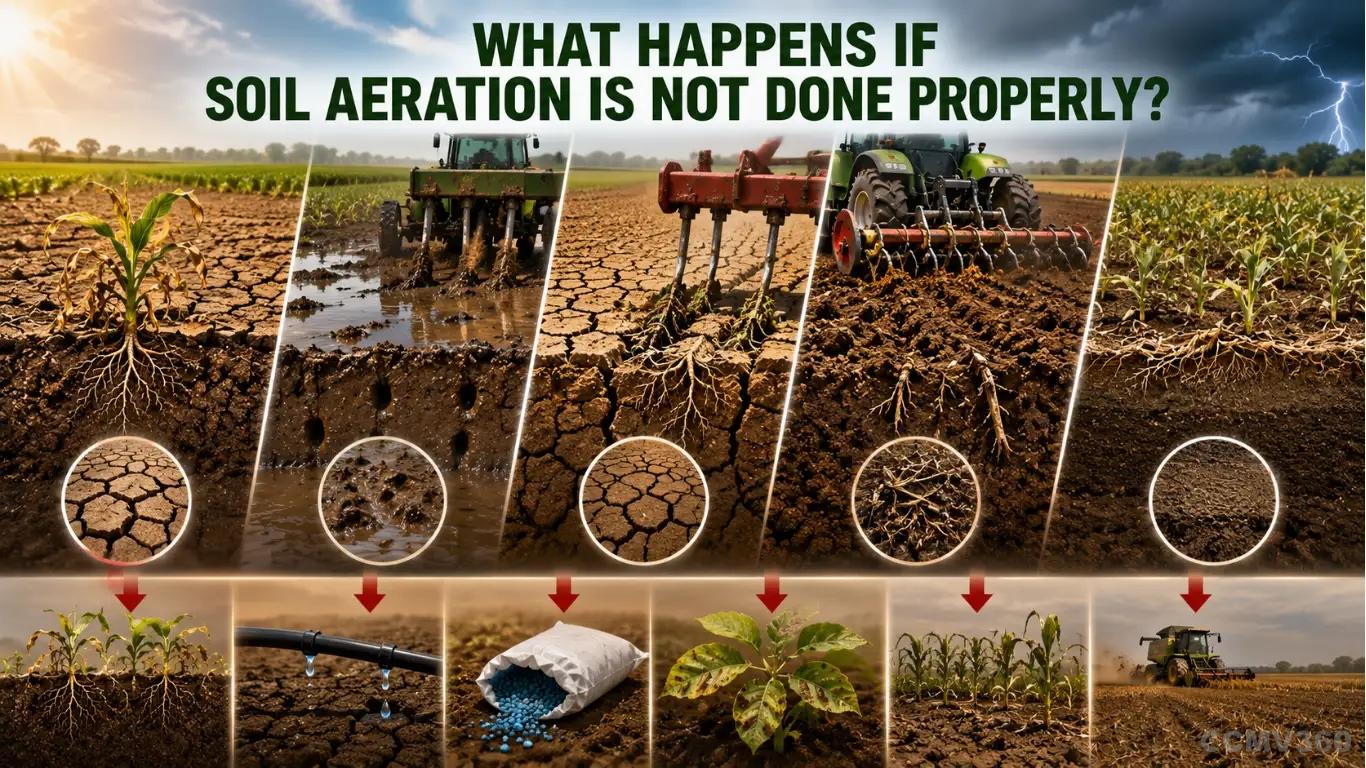
Although aeration is highly beneficial, incorrect timing or improper methods can negatively affect soil health.
Aerating During Dormancy or Extreme Stress
Aerating crops, lawns, or grasses during dormancy, severe heat, or drought increases stress and slows recovery.
Aerating Wet Soil
When soil is waterlogged, aeration equipment can smear the walls of aeration holes.
Instead of improving airflow, this seals soil pores and may worsen compaction.
Aerating Extremely Dry Soil
Very dry soil may crack excessively during aggressive aeration, damaging roots and increasing moisture loss.
Over-Aeration
Too much mechanical disturbance can:
Damage root systems
Accelerate organic matter loss
Increase long-term compaction
Under-Aeration
If compacted soils are never aerated, farmers may experience:
Poor root growth
Higher irrigation needs
Increased fertilizer use
Greater disease incidence
Reduced crop yields
Best Practices for Soil Aeration
Following the correct method is just as important as aeration itself.
Aerate at the Right Time
The golden rule is simple:
Aerate only when roots are actively growing and the soil is moist, but not saturated or extremely dry.
Recommended timing includes:
Crop/Grass Type | Best Time |
Cool-season grasses | Early spring or early autumn |
Warm-season grasses | Late spring to early summer |
Agricultural crops and pastures | Before peak growth when soil moisture is ideal |
Choose the Right Frequency
Aeration frequency depends on soil type and traffic levels.
Residential lawns: Every 1–3 years or when compaction becomes visible.
High-traffic sports fields and pastures: More frequent aeration, but only during active growth periods.
Agricultural fields: As required based on soil condition, machinery use, and crop rotation.
Annual aeration is not always necessary unless soil compaction is severe.
Use the Correct Aeration Method
Among different techniques, core aeration, which removes small soil plugs, is generally considered more effective than simple solid-tine spiking because it relieves compaction more efficiently and improves water infiltration.
For best results:
Avoid aerating wet or extremely dry soil.
Combine aeration with organic matter application.
Integrate cover crops and crop rotation.
Use overseeding where applicable.
Practical Ways Farmers Can Improve Soil Aeration
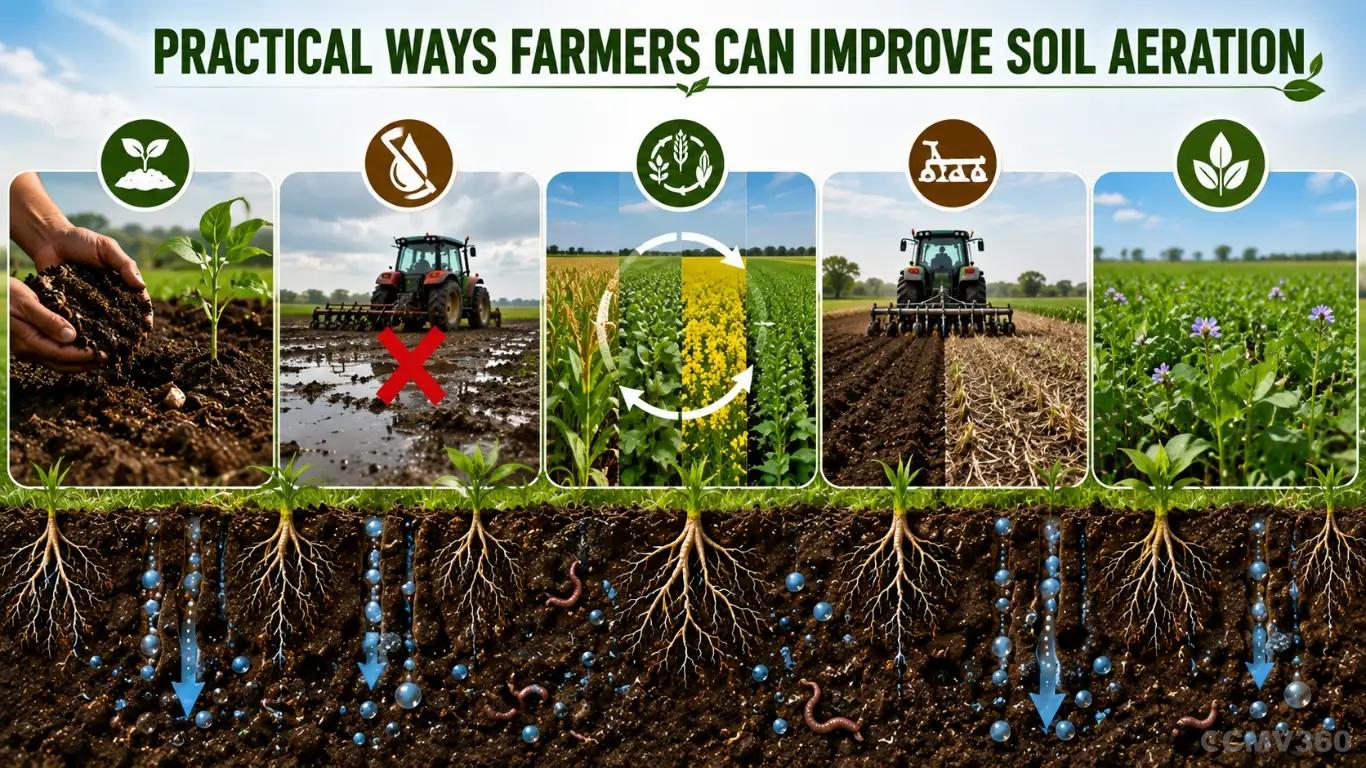
Improving soil aeration does not always require specialised machinery. Several simple farming practices can gradually restore healthy soil structure.
Add Organic Matter
Applying compost, farmyard manure, crop residues, or other organic amendments improves soil aggregation and creates more pore spaces for air and water movement.
Avoid Working on Wet Soil
Using tractors or heavy machinery on waterlogged fields significantly increases soil compaction. Waiting until the soil reaches the right moisture level helps preserve its natural structure.
Practice Crop Rotation
Growing deep-rooted crops in rotation naturally loosens compacted soil while improving organic matter and soil structure.
Reduce Excessive Tillage
Minimum tillage or conservation tillage helps maintain stable soil aggregates and protects natural pore spaces.
Grow Cover Crops
Cover crop roots create natural channels that improve air movement, water infiltration, and long-term soil health while adding valuable organic matter.
Proper vs Improper Soil Aeration: Quick Comparison
Aspect | Proper Aeration | Improper or Poorly Timed Aeration |
Root growth | Deep and healthy | Shallow or damaged |
Water movement | Better infiltration | Waterlogging or excessive drying |
Nutrient uptake | Higher efficiency | Poor absorption and runoff |
Soil biology | Active aerobic microbes | Reduced microbial activity |
Crop vigour | Strong and resilient | Weak, stressed plants |
Disease risk | Lower | Higher root disease pressure |
Long-term cost | Reduced input requirement | Higher water and fertilizer expenses |
CMV360 Says
Soil aeration is one of the simplest yet most effective practices for improving long-term soil health and crop productivity. By ensuring a continuous supply of oxygen to plant roots and beneficial microorganisms, it strengthens root development, improves water infiltration, enhances nutrient uptake, reduces compaction, and supports healthier, more resilient crops. Whether achieved naturally through good soil management or mechanically using aeration equipment, maintaining proper soil aeration allows farmers to maximise the benefits of fertilizers, irrigation, and organic matter while reducing runoff, erosion, and input costs. Investing in healthy, well-aerated soil today lays the foundation for sustainable farming and consistently better harvests in the years ahead.

Robin Kumar Attri is a content and video professional with 2.7 years of experience in the commercial vehicle d .....