Tractors
Trucks
- Find by Budget
- Find by Type

English
 New Delhi
Learn why tractor tyres rub against mudguards, common causes, warning signs, practical fixes, maintenance tips, and prevention methods to improve safety, tyre life, and overall tractor performance.

By Robin Kumar Attri

A tractor is one of the most valuable machines on any farm, and every component plays a vital role in keeping it working efficiently. Among these, tractor tyres are responsible for traction, stability, fuel efficiency, and carrying heavy loads across challenging terrains. Whether you own a Mahindra, Swaraj, John Deere, New Holland, Farmtrac, Massey Ferguson, Sonalika, Kubota, or Eicher tractor, maintaining proper tyre clearance is essential for safe and smooth operation.
One problem that many tractor owners ignore until it becomes serious is the tyre rubbing against the mudguard. At first, it may only produce a slight scraping sound while turning or driving over uneven ground. However, if left unchecked, continuous contact can wear out the tyre, damage the mudguard, affect steering performance, increase fuel consumption, and even create a serious safety risk during field work or road transport.
The good news is that this issue is usually easy to identify and fix-provided you understand what causes it. Is the tyre size incorrect? Has the mudguard shifted out of place? Could worn bearings, improper wheel alignment, or incorrect tyre pressure be responsible? In this detailed guide, we explain every possible reason behind tractor tyre rubbing, the warning signs to watch for, practical solutions, and preventive maintenance tips to help you avoid expensive repairs and keep your tractor performing at its best all year round.
Many farmers continue operating their tractor even after noticing the tyre touching the mudguard. Unfortunately, what begins as a minor rubbing sound can quickly develop into a costly repair.
Continuous friction gradually wears away the tyre's sidewall or shoulder, creating grooves that weaken the tyre structure. If the damage reaches the carcass, the chances of a tyre blowout increase significantly, especially while carrying heavy implements or travelling on roads.
The mudguard also suffers. Metal mudguards can bend further over time, while plastic mudguards may crack, warp, or even detach completely. Besides damaging these parts, the underlying issue-whether poor alignment, worn bearings, or incorrect wheel spacing-can also lead to uneven tyre wear, steering instability, vibration, and reduced fuel efficiency.
Fixing the problem early is always far less expensive than replacing damaged tyres, mudguards, or suspension components later.
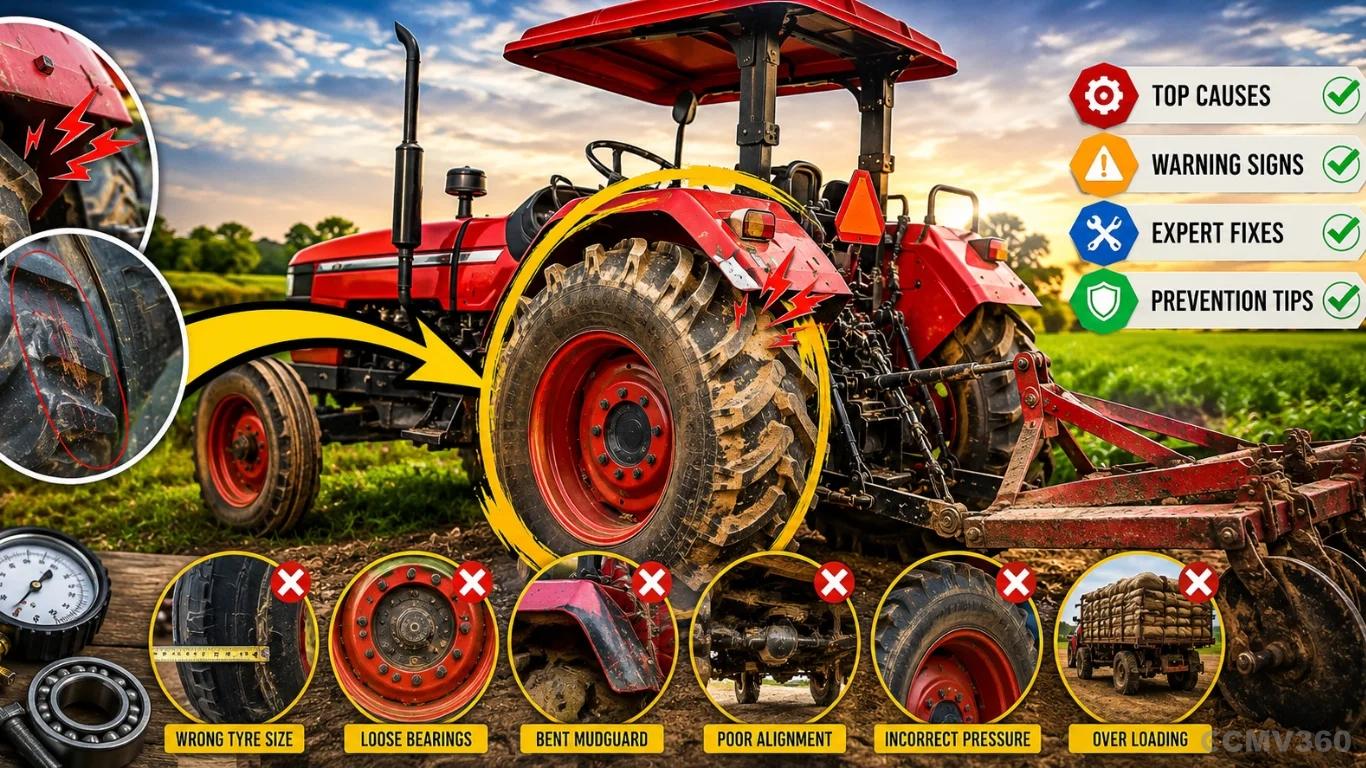
Several mechanical and maintenance-related issues can reduce the clearance between the tyre and the mudguard.
Cause | Effect |
Incorrect tyre size | Reduced clearance |
Wrong track width | Tyres move closer to mudguards |
Bent or loose mudguard | Direct contact with tyre |
Wheel alignment problems | Off-centre tyre movement |
Loose bearings or worn hubs | Sideways wheel movement |
Incorrect tyre pressure | Tyre deformation |
Heavy loads | Excessive tyre flex |
Suspension or chassis wear | Reduced clearance during movement |
Improper aftermarket mudguard installation | Poor fitment |
Let's understand each of these in detail.
One of the most common reasons behind mudguard rubbing is installing tyres that are wider or taller than the manufacturer's specifications.
Many tractor owners upgrade to larger flotation tyres or radial tyres for better traction without checking whether sufficient clearance exists around the mudguard. A wider tyre naturally occupies more space, increasing the chances of contact during steering, suspension movement, or while driving over uneven fields.
Sometimes, even mixing different front and rear tyre sizes without following OEM recommendations can disturb the overall wheel geometry.
Typical Symptoms
Rubbing occurs only during sharp turns.
Contact increases while carrying heavy implements.
Scrape marks appear on the tyre shoulder.
Rubber marks become visible inside the mudguard.
Solution
Always verify the tyre size recommended in the tractor owner's manual. If upgrading tyres, ensure the new size maintains adequate clearance under all operating conditions.
Most tractors allow owners to adjust the rear wheel track width using spacers or by reversing the wheel rims.
While this feature helps farmers adapt tractors for different row crops, incorrect adjustment can bring the tyres dangerously close to the mudguards.
This issue is particularly common when the wheels are moved inward for narrow-row farming without repositioning the mudguards.
Warning Signs
Both rear tyres rub equally.
Contact increases on rough terrain.
Tyres touch the mudguard when the axle flexes under load.
Solution
Reset the wheel spacing according to the tractor manufacturer's specifications while maintaining stability and crop compatibility.
Mudguards frequently encounter stones, tree stumps, walls, and agricultural equipment. Even a minor impact can bend the mounting brackets.
Over time, vibration, rust, UV exposure, and heavy field use can loosen bolts or warp plastic mudguards.
Once the mudguard shifts slightly towards the tyre, rubbing begins.
Common Symptoms
Only one side rubs.
Mudguard appears crooked.
Cracks around mounting brackets.
Mudguard moves when pushed by hand.
Solution
Inspect mounting bolts, brackets, and stays. Tighten loose hardware, straighten bent metal guards, and replace severely damaged mudguards.
Proper wheel alignment ensures the tyres remain centred within the wheel arch throughout operation.
If the axle becomes misaligned or the hub bends due to heavy impacts, the tyre may tilt slightly and begin rubbing the mudguard.
Similarly, worn steering joints, kingpins, bearings, or front differential components can alter wheel positioning.
Warning Signs
Tractor pulls towards one side.
Steering feels loose.
Uneven tread wear.
Lateral streaks on tyre lugs.
Vibration during transport.
Solution
Have the steering system, axle alignment, hubs, bearings, and differential inspected by a qualified mechanic.
Correct alignment not only eliminates rubbing but also improves tyre life and driving comfort.
Wheel bearings support smooth wheel rotation while keeping the wheel properly positioned.
As bearings wear, excessive side-to-side movement develops, allowing the tyre to contact nearby components, including the mudguard.
Common Symptoms
Grinding or humming noise.
Sideways wheel play.
Uneven tyre wear.
Intermittent rubbing.
Solution
Replace worn wheel bearings immediately to avoid additional damage.
Tyre pressure has a significant influence on tyre shape.
Overinflated tyres become more rounded, while underinflated tyres bulge outward.
When tractors carry heavy implements or trailers, sidewall deformation becomes even greater, reducing the gap between the tyre and mudguard.
Typical Symptoms
Shoulder wear from underinflation.
Centre tread wear from overinflation.
Rubbing occurs only under heavy loads.
Solution
Always follow the manufacturer's recommended tyre pressure for both field operations and road transport.
Modern tractors frequently pull heavy trailers, cultivators, rotavators, seed drills, and other implements.
As load increases, tyres flex more than usual.
If tyre clearance is already minimal, even slight deformation can cause the tyre to touch the mudguard.
Solution
Avoid exceeding the tractor's rated carrying capacity and maintain correct tyre pressure based on the working load.
Many premium tractors now feature front axle suspension or cab suspension systems.
If suspension bushes, shock absorbers, or linkage components wear out, the suspension compresses more than intended, reducing tyre clearance.
Warning Signs
Rubbing mainly over potholes.
Excessive bouncing.
Nose-diving during braking.
Solution
Replace worn suspension components and ensure mudguards are compatible with the suspension travel.
Universal or aftermarket mudguards may not perfectly match the tractor's original tyre dimensions or steering angles.
Improper bracket positioning, incorrect stay lengths, or poorly aligned mounting points often leave insufficient clearance.
Typical Symptoms
Rubbing starts immediately after installation.
Mounting holes don't align correctly.
Improvised spacers or brackets have been used.
Solution
Use tractor model-specific mudguards and install them exactly according to the manufacturer's instructions.
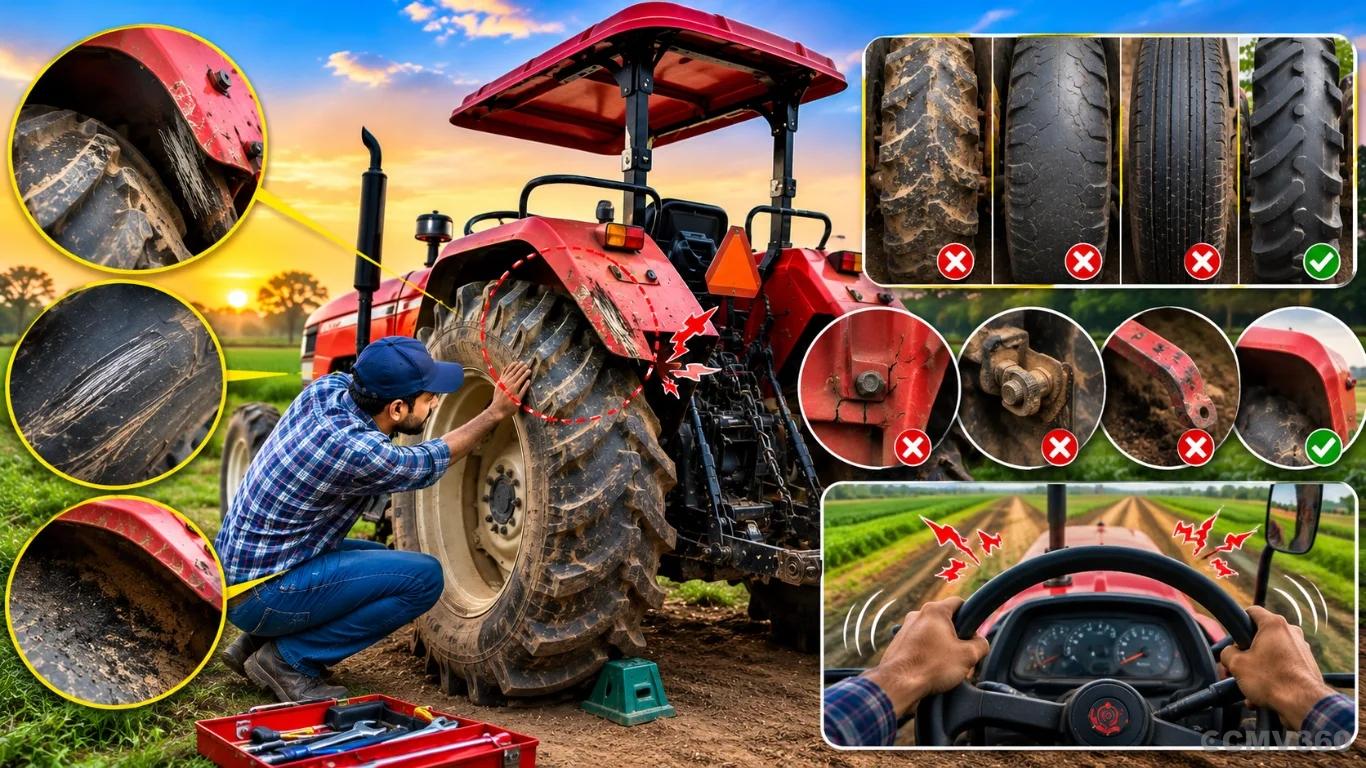
Early inspection can prevent major repairs.
Look for:
Rubber dust inside the mudguard
Shiny polished contact areas
Sidewall scratches
Cracks around mounting brackets
Loose bolts
Bent mudguard stays
Inspect both tyres carefully.
Watch for:
Uneven shoulder wear
Flat spots
Sidewall grooves
Chafing
One-sided tread wear
Comparing the left and right tyres often helps identify alignment issues.
Pay attention to:
Scraping noises
Squeaking while turning
Vibration
Steering pull
Knocking sounds
These often indicate a mechanical problem beyond simple mudguard clearance.
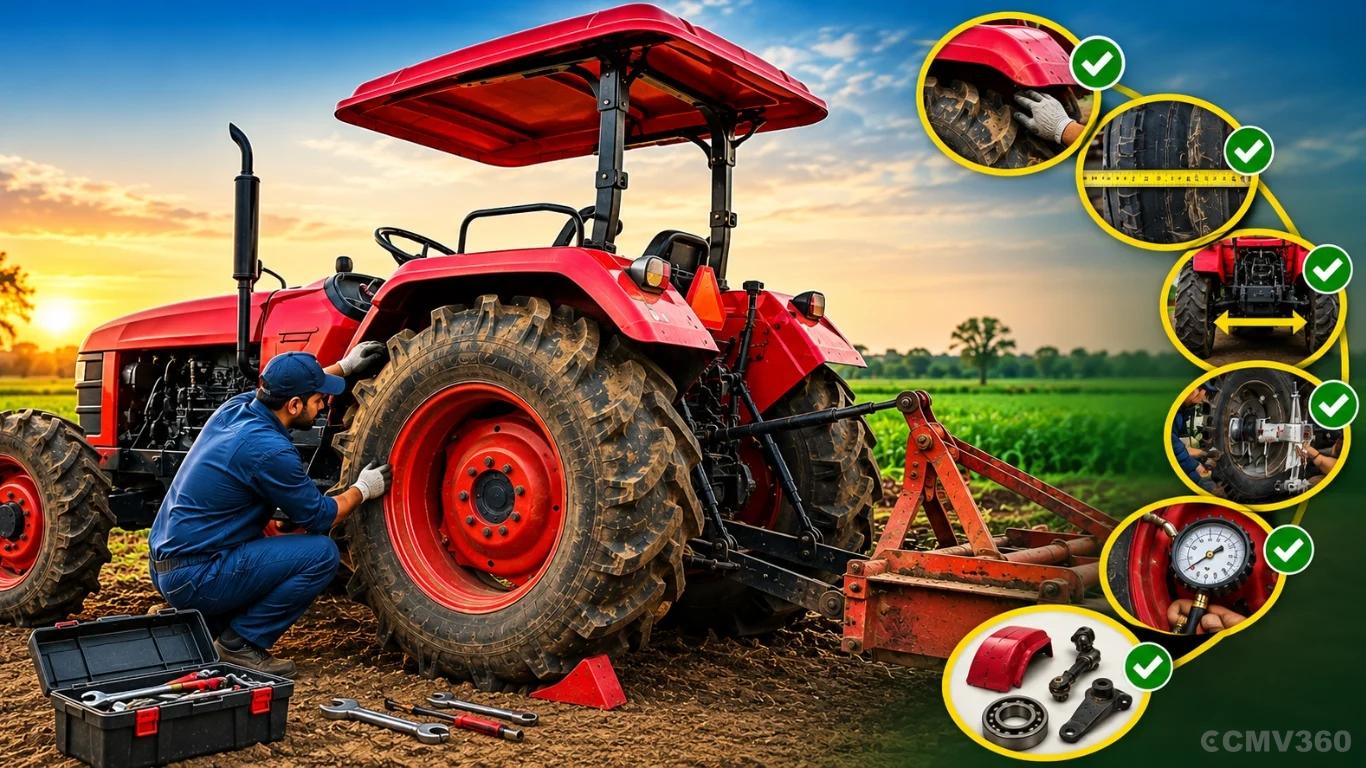
Follow this systematic approach.
Park on level ground.
Apply the parking brake.
Use wheel chocks.
Check mounting brackets.
Tighten loose bolts.
Centre the mudguard over the tyre.
Maintain approximately 6-10 mm of clearance to account for mud, stones, and tyre flex.
Compare the installed tyre dimensions with the manufacturer's recommended specifications.
If oversized tyres were recently installed, switching back to the recommended size may permanently solve the problem.
If your tractor has adjustable rims or spacers:
Reset the track width.
Ensure proper stability.
Recheck mudguard clearance after adjustment.
Have a professional inspect:
Front axle alignment
Rear axle alignment
Steering joints
Wheel bearings
Differential
Kingpins
Use the recommended pressure based on:
Field work
Road transport
Implement weight
Trailer load
Correct pressure improves traction while preventing excessive sidewall bulging.
Replace:
Broken mudguards
Bent brackets
Worn bearings
Loose steering joints
Damaged suspension bushes
Using genuine or tractor-specific replacement parts ensures the correct fit and long-term reliability.
Routine maintenance greatly reduces the chances of tyre rubbing.
Inspect mudguards every month.
Tighten loose fasteners regularly.
Remove packed mud and stones after field work.
Monitor tyre wear patterns.
Maintain recommended tyre pressure.
Avoid overloading the tractor.
Check wheel alignment during scheduled servicing.
Inspect steering and axle components periodically.
Replace damaged tyres before sidewall wear becomes severe.
Preventive inspections are especially important before long road journeys or during busy harvesting and sowing seasons when tractors operate for extended hours.
Do not continue operating the tractor if you notice:
Deep grooves on the tyre sidewall
Exposed tyre cords
Bulges or cracks
Severely broken mudguards
Sharp metal edges touching the tyre
Excessive steering vibration
These conditions significantly increase the risk of tyre failure and loss of control, particularly on highways, slopes, or while transporting heavy loads.
Check | Status |
Correct tyre size | ✓ |
Proper tyre pressure | ✓ |
Mudguard securely mounted | ✓ |
No rubbing marks | ✓ |
Wheel alignment correct | ✓ |
Bearings in good condition | ✓ |
Track width properly adjusted | ✓ |
Suspension components inspected | ✓ |
A tractor tyre rubbing against the mudguard may appear to be a minor inconvenience, but it often points to a larger mechanical or maintenance issue that should never be ignored. Problems such as incorrect tyre size, improper track width, bent mudguards, loose wheel bearings, poor wheel alignment, incorrect tyre pressure, worn steering components, or suspension wear can all reduce tyre clearance and lead to continuous contact. Addressing these issues early not only prevents costly tyre and mudguard replacements but also improves steering stability, fuel efficiency, operator safety, and overall tractor performance. With regular inspections, proper maintenance, and timely repairs, farmers can keep their tractors running reliably through every season while avoiding unnecessary downtime and expensive breakdowns.

About the author
Robin Kumar Attri is a content and video professional with 2.7 years of experience in the commercial vehicle domain. At CMV360, he creates news articles and videos covering trucks, tractors, buses, three-wheelers, and infrastructure machines.


 Add CMV360 on Google