Best Tractor Brand Comparison in India 2026: Which HP Range is Right for You?
 Add CMV360 on Google
Find the ideal tractor HP with this 2026 guide. Compare leading brands, fuel efficiency, and farm needs to make a smart buying decision.

By Robin Kumar Attri

Buying a tractor is not just another purchase; it is a long-term investment that directly impacts your farm productivity, fuel costs, and overall profitability. Whether you are a small farmer managing a few acres or someone handling large-scale agricultural operations, choosing the right tractor can make all the difference.
When you walk into a showroom, one term dominates every conversation: Tractor Horsepower (HP). From brands like Mahindra, John Deere, Swaraj, Sonalika, New Holland, Farmtrac, Solis, and Eicher, every model is positioned based on its HP. But here’s the real question: Does higher HP always mean a better tractor?
The answer is simple: No.
A tractor that is too powerful for your land will increase fuel expenses unnecessarily, while a tractor with lower HP may struggle with heavy implements and reduce efficiency. This makes understanding tractor horsepower not just important, but also essential.
So, how do you find the perfect balance between power, performance, and profitability? Let’s break it down step by step.
What Is Tractor Horsepower (HP)?
Tractor horsepower is the measure of how much work a tractor can perform over a specific period. In simple words, it represents the strength and stamina of your machine.
There are mainly three types of horsepower in tractors:
Engine HP: Total power produced by the engine
PTO HP: Power available to run implements like rotavators and threshers
Drawbar HP: Power used for pulling loads such as trolleys or ploughs
Understanding these helps you decide whether your tractor can handle heavy soil, hilly terrain, or large implements efficiently.
Why Choosing the Right Tractor HP Matters
Choosing the right HP is not about showing off; it’s about making a smart financial decision.
Key Reasons:
Fuel Efficiency: A high HP tractor doing light work consumes more diesel without adding value.
Implement Compatibility: Each implement, rotavator, cultivator, plough, requires specific HP to function smoothly.
Soil Health: Overpowered tractors can compact soil, affecting crop growth.
Resale Value: Popular HP ranges like 45-50 HP have better demand in the second-hand market.
Tractor Horsepower Categories in India 2026
In India, tractors are broadly divided into three categories based on farm size and usage.
36-40 HP Tractors (Light to Medium Work)
Ideal for farmers with 2-5 acres of land, these tractors are perfect for orchard farming, sowing, and light haulage.
Specification | |||
HP | 31-40 HP | 39 HP | 40 HP |
Cylinders | 3 | 3 | 3 |
Gearbox | 8F + 2R | 8F + 2R | 8F + 4R |
Steering | Mechanical / Power | Manual / Power | Power Steering |
Brakes | Oil Immersed | Dry Disc | Oil Immersed Disc |
Lifting Capacity | 1650 kg | 1100 kg | 1600 kg |
41-50 HP Tractors (Balanced & Versatile Range)
This is the most popular category in India, suitable for 5-10 acres and ideal for 6-7 ft rotavators.
Specification | |||
HP | 47 HP | 50 HP | 50 HP |
Cylinders | 4 | 3 | 3 |
Gearbox | 8F + 2R | 8F + 4R | 8F + 2R |
Steering | Dual-Acting Power / Manual | Power Steering | Mechanical / Power |
Brakes | Oil Immersed | Oil Immersed Disc | Dry Disc / Oil Immersed |
Lifting Capacity | 1500 kg | 1600 kg | 2000 kg |
50-60 HP Tractors (Heavy Duty Farming)
Best suited for large farms (10-15+ acres) and heavy implements like laser levellers and straw reapers.
Specification | |||
HP | 57 HP | 55 HP | 50 HP |
Cylinders | 3 | 3 | 3 |
Gearbox | 9F + 3R | 16F + 4R | 8F + 2R |
Steering | Power Steering | Balanced Power Steering | Power Steering |
Brakes | Oil Immersed Disc | Oil Immersed | Oil Immersed Multi Disc |
Lifting Capacity | 2000 kg | 2500 kg | 1700 kg |
Tractor HP Selection Based on Farm Size
Choosing HP based on land size is one of the simplest and most effective methods.
Farm Size | Ideal HP Range | Tasks |
1-5 acres | 15-35 HP | Mowing, light hauling |
5-15 acres | 36-50 HP | Cultivation, rotavation |
15-40 acres | 51-75 HP | Medium-heavy operations |
40+ acres | 75+ HP | Large-scale farming |
Tractor HP Based on Farming Tasks
Different tasks require different power levels.
Task | Ideal HP | Tasks |
Light hauling | 20-35 HP | Small implements |
Cultivation | 36-50 HP | Disc ploughs, seed drills |
Heavy tillage | 50-75 HP | Subsoilers, heavy trailers |
Harvesting | 75+ HP | Multi-crop operations |
Fuel Efficiency Comparison by HP Range
Fuel efficiency plays a major role in long-term cost savings.
HP Range | Avg SFC (g/kWh) | Road Mileage | Field Use |
20-35 HP | 250-265 | 16-20 km/l | Light work |
36-50 HP | 241-258 | 15-19 km/l | Best balance |
50+ HP | 260-270 | 14-18 km/l | Heavy work |
Insight: Mid-range tractors (36-50 HP) offer the best combination of power and fuel efficiency, making them the most preferred choice in India.
Top Tractor Models in 36-50 HP Range
This category is highly competitive and offers some of the best value-for-money options.
Model | HP / PTO HP | SFC | Price |
47 / 43 | 241 | ₹7.05 lakh | |
48 / 38 | 250 | ₹8 lakh | |
45 / 40 | 252 | ₹7.2 lakh | |
49 / 42 | 258 | ₹6.9 lakh |
Terrain Impact: Choosing HP for Hilly Farms
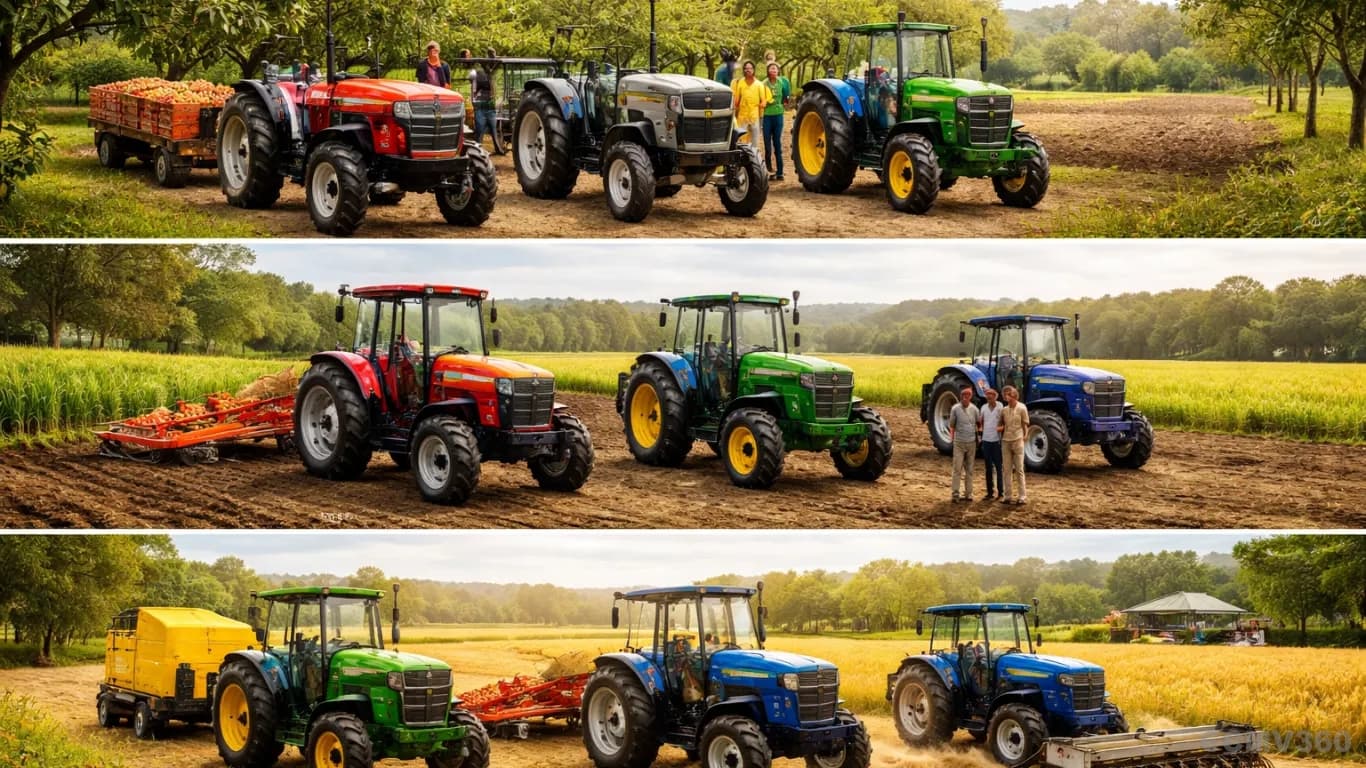
Terrain plays a crucial role in tractor performance.
Hilly areas require 10-20% more HP
Slopes above 10° need 4WD tractors
Clay soil increases power demand further
Ballast weight improves traction and stability
Slope-Based HP Requirement
Slope | HP Multiplier | Example |
0-5° | 1.0 | 50 HP |
6-15° | 1.1-1.2 | 55-60 HP |
16-25° | 1.25-1.4 | 63-70 HP |
How to Select the Right Tractor HP
Before making a decision, ask yourself:
What is your primary implement?
Focus on PTO HP if using rotavators frequently.
What is your soil type?
Hard clay requires 5-10 extra HP compared to sandy soil.
How much trolley work will you do?
Choose better speed and braking for haulage.
Common Mistakes Farmers Must Avoid
Even experienced buyers often make these mistakes:
Buying for Status: A 60 HP tractor on small land leads to higher fuel costs.
Ignoring PTO HP: Engine HP alone doesn’t guarantee performance.
Overloading Implements: Running large implements on small tractors damages the engine.
Wrong Terrain Choice: Using 2WD tractors on slopes increases slippage and wear.
HP Requirement for Ploughing vs Harrowing
Understanding implementation requirements is key.
Operation | Flat HP | Slope HP | Notes |
Plowing | 8-12 HP/ft | 10-15 HP | Deep soil work |
Harrowing | 4-6 HP/ft | 5-7 HP | Surface leveling |
Harrowing needs 20-40% less HP than plowing due to lower soil resistance.
Finding the Perfect Tractor Match
Choosing the right tractor horsepower is not about going big-it’s about going smart. The right HP ensures better fuel efficiency, longer engine life, and higher productivity.
For most Indian farmers, the 36-50 HP range stands out as the sweet spot, offering the perfect balance of power, efficiency, and versatility. However, your final decision should always depend on your land size, soil type, and primary usage.
In the end, the real question is not: “Which tractor is the most powerful?”
But rather: “Which tractor is the most suitable for my farm?”
And once you answer that, you are already one step closer to making a profitable investment

Robin Kumar Attri is a content and video professional with 2.7 years of experience in the commercial vehicle d .....