Tractors
Trucks
- Find by Budget
- Find by Type

English
 New Delhi
Learn the best rotavator blade types, tractor HP, soil-wise selection, maintenance tips, and ideal tractor-rotavator combinations for Indian farmers to improve tillage, fuel efficiency, and productivity in 2026.

By Robin Kumar Attri

A rotavator has become one of the most important farm implements for Indian farmers. Whether it is preparing land for wheat in Punjab, puddling paddy fields in West Bengal, or breaking hard black cotton soil in Maharashtra, a rotavator can complete multiple tillage operations in a single pass. Compared to conventional ploughing, it can reduce field preparation time by up to 40%, lower labour requirements, and help farmers prepare a finer seedbed while saving both time and operational costs.
However, buying a good rotavator alone is not enough. The real performance of a rotavator depends on three key factors-the right blade type, the right tractor HP, and the right combination for your soil condition. A premium rotavator fitted with the wrong blade can increase fuel consumption, overload the tractor, leave the field uneven, and even shorten the life of the implement. On the other hand, selecting the correct blade and matching it with the right tractor can improve soil pulverisation, reduce repeated field passes, minimise maintenance costs, and deliver better crop establishment.
Today, leading agricultural implement brands offer different blade configurations to suit India's diverse farming conditions, while tractor manufacturers such as Mahindra, Swaraj, New Holland, Eicher, Powertrac, Kubota, Massey Ferguson, and several others provide tractors specifically designed to handle varying rotavator sizes efficiently.
So, which rotavator blade is best for your soil? Which tractor HP should you choose? Which tractor models work best with different rotavators? And what combination is most suitable for your state's farming conditions? Let's explore everything in this complete 2026 guide.
Rotavator blades are the actual working components that cut, loosen, mix and pulverise the soil. Their shape determines how aggressively the soil is broken, how much power the tractor needs, and how efficiently the machine performs.
Higher fuel consumption
Increased tractor load
Poor soil pulverisation
Blade clogging in wet fields
More maintenance
Multiple tillage passes
Uneven seedbed preparation
In contrast, selecting the correct blade according to soil texture and moisture results in smoother operation, lower operating costs, improved field finish and longer machine life.
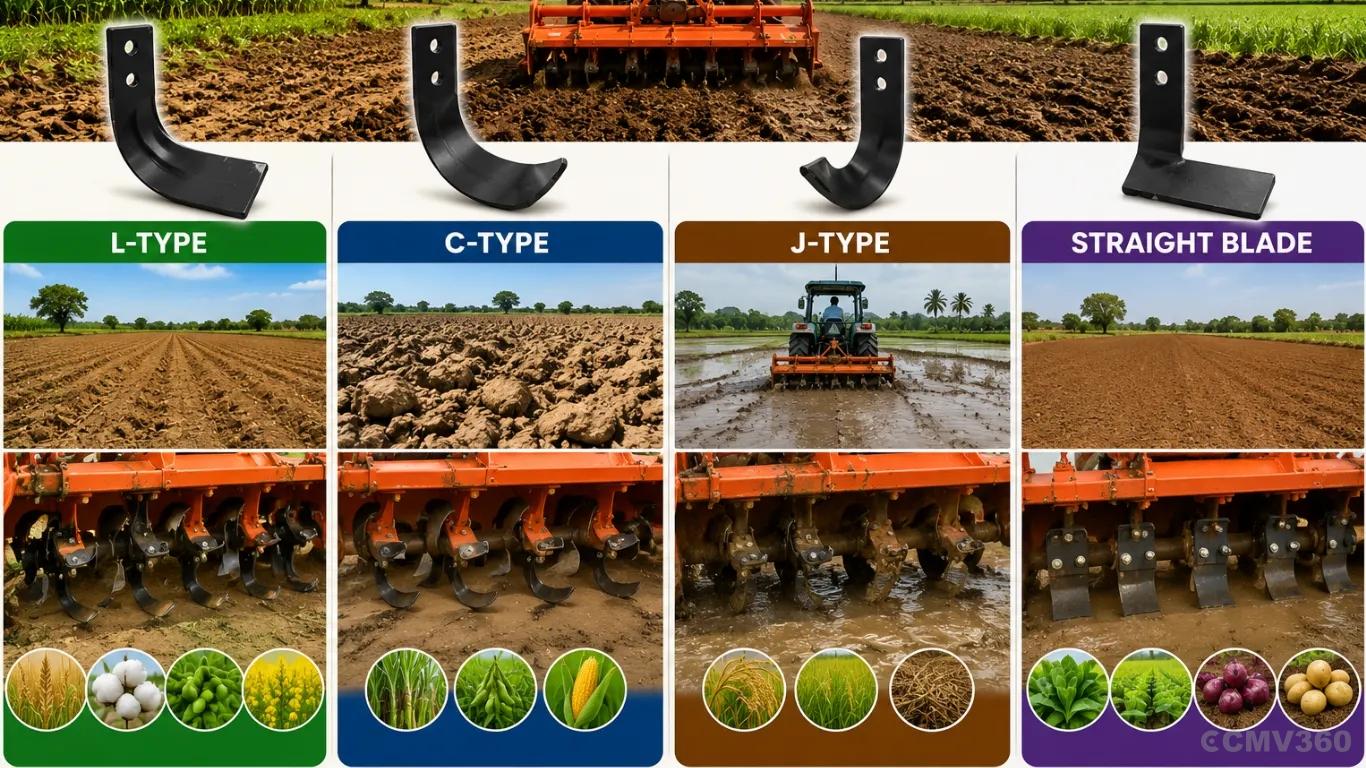
Although several blade designs are available, four blade types dominate Indian agriculture in 2026.
Blade Type | Best Suitable For | Main Advantage |
L-Type | Soft to medium soils | Excellent all-round performance with lower fuel consumption |
C-Type | Hard, dry and compact soils | Stronger soil penetration and clod breaking |
J-Type | Wet, sticky clay and paddy fields | Prevents mud clogging and improves soil flow |
Straight Blade | Shallow cultivation, weed control and finishing | Produces smooth finishing with minimal soil disturbance |
Among all blade types, the L-type blade remains the most widely used across India because it suits a wide variety of farming conditions.
Its curved design cuts soil efficiently while maintaining relatively low power demand. This means tractors consume less fuel and experience lower mechanical stress.
L-type blades are particularly suitable for:
Regular seedbed preparation
Light to medium soils
Sandy fields
Loamy soils
General cultivation
For farmers cultivating different crops throughout the year, this blade offers the best balance between performance, fuel economy and operating cost.
Not every field is soft enough for standard blades.
After prolonged summer heat or in regions with black cotton soil, fields often become hard and compact. Under such conditions, C-type blades provide a significant advantage.
Their more aggressive curved profile allows deeper penetration into compact soil while breaking larger clods effectively.
They are ideal for:
Hard dry fields
Compact soil
Deep cultivation
Heavy commercial farming
Black soil regions
Since these blades require greater torque, pairing them with higher horsepower tractors is recommended.
Farmers working in paddy cultivation understand the challenge of sticky soil.
Wet clay tends to accumulate around the rotor, reducing efficiency and increasing tractor load. This is where J-type blades perform exceptionally well.
Their special design reduces mud sticking and allows continuous soil flow even under high moisture conditions.
J-type blades work best for:
Paddy cultivation
Wet clay soil
Sticky fields
Heavy residue incorporation
Waterlogged conditions
These blades are widely preferred in rice-growing regions across India.
Straight blades are designed differently from curved blades.
Instead of aggressive soil cutting, they focus on light finishing operations.
They are commonly used for:
Weed cutting
Shallow cultivation
Final land levelling
Seedbed finishing
Since they disturb the soil less, they also require comparatively lower power than heavy-duty tillage operations.
Selecting blades according to soil conditions ensures maximum field efficiency.
Soil Type | Recommended Blade |
Sandy Soil | L-Type |
Medium Loam | L-Type |
Dry Loam | C-Type |
Hard Compact Soil | C-Type |
Clay Soil | J-Type |
Wet Sticky Soil | J-Type |
Paddy Fields | J-Type |
Final Levelling | Straight Blade |
A simple rule works for most Indian farms:
Normal soil = L-Type
Hard soil = C-Type
Wet soil = J-Type
Finishing work = Straight Blade
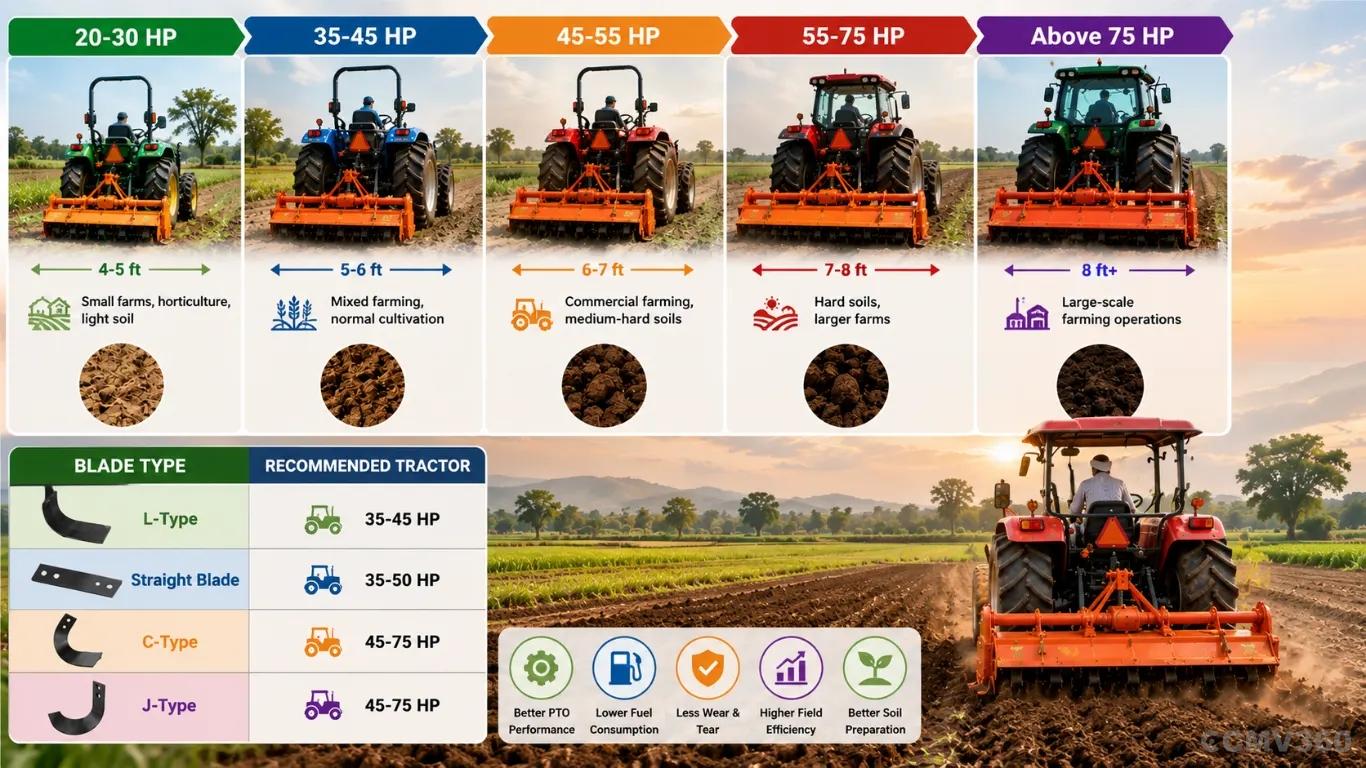
A rotavator performs efficiently only when matched with a suitable tractor.
An underpowered tractor struggles to maintain PTO speed, while an oversized tractor increases unnecessary operating costs.
The ideal tractor depends on rotavator width, blade type, and soil condition.
Tractor HP | Suitable Rotavator | Best Use |
20-30 HP | 4-5 ft | Small farms, horticulture, light soil |
35-45 HP | 5-6 ft | Mixed farming, normal cultivation |
45-55 HP | 6-7 ft | Commercial farming, medium-hard soils |
55-75 HP | 7-8 ft | Hard soils, larger farms |
Above 75 HP | 8 ft+ | Large-scale farming operations |
The best results come from pairing blade type with appropriate horsepower.
Blade Type | Recommended Tractor |
L-Type | 35-45 HP |
Straight Blade | 35-50 HP |
C-Type | 45-75 HP |
J-Type | 45-75 HP |
This combination ensures proper PTO performance while avoiding unnecessary strain on the tractor.
The 45-55 HP category remains the most preferred choice because it offers an excellent balance of power, fuel efficiency and versatility.
Some of the most commonly used tractor models include:
Tractor Model | Suitable Rotavator |
6-7 ft | |
6-7 ft | |
6-7 ft | |
6-7 ft | |
6-7 ft | |
6-7 ft | |
7 ft | |
6-7 ft |
These tractors are popular because they deliver adequate PTO power, reliable torque, and efficient fuel consumption for regular rotavation work.
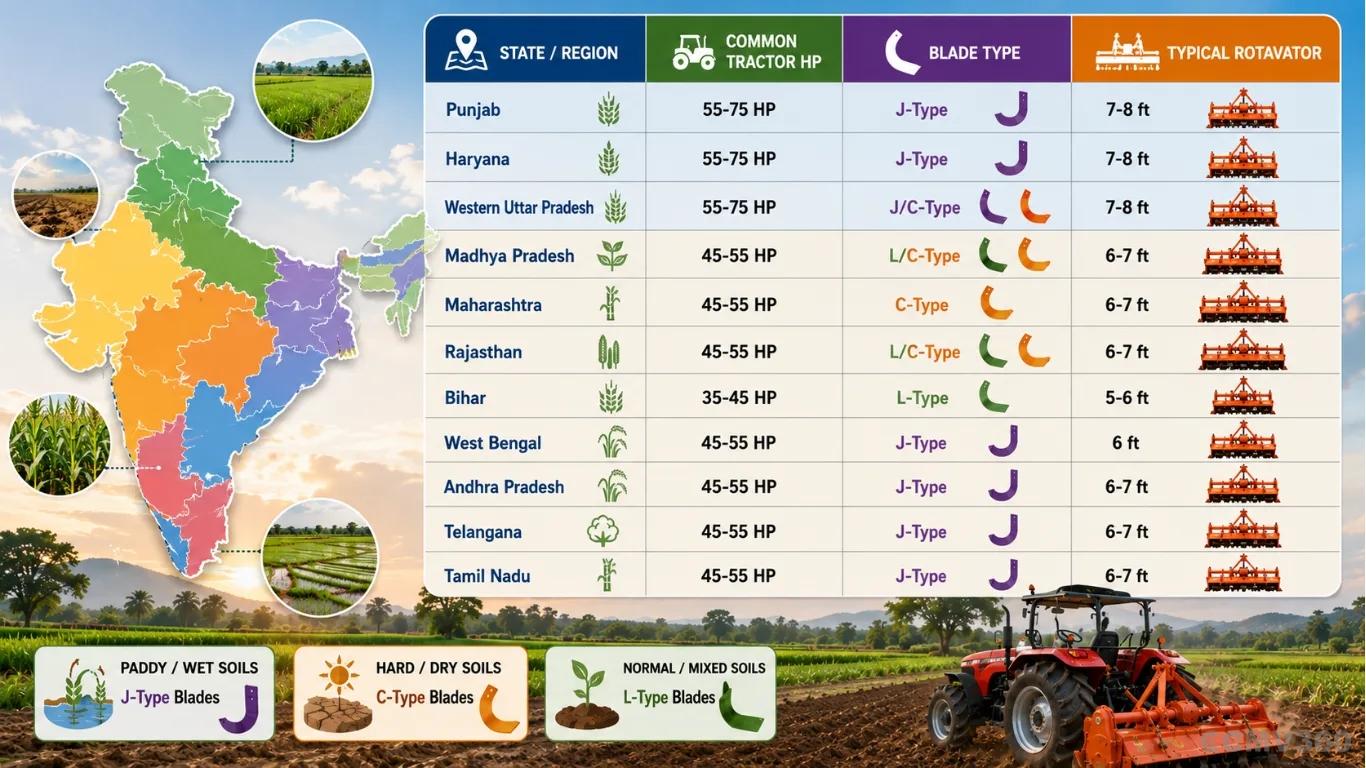
Different states require different equipment combinations because of varying soil types and cropping patterns.
State/Region | Common Tractor HP | Blade Type | Typical Rotavator |
Punjab | 55-75 HP | J-Type | 7-8 ft |
Haryana | 55-75 HP | J-Type | 7-8 ft |
Western Uttar Pradesh | 55-75 HP | J/C-Type | 7-8 ft |
Madhya Pradesh | 45-55 HP | L/C-Type | 6-7 ft |
Maharashtra | 45-55 HP | C-Type | 6-7 ft |
Rajasthan | 45-55 HP | L/C-Type | 6-7 ft |
Bihar | 35-45 HP | L-Type | 5-6 ft |
West Bengal | 45-55 HP | J-Type | 6 ft |
Andhra Pradesh | 45-55 HP | J-Type | 6-7 ft |
Telangana | 45-55 HP | J-Type | 6-7 ft |
Tamil Nadu | 45-55 HP | J-Type | 6-7 ft |
In paddy-growing states, J-type blades remain the preferred choice, while C-type blades dominate regions with hard and dry soils.
Rather than choosing equipment solely based on price, farmers should follow a practical buying sequence.
Identify your soil type.
Select the correct blade.
Decide the required working width.
Match the rotavator with tractor horsepower.
Verify blade compatibility with the rotavator model.
Always check:
Blade thickness
Hole spacing
Curvature
Mounting dimensions
Tractor PTO compatibility
Even blades of the same type may differ in dimensions across manufacturers.
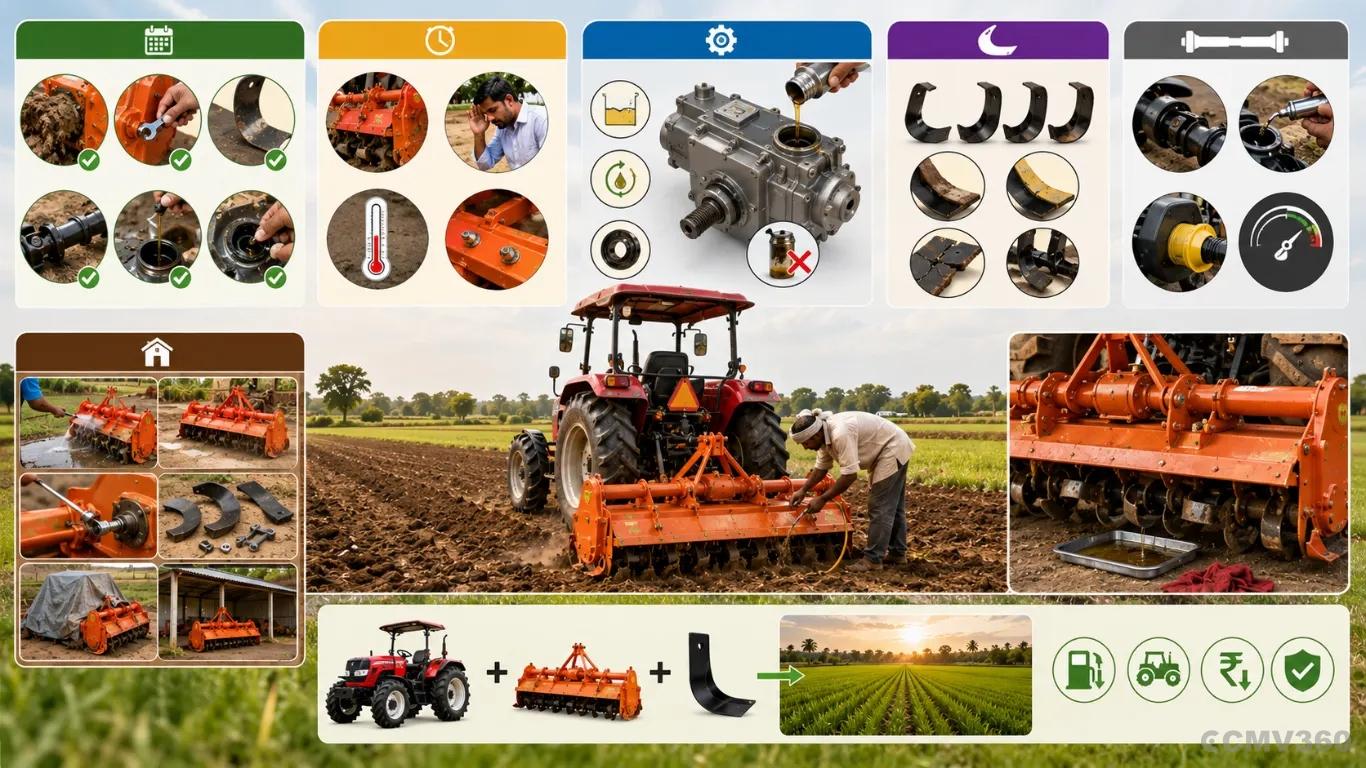
Proper maintenance significantly improves both machine life and field performance.
Clean mud and crop residue after every use.
Tighten blade bolts and flange nuts.
Inspect blades for cracks or uneven wear.
Grease the PTO shaft and universal joints.
Check gearbox oil level.
Look for oil leakage around seals.
After several hours of continuous work:
Remove accumulated mud.
Listen for unusual noises.
Monitor gearbox temperature.
Check for loose hardware.
The gearbox is one of the most expensive components of a rotavator.
Always:
Maintain the correct oil level.
Replace oil as recommended.
Repair leaking seals immediately.
Avoid operating with contaminated oil.
Blades gradually wear depending on soil conditions.
Replace blades when:
Edges become excessively rounded.
Blade length reduces significantly.
Cracks appear.
Bending affects rotor balance.
Replacing blades in complete sets helps maintain rotor balance and reduces vibration.
A properly maintained PTO shaft reduces driveline failures.
Always ensure:
Correct alignment
Regular greasing
Safety guards remain installed
Proper PTO speed during operation
Before storing the machine after the farming season:
Wash thoroughly.
Dry completely.
Apply grease.
Repair worn parts.
Store under a covered shed.
Prevent moisture accumulation.
Proper off-season storage greatly reduces rust and corrosion.
For most Indian farmers in 2026, the safest all-round combination remains:
45-55 HP tractor
6-7 ft rotavator
L-type blade for normal farming
For hard land, upgrade to C-type blades, while farmers engaged in paddy cultivation should opt for J-type blades paired with higher-torque tractors.
Instead of purchasing the most expensive blade or the biggest tractor, choosing equipment according to soil conditions, moisture levels and farm size will deliver better productivity, lower fuel costs and longer machine life.
A rotavator is far more than just another farm implement-it is a productivity tool that directly influences field preparation, fuel efficiency and crop establishment. The secret to getting the best results lies in selecting the right combination of blade type, tractor horsepower and rotavator size rather than focusing on price alone. Whether you farm sandy soils in Rajasthan, black cotton soils in Maharashtra or paddy fields in Punjab and West Bengal, matching your equipment to local field conditions will improve tillage quality, reduce operating costs and extend the life of both the tractor and the rotavator. Making an informed choice today can lead to better performance and higher returns for many farming seasons ahead.

About the author
Robin Kumar Attri is a content and video professional with 2.7 years of experience in the commercial vehicle domain. At CMV360, he creates news articles and videos covering trucks, tractors, buses, three-wheelers, and infrastructure machines.


 Add CMV360 on Google