Crop Diversification vs Crop Specialization: Which Farming Strategy Delivers Better Profits, Lower Risks, and Long-Term Success?
 Add CMV360 on Google
Compare crop diversification and specialization to understand profitability, risks, income stability, sustainability, and discover which farming strategy suits different farmers and agricultural conditions best.

By Robin Kumar Attri

Indian agriculture is evolving faster than ever before. Rising production costs, unpredictable weather, changing consumer demand, fluctuating crop prices, and growing climate risks have forced farmers to rethink the way they cultivate their land. Today, success in farming is no longer measured only by higher yields. It is equally about reducing risks, improving income stability, maintaining soil health, and ensuring long-term sustainability.
This has brought one important question into focus: Should farmers diversify by growing multiple crops or specialize in a single high-value crop?
Both Crop Diversification and Crop Specialization have become popular farming strategies across India and around the world. While diversification helps farmers spread risks and create multiple income sources, specialization allows them to maximize efficiency, improve productivity, and benefit from economies of scale. Neither approach is universally superior because the right choice depends on several factors, including farm size, market access, climate conditions, irrigation availability, input costs, and the farmer's overall objectives.
For instance, a small rainfed farmer in a climate-sensitive region may benefit more from cultivating cereals, pulses, vegetables, and oilseeds together, whereas a large commercial farmer with access to irrigation, storage facilities, contract buyers, and modern machinery may earn better returns by focusing on a single profitable crop.
So, which farming strategy actually delivers better profits, greater resilience, and long-term success? Let's understand both approaches in detail and examine what recent research says about crop diversification versus specialization.
Also Read: India’s Soil Crisis: How Modern Farming Is Destroying Fertile Land Built Over Thousands of Years
Understanding Crop Diversification
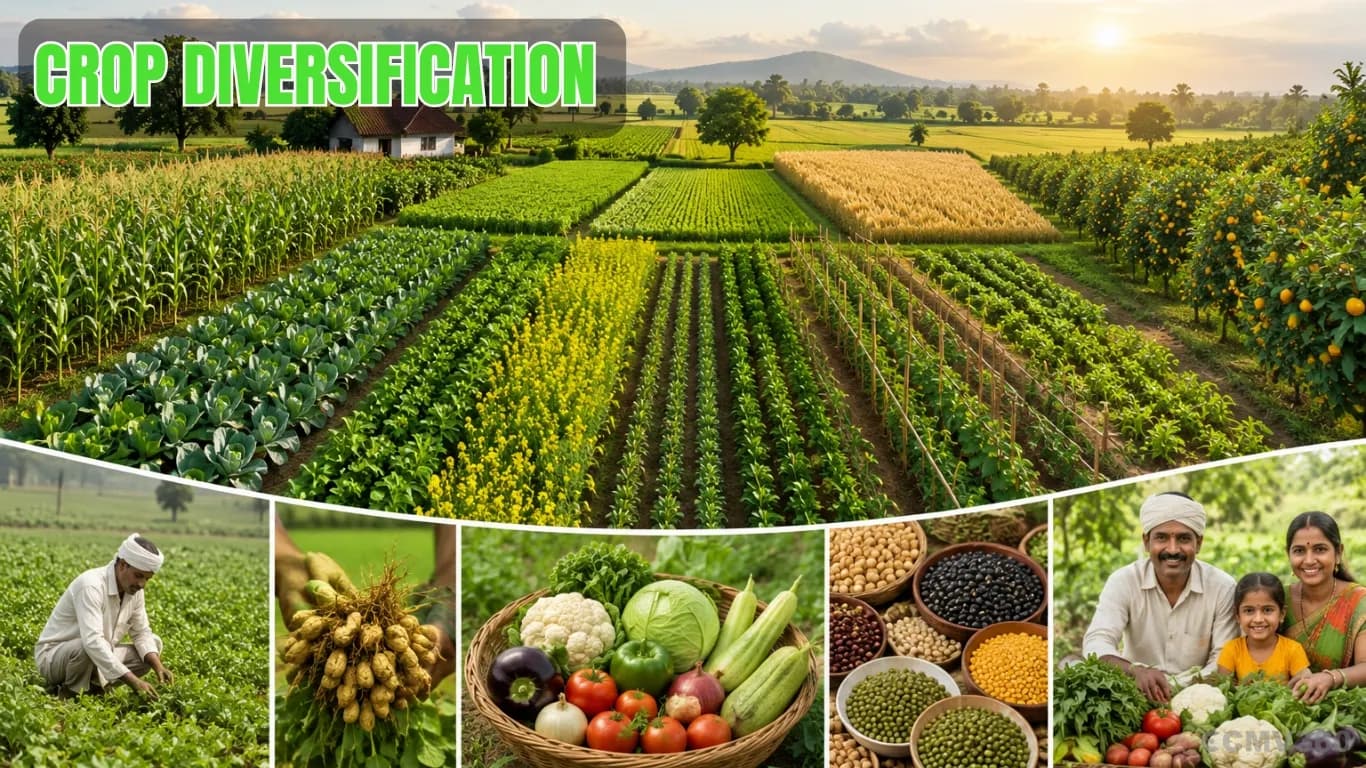
Crop diversification simply means growing two or more crops on the same farm either during the same season or across different cropping seasons. Instead of depending entirely on one crop, farmers distribute their land among different crops to reduce financial and production risks.
In India, diversification commonly includes combinations such as cereals with pulses, vegetables alongside fruits, oilseeds with legumes, or seasonal cash crops together with food crops.
Rather than relying on one source of income, farmers create several earning opportunities throughout the year while also improving the overall health of their farming system.
Why Many Farmers Choose Crop Diversification
Crop diversification offers multiple benefits that go beyond simply increasing production.
Some of its biggest advantages include:
Reduces dependence on a single crop.
Creates multiple sources of farm income.
Protects farmers against sudden price crashes.
Reduces financial losses during crop failures.
Improves soil fertility through crop rotation.
Controls pest and disease pressure naturally.
Supports better household food security.
Improves nutritional diversity for farming families.
Increases resilience against climate change.
Diversified farming also allows farmers to harvest different crops at different times, ensuring regular cash flow instead of waiting for one annual harvest.
Understanding Crop Specialization
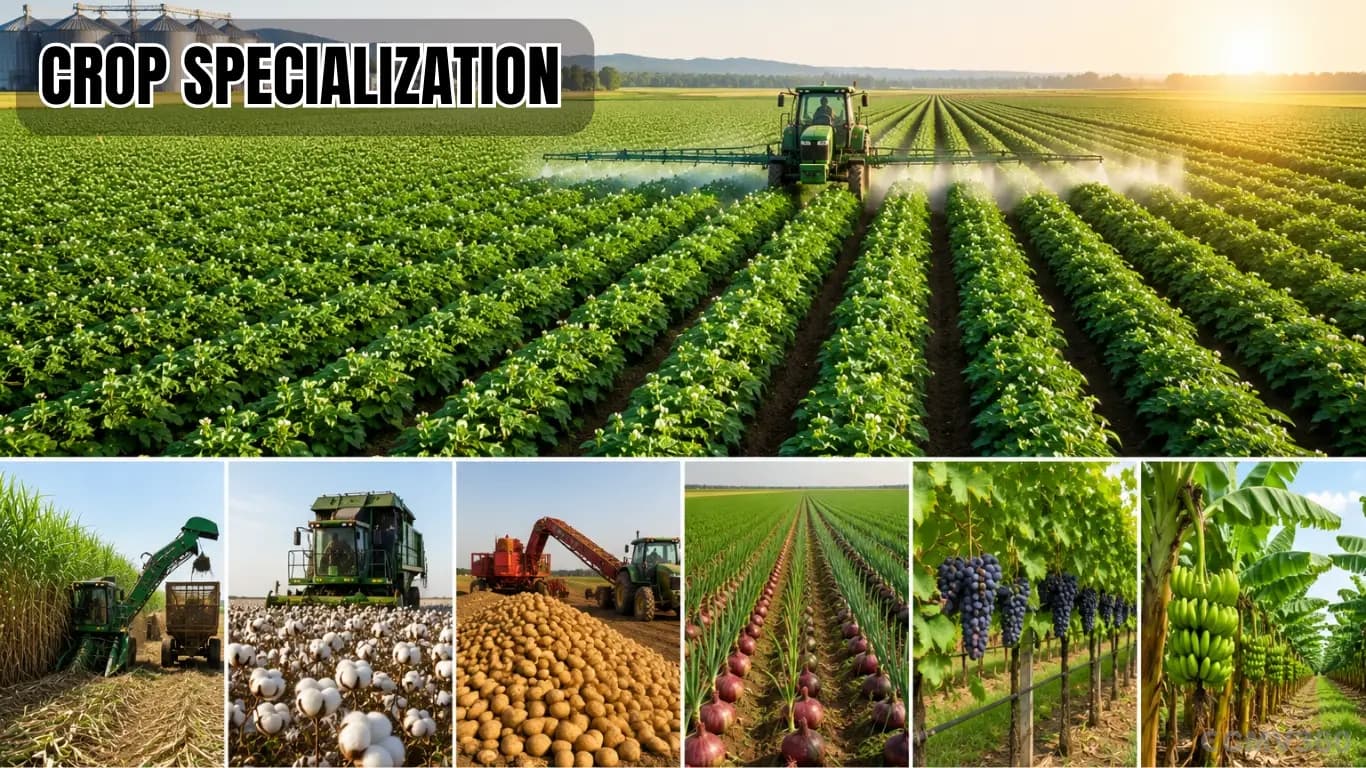
Crop specialization refers to cultivating one crop or a limited group of crops on most or all of the available farmland. Instead of spreading resources across multiple crops, farmers concentrate their investments, labour, machinery, and expertise on maximizing the productivity of a particular crop.
This approach is common among commercial farms producing crops such as sugarcane, cotton, potatoes, onions, grapes, bananas, or vegetables for organized buyers and processing industries.
By focusing on one enterprise, farmers can optimize production techniques, adopt specialized equipment, and improve operational efficiency.
Why Commercial Farmers Prefer Specialization
Specialized farming offers several economic advantages, especially where strong market linkages exist.
Major benefits include:
Higher operational efficiency.
Better utilization of farm machinery.
Easier crop planning and management.
Greater technical expertise.
Lower production cost per unit through economies of scale.
Stronger market positioning.
Better opportunities for contract farming.
Potentially higher profits during favourable market conditions.
However, specialization also increases dependency on the success of one crop.
Crop Diversification vs Specialization: Understanding the Core Difference
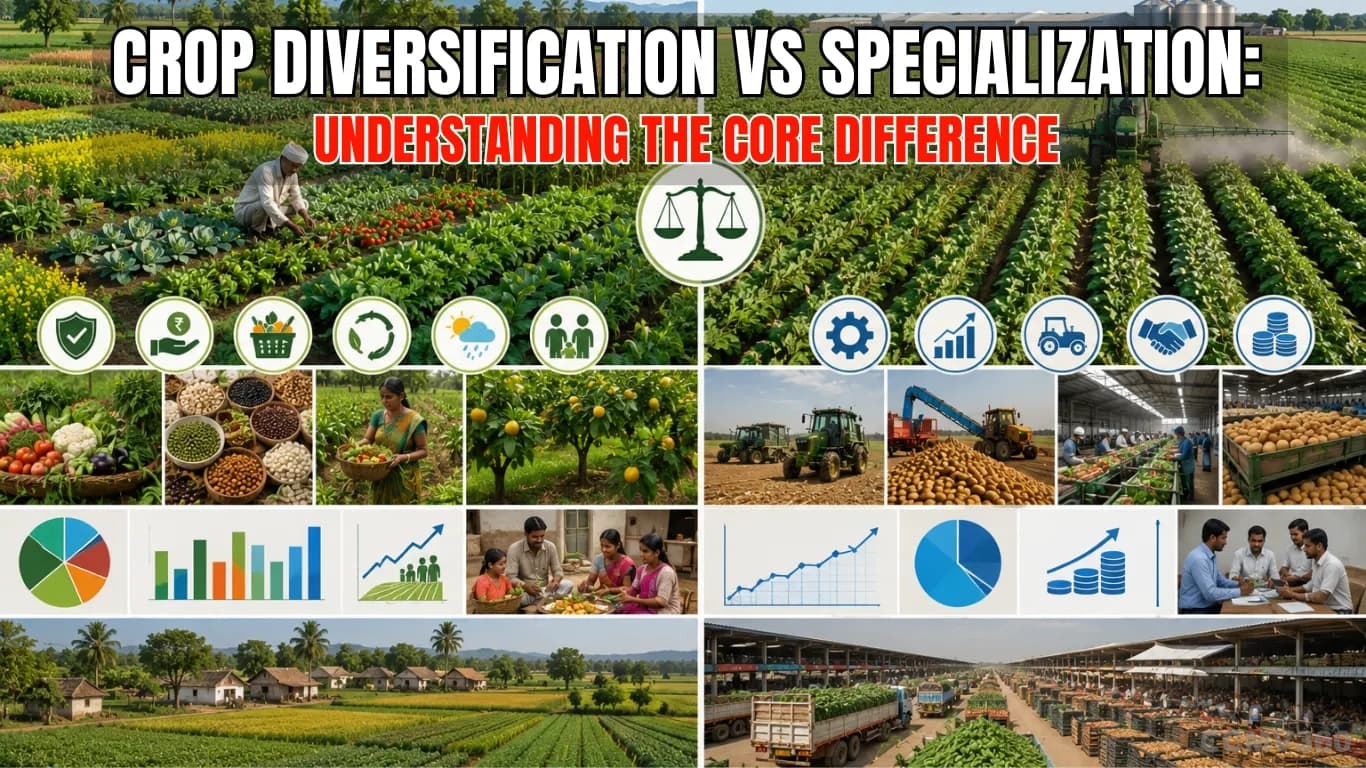
Although both approaches aim to improve farm profitability, they follow completely different strategies.
Diversification focuses on risk management, while specialization focuses on efficiency and scale.
One spreads investment across several crops to reduce uncertainty. The other concentrates investment to maximize returns from one enterprise.
The better option depends entirely on local farming conditions.
Crop Diversification vs Crop Specialization: Complete Comparison
Factor | Crop Diversification | Crop Specialization |
Income Stability | High | Moderate to Low |
Risk Level | Lower | Higher |
Profit Potential | Stable | Higher during favourable markets |
Market Dependence | Low | High |
Climate Resilience | Strong | Limited |
Soil Health | Better due to crop rotation | Can decline without rotation |
Pest & Disease Risk | Lower | Higher |
Farm Management | More complex | Simpler |
Machinery Requirement | Moderate | Often higher |
Food Security | Strong | Depends on market purchases |
Sustainability | High | Depends on management practices |
The comparison clearly shows that neither system is inherently better. Each offers unique advantages depending on the farming situation.
What Does Research Say?
Several recent studies have attempted to answer whether diversification or specialization delivers better outcomes.
The findings reveal that context matters far more than choosing one strategy over the other.
Evidence Supporting Crop Diversification
A study conducted by Bellon et al. in northern Ghana analysed 637 farming households.
Researchers observed:
Farmers cultivated an average of 3.2 crops per household.
Greater crop diversity increased both cash income and self-consumption value.
The value of food consumed by farming families was approximately 55% higher than the value generated through crop sales.
The study concluded that crop diversification significantly improves household welfare, particularly in regions where markets are weak and climate risks remain high.
This finding is particularly relevant for many smallholder farmers in India who depend partly on self-consumption while also selling surplus produce.
Evidence Supporting Crop Specialization
Another important study by Singbo et al. (2021) examined vegetable farms in Benin.
Using advanced efficiency analysis, researchers found that specialization improved technical efficiency among vegetable producers.
Interestingly, the study did not find strong evidence of economies of scope, meaning that diversification did not automatically reduce production costs in that farming system.
The findings suggest that when farmers have access to reliable inputs, irrigation, technology, and organized markets, specialization can significantly improve productivity and profitability.
When Does Crop Diversification Work Best?
Diversification generally performs better under conditions where uncertainty is high.
It becomes the preferred strategy when:
Farm size is small or fragmented.
Weather patterns are unpredictable.
Rainfed agriculture dominates.
Market prices fluctuate frequently.
Transportation infrastructure is weak.
Farmers prioritize household food security.
Soil fertility requires improvement.
Climate risks are increasing.
In these situations, cultivating multiple crops helps farmers reduce financial shocks while ensuring regular income.
When Does Crop Specialization Deliver Better Results?
Specialization performs well when farmers can fully capitalize on scale and market opportunities.
It is generally suitable when:
Reliable irrigation is available.
Markets are easily accessible.
Farmers have storage facilities.
Contract farming opportunities exist.
Credit and farm inputs are easily available.
Mechanization levels are high.
Large-scale cultivation is possible.
Demand for high-value crops remains consistent.
Commercial farming enterprises often adopt specialization to maximize operational efficiency and improve profitability.
Factors That Should Guide a Farmer's Decision
Before choosing either strategy, farmers should carefully evaluate several practical factors.
1. Farm Size: Small and fragmented farms generally benefit from diversification because they can produce multiple crops for consumption and sale.
Larger farms often gain more from specialization due to economies of scale.
2. Market Access: Reliable buyers, processing industries, cold chains, and transport networks favour specialization.
Where markets remain uncertain or distant, diversification reduces marketing risks.
3. Climate Conditions: Regions frequently affected by droughts, floods, or erratic rainfall benefit more from diversified cropping systems.
Areas with stable irrigation and controlled production conditions often support specialized farming.
4. Financial Objectives: Farmers seeking steady annual income generally prefer diversification.
Those aiming to maximize profits through commercial production may benefit from specialization.
5. Government Policies and Support: Subsidies, crop insurance, extension services, input availability, and procurement policies also influence which strategy becomes more profitable.
Policies supporting mixed farming systems encourage diversification, while commodity-focused incentives often promote specialization.
A Practical Example
Understanding the difference becomes easier through real-world examples.
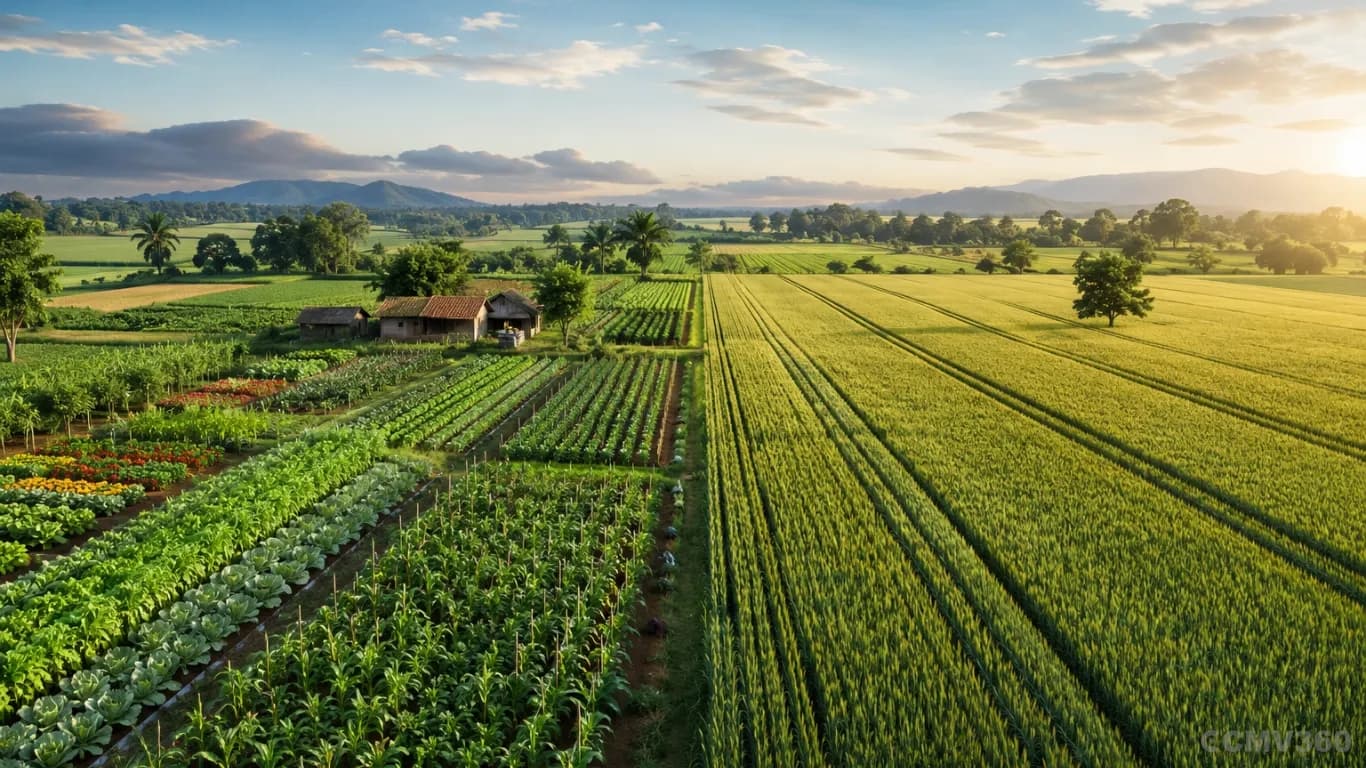
Example 1: Small Rainfed Farmer
Imagine a farmer cultivating 2 hectares in a drought-prone region.
Instead of planting only one crop, the farmer grows:
Wheat
Mustard
Pulses
Seasonal vegetables
If mustard prices decline, vegetables may generate additional income. If wheat production suffers due to rainfall, pulses may still perform well.
The farm also produces food for household consumption, reducing dependence on market purchases.
This is diversification in action.
Example 2: Large Commercial Farm
Now consider a 50-hectare irrigated farm located near food processing industries.
The farmer specializes in a high-value vegetable crop under contract farming.
Because irrigation, machinery, storage, transportation, and assured buyers are available, focusing entirely on one crop reduces production costs while increasing productivity and profitability.
This represents specialization.
Common Challenges of Crop Diversification
Despite its advantages, diversification also presents certain difficulties.
Farmers often need to:
Manage multiple cropping calendars.
Learn different production techniques.
Arrange labour throughout the year.
Market different commodities separately.
Maintain quality across several crops.
Proper planning and extension support become essential for successful diversified farming.
Common Challenges of Crop Specialization
Specialized farming also carries significant risks.
Major concerns include:
Heavy dependence on one crop.
Greater exposure to market price crashes.
Higher financial losses if crops fail.
Increased pest and disease outbreaks.
Greater reliance on irrigation and inputs.
Without effective risk management, specialization can become financially challenging during adverse years.
Which Strategy Generates Higher Farm Profitability?
There is no single answer.
Specialization often delivers higher peak profits under favourable market conditions because farmers benefit from efficiency, scale, and focused investments.
However, diversification generally provides more stable long-term income by reducing exposure to production failures and market volatility.
Research consistently indicates that:
Smallholders in climate-sensitive regions generally benefit more from diversification.
Commercial farms with strong market linkages often earn more through specialization.
Therefore, profitability depends not only on production but also on risk tolerance, infrastructure, and market access.
CMV360 Says
The debate between crop diversification and crop specialization does not have a universal winner because agriculture is highly dependent on local conditions.
For small and marginal farmers, especially those operating in rainfed, climate-sensitive, or poorly connected regions, diversification remains one of the most practical strategies. It improves food security, stabilizes income, strengthens resilience against weather extremes, and reduces dependence on any single crop.
On the other hand, larger commercial farms with reliable irrigation, strong market connections, modern machinery, contract farming opportunities, and access to quality inputs can often achieve greater productivity and profitability through specialization.
Rather than viewing these approaches as competing systems, farmers should see them as strategic tools. The most successful farming decisions are those that align with local climate, available resources, market opportunities, and long-term financial goals. Choosing the right strategy based on these factors can help build a more profitable, resilient, and sustainable farming future.

Robin Kumar Attri is a content and video professional with 2.7 years of experience in the commercial vehicle d .....