Tractors
Trucks
- Find by Budget
- Find by Type

English
 New Delhi
Learn what white, black, blue, and grey truck exhaust smoke means. Discover causes, warning signs, maintenance tips, BS6 issues, and solutions to prevent costly engine repairs in India 2026.

By Robin Kumar Attri

Every truck engine tells a story, and one of the easiest ways to understand its condition is by looking at the exhaust smoke. Whether you drive a Tata Motors Truck, Ashok Leyland Truck, Mahindra Truck, BharatBenz Truck, Eicher Truck, Volvo Trucks, or Scania truck, the colour of the smoke coming from the exhaust can reveal early signs of engine trouble before a major breakdown occurs.
For truck owners and fleet operators in India, especially those running BS6 diesel trucks, exhaust smoke is no longer just an indication of engine health. It also reflects the condition of advanced emission control systems like the Diesel Particulate Filter (DPF), Selective Catalytic Reduction (SCR) system, AdBlue, and Exhaust Gas Recirculation (EGR) technology. Ignoring these warning signs can lead to expensive repairs, reduced fuel efficiency, failed pollution tests, loss of power, unexpected downtime, and even fines in cities with strict emission regulations.
On the other hand, identifying the problem early can help extend engine life, improve mileage, reduce maintenance costs, and keep the truck performing at its best for years. But what does each exhaust smoke colour actually mean? Is white smoke always dangerous? Why do some trucks emit black smoke under heavy load? When does blue smoke indicate serious engine wear? And what should a driver do the moment these symptoms appear?
Let's understand what every exhaust smoke colour means, its possible causes, immediate actions, preventive maintenance, and why timely repairs matter more than ever in India's 2026 commercial vehicle landscape.
Modern diesel trucks are designed to emit almost invisible exhaust under normal operating conditions. Therefore, whenever visible smoke starts coming out of the exhaust pipe, it usually indicates that something inside the engine, fuel system, turbocharger, or emission control system requires attention.
The colour of the smoke acts like a warning code, helping drivers identify the likely issue before it develops into a major engine failure.
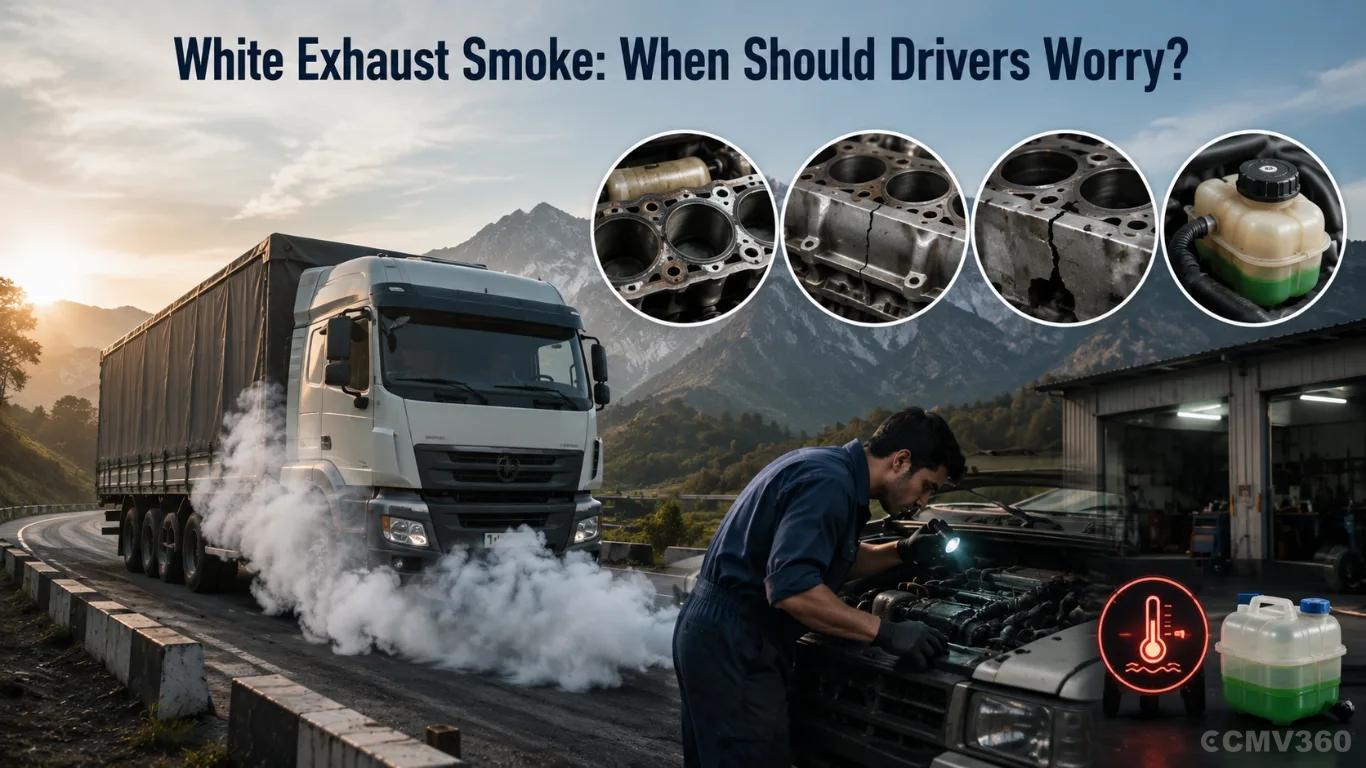
White smoke can either be completely normal or indicate one of the most serious engine problems.
During winter mornings or after the truck has remained parked overnight, a thin layer of white smoke may appear for a few minutes after startup. This is simply water vapour or condensation inside the exhaust system and disappears once the engine reaches operating temperature.
This type of smoke is completely normal.
If thick white smoke continues even after the engine has warmed up, it should never be ignored.
The situation becomes even more serious if the smoke:
Has a sweet coolant-like smell
Is accompanied by engine overheating
Causes coolant levels to drop
Results in rough engine running
These signs usually indicate coolant entering the combustion chamber.
Common Causes
Problem | Reason |
Blown head gasket | Coolant leaks into cylinders |
Cracked cylinder head | Internal coolant leakage |
Cracked engine block | Severe engine damage |
If thick white smoke continues:
Avoid carrying heavy loads.
Do not continue long-distance driving.
Check the coolant level.
Watch the engine temperature gauge carefully.
Visit a qualified workshop immediately.
Technicians generally perform:
Compression testing
Leak-down testing
Head gasket inspection
Cylinder head inspection
Engine block inspection
Ignoring persistent white smoke can eventually result in complete engine failure requiring an expensive engine rebuild or replacement.
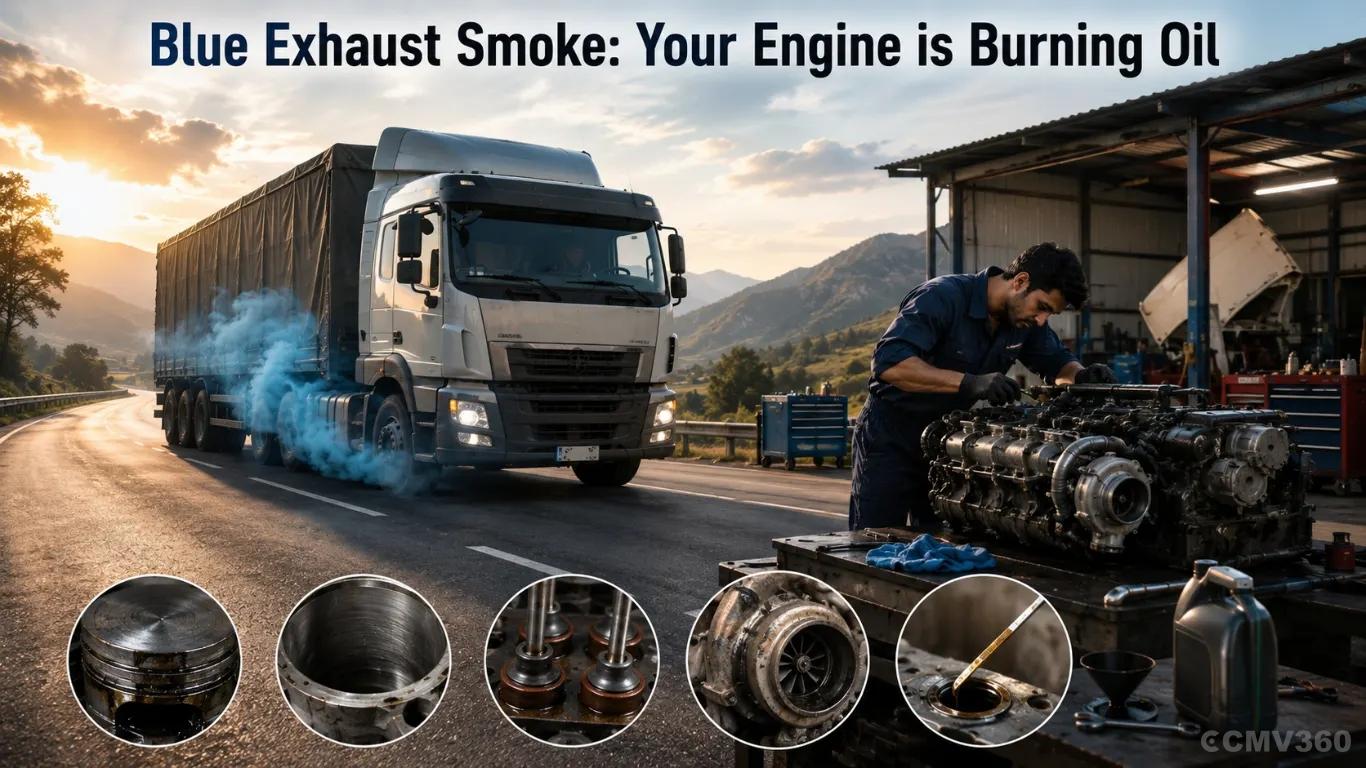
Blue or bluish-grey smoke almost always indicates that engine oil is entering the combustion chamber and burning along with diesel fuel.
Drivers may also notice:
Burning oil smell
Frequent engine oil top-ups
Reduced engine performance
Higher oil consumption
Most Common Causes
Worn piston rings
Cylinder wear
Damaged valve stem seals
Turbocharger oil seal failure
Excess engine oil after servicing
High-mileage trucks are particularly prone to this issue.
If blue smoke appears immediately after an oil change, first check whether the engine oil has been overfilled.
If the oil level is above the maximum mark, excess oil should be drained.
However, if blue smoke continues during acceleration, idling, or heavy load:
Check engine oil regularly.
Monitor oil consumption.
Avoid long-distance operation if smoke becomes severe.
Get the turbocharger inspected.
Request compression testing.
Continuous oil burning eventually leads to:
Low lubrication
Increased engine wear
Carbon deposits
DPF clogging in BS6 trucks
Turbo damage
Complete engine overhaul
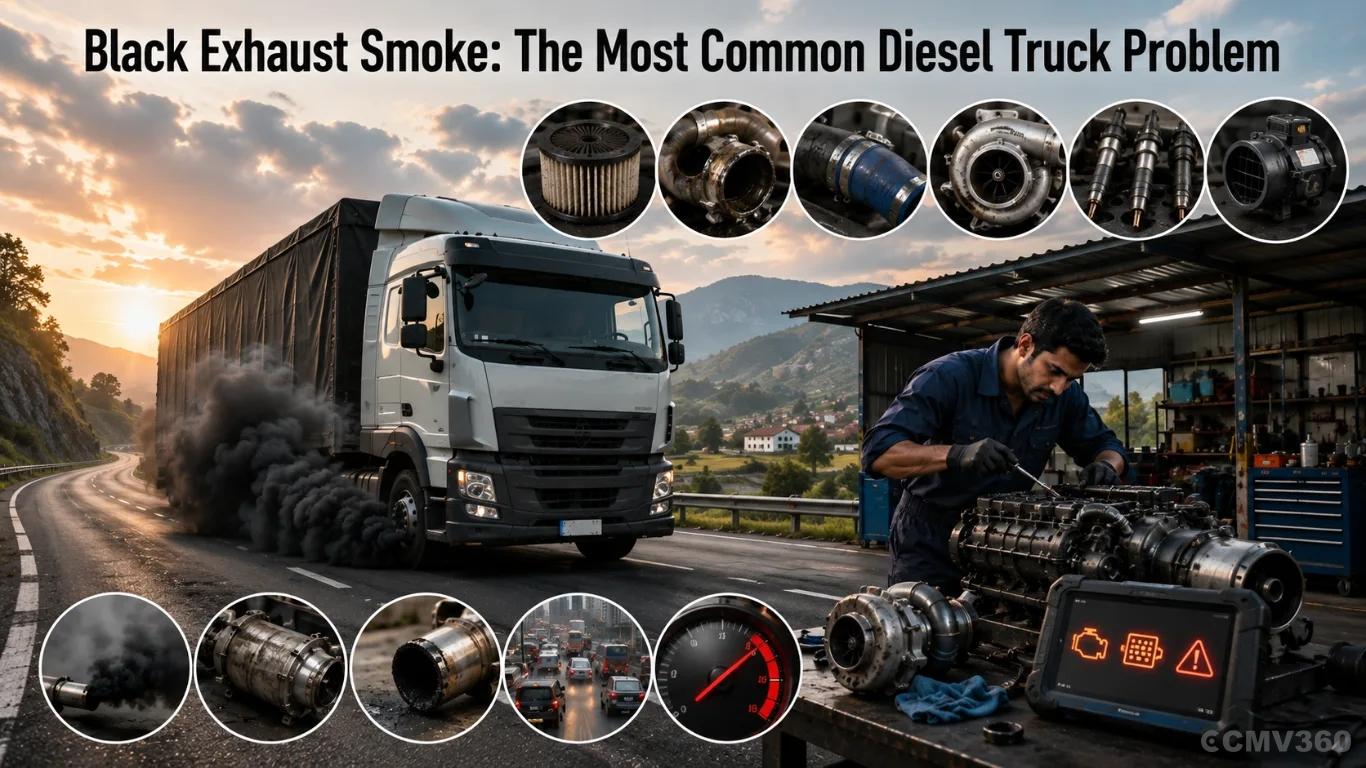
Among Indian trucks, black smoke is the most frequently observed exhaust issue.
Black smoke simply means that more fuel is entering the engine than the available air can burn efficiently.
The result is incomplete combustion, producing soot.
The most frequent causes include:
Dirty or clogged air filter
Restricted airflow
Damaged intercooler hoses
Turbo boost leaks
Faulty fuel injectors
Incorrect fuel pressure
Poor injector spray pattern
Faulty MAF sensor
Faulty oxygen sensor
Incorrect fuel injection timing
For BS6 trucks, black smoke may also indicate:
Blocked Diesel Particulate Filter (DPF)
Incomplete DPF regeneration
Poor fuel quality
Frequent city driving
Continuous stop-and-go traffic
Eventually, the truck may enter Limp Mode, reducing engine power to protect critical components.
Before visiting the workshop, drivers should inspect:
Air Filter
Observe When Smoke Appears
Situation | Possible Cause |
During hard acceleration | Turbo or boost problem |
Uphill driving | Rich air-fuel mixture |
Heavy load | DPF stress |
Even at idle | Injector or timing issue |
Dashboard Warning Lights
For BS6 trucks, never ignore:
Engine Check Light
DPF Warning
Reduced Power Warning
These usually indicate that diagnostic scanning is required.
A technician may recommend:
Injector testing
Injector cleaning or replacement
Turbo pressure inspection
Intercooler inspection
MAF sensor diagnostics
DPF forced regeneration
DPF cleaning
DPF replacement (if severely blocked)
Ignoring black smoke significantly increases fuel consumption and can eventually damage the engine, injectors, and DPF.
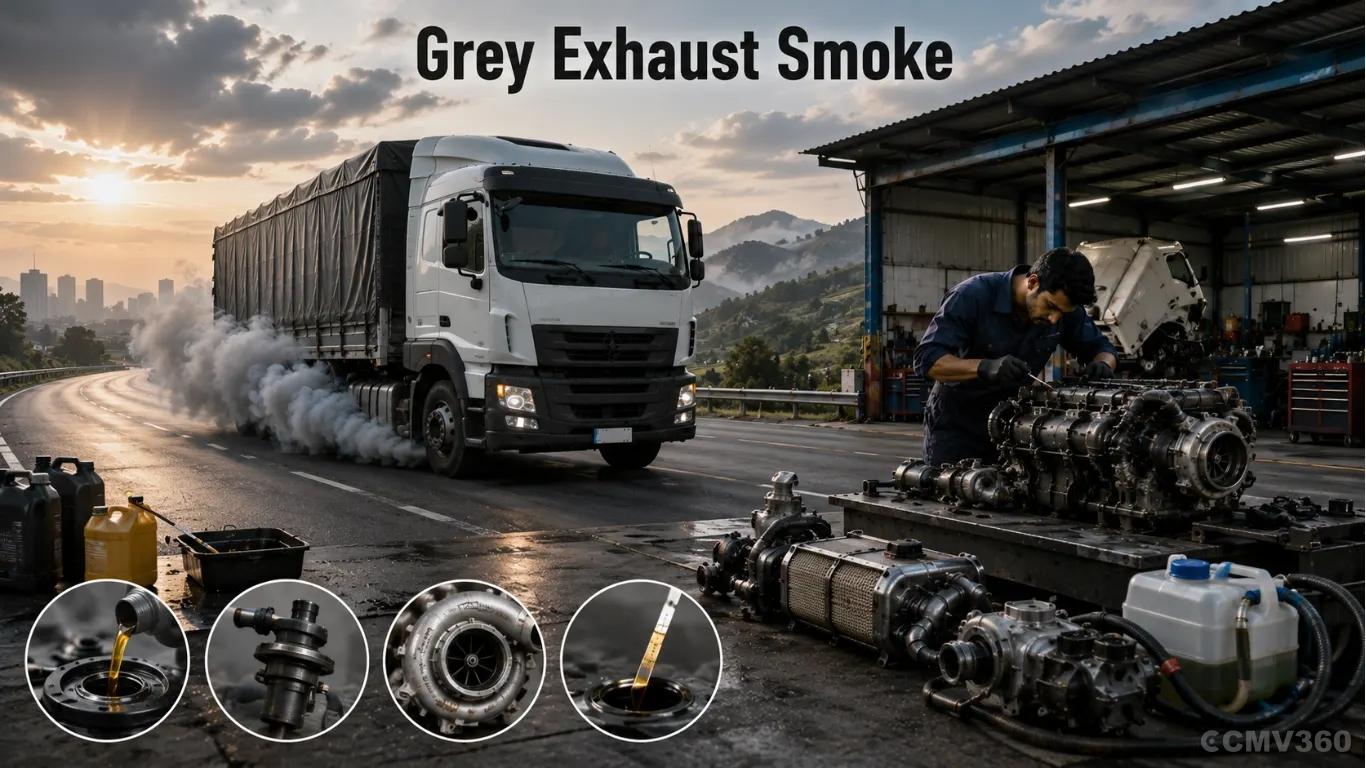
Grey smoke is comparatively uncommon but should still be investigated if it continues.
It generally indicates:
Slight engine oil overfilling
PCV (Positive Crankcase Ventilation) system issues
Turbocharger problems
Low engine oil
Combustion irregularities
Drivers should first inspect engine oil levels.
If the problem continues, the PCV system and turbocharger should be checked by a technician.
India's transition to BS6 emission norms has significantly changed diesel truck maintenance.
Today's commercial vehicles use advanced emission technologies such as:
Diesel Particulate Filter (DPF)
Exhaust Gas Recirculation (EGR)
Selective Catalytic Reduction (SCR)
AdBlue system
These systems reduce harmful emissions but also require disciplined maintenance.
Visible exhaust smoke usually indicates that one or more of these systems may not be functioning correctly.
Ignoring the issue can lead to:
Failed Pollution Under Control Certificate (PUCC)
Fitness certificate failures
Pollution-related penalties
Reduced resale value
Expensive component replacement
Truck operators in India regularly face challenging conditions that accelerate engine wear.
These include:
Dusty highways that clog air filters quickly
Heavy stop-and-go traffic preventing proper DPF regeneration
Variable diesel quality affecting injectors
Long hill climbs producing excessive soot
Overloading that increases thermal stress
Because of these operating conditions, preventive maintenance becomes even more important than the manufacturer's minimum service schedule.
Regular maintenance is the easiest way to avoid expensive repairs and keep exhaust smoke under control.
Inspect the air filter every 5,000-10,000 km, especially in dusty areas.
Replace dirty filters according to OEM recommendations.
Check intercooler pipes and hose clamps for leaks.
Use only the recommended engine oil grade.
Replace engine oil and filters on schedule.
Always maintain oil between the MIN and MAX marks.
Never overfill the engine.
Use diesel from trusted fuel stations.
Replace fuel filters on time.
Use OEM-approved injector cleaners where recommended.
If the truck mainly operates in city traffic, occasionally drive it on highways for 20-30 minutes under moderate load to assist DPF regeneration.
Check coolant levels before long trips.
Use the correct coolant-water mixture.
Inspect hoses, radiator, and water pump regularly.
Never ignore engine overheating.
Respond immediately to DPF warning lights.
Schedule forced regeneration whenever required.
Keep genuine AdBlue topped up.
Replace or clean DPF only as recommended by the manufacturer.
Follow the complete OEM service schedule.
Conduct periodic compression tests for high-mileage trucks.
Inspect turbocharger shaft play whenever power loss accompanies smoke.
Proper maintenance offers several long-term advantages.
Better fuel efficiency
Longer engine life
Reduced breakdowns
Lower repair costs
Improved vehicle reliability
Better resale value
Easier pollution compliance
Fewer roadside breakdowns on highways and hilly routes
Delaying repairs often turns minor issues into major expenses.
Common consequences include:
Head gasket replacement
Engine overheating
Turbocharger failure
Complete engine overhaul
Expensive DPF replacement
Higher fuel bills
Reduced payload capability
Increased workshop downtime
Pollution penalties
Difficulty obtaining fitness certificates in states with stricter enforcement
Early diagnosis almost always costs significantly less than repairing a failed engine.
Smoke Colour | Most Likely Cause | Driver's Immediate Action |
Thin White (Cold Start) | Water vapour or condensation | Normal; monitor only |
Thick White | Coolant leak, blown head gasket, cracked head/block | Check coolant, avoid heavy loads, visit workshop immediately |
Blue / Bluish-Grey | Engine oil burning, worn piston rings, valve seals, turbo failure | Check oil level, monitor consumption, inspect engine and turbo |
Black | Dirty air filter, injector problems, turbo issues, DPF blockage | Inspect air filter, use quality fuel, check warning lights, diagnose DPF and injectors |
Grey | Oil level issues, PCV faults, turbo or combustion problems | Check oil level and inspect PCV system and turbocharger |
Exhaust smoke is one of the earliest and most reliable indicators of a truck's mechanical health. Whether it's a brief puff of white vapour on a cold morning or persistent blue, black, or grey smoke during operation, every colour points toward a specific issue that deserves attention. For modern BS6 trucks, these warning signs extend beyond engine performance to include critical emission systems such as the DPF, SCR, EGR, and AdBlue setup. Acting early not only prevents expensive repairs but also improves fuel efficiency, reduces downtime, ensures compliance with emission norms, and helps preserve the truck's long-term value. For truck owners, fleet operators, and drivers alike, recognising exhaust smoke early and following a disciplined maintenance routine is one of the smartest ways to maximise reliability, performance, and profitability on Indian roads.

About the author
Robin Kumar Attri is a content and video professional with 2.7 years of experience in the commercial vehicle domain. At CMV360, he creates news articles and videos covering trucks, tractors, buses, three-wheelers, and infrastructure machines.





 Add CMV360 on Google