Tractors
Trucks
- Find by Budget
- Find by Type

English
 New Delhi
Learn microgreens farming at home and commercially in India. Discover benefits, profitable crops, growing tips, setup requirements, nutrition, and step-by-step methods for beginners and urban farmers.

By Robin Kumar Attri

Microgreens farming is rapidly becoming one of the most exciting opportunities in modern urban agriculture. From premium restaurants and luxury hotels to health-conscious families and fitness enthusiasts, demand for fresh and nutrient-rich microgreens is rising across India. Cities like Delhi, Mumbai, Bengaluru, Pune, and Hyderabad are witnessing a sharp increase in rooftop farms, indoor growing setups, and small-scale commercial units dedicated entirely to microgreens production.
What makes this farming model even more attractive is its simplicity. Unlike traditional farming, microgreens do not require acres of land, heavy irrigation systems, or expensive machinery. A small balcony, terrace, spare room, or indoor shelf can become a productive mini-farm capable of generating fresh produce every 10 to 14 days.
At the same time, the global food industry is moving toward healthier eating habits. Consumers today want fresh, chemical-free, nutrient-rich food that can be grown sustainably with less water and space. This is where microgreens stand out. These tiny greens may look small, but they carry intense flavours, vibrant colours, and extremely high nutritional value.
Brands, startups, urban farmers, hydroponic companies, and vertical farming businesses are now treating microgreens as a premium agricultural category with strong future potential. Restaurants use them for garnishing and flavour enhancement, while households increasingly add them to salads, sandwiches, smoothies, soups, and healthy meals.
But what exactly are microgreens? How are they different from sprouts? Which plants can be grown as microgreens? Are they profitable in India? And most importantly, how can beginners start microgreens farming at home or commercially?
Let’s explore everything in detail.
Also Read: LED Smart Farming Revolution: How Farmers Control Flower Blooming Time Using Light Technology
Microgreens are young vegetable, herb, grain, or legume plants harvested at the first true-leaf stage. They are generally harvested within 7 to 21 days after germination when the plants are around 2-5 cm tall.
These greens are younger than baby greens but older than sprouts.
Type | Harvest Time | Growing Method | How It Is Eaten |
Sprouts | 2-5 days | Water only | Whole plant, including roots |
Microgreens | 7-21 days | Soil or growing medium | Stem and leaves only |
Baby Greens | 3-4 weeks | Soil cultivation | Mature small leaves |
Microgreens are grown in shallow trays using soil, cocopeat, hydroponic mats, or other growing media. Once the first true leaves appear, they are cut just above the growing medium and consumed fresh.
The popularity of microgreens farming is not just a temporary trend. It is supported by changing food habits, increasing urbanisation, rising health awareness, and advancements in indoor farming technologies.
Major Reasons Behind the Growth of Microgreens
High nutritional value
Fast harvesting cycle
Low space requirement
Minimal water consumption
Premium selling prices
Strong demand from restaurants and cafés
Suitable for urban farming and rooftop farming
Easy to grow indoors
Works well with hydroponics and vertical farming
The global microgreens market was valued at nearly USD 2.5-3 billion in 2025 and is expected to grow significantly in the coming years. Experts project the market could reach USD 5-7.6 billion by 2031-2034 due to growing consumer interest in functional foods and sustainable agriculture.
One of the biggest reasons behind the demand for microgreens is their exceptional nutritional profile.
Research shows that many microgreens contain 3 to 40 times more vitamins, antioxidants, and minerals than their fully mature vegetables, depending on the crop variety and growing conditions.
Important Nutrients Found in Microgreens
Vitamin C
Vitamin E
Vitamin K
Iron
Magnesium
Potassium
Carotenoids
Polyphenols
Antioxidants
These nutrients are linked to multiple health benefits including improved immunity, better heart health, reduced inflammation, and support against chronic diseases.
For example, a mix of sunflower and basil microgreens may provide:
Nutrient | Approximate Value per 100 g |
Energy | 28 kcal |
Protein | 2.2 g |
Carbohydrates | 4.4 g |
Fiber | 2.2 g |
Iron | 15.9 mg |
Magnesium | 66 mg |
Potassium | 298 mg |
A large variety of edible plants can be grown as microgreens. However, some crops perform better due to faster growth, stronger flavours, and higher market demand.
These are among the most popular and fastest-growing varieties.
Examples:
Broccoli
Radish
Mustard
Kale
Arugula
Cabbage
Cauliflower
Kohlrabi
Turnip
USP:
Rich in antioxidants and glucosinolates with spicy and fresh flavours.
These varieties are softer in flavour and ideal for salads.
Examples:
Spinach
Lettuce
Beet
Swiss chard
Mizuna
Amaranth
USP:
Colourful appearance and mild taste are suitable for beginners.
Herb-based microgreens are highly valued in restaurants and premium kitchens.
Examples:
Basil
Coriander
Dill
Mint
Parsley
Chives
Thyme
USP:
Strong aroma and premium culinary appeal.
Often consumed as health shots or juice ingredients.
Examples:
Wheatgrass
Barley
Oats
Rye
Buckwheat
USP:
Popular in detox and wellness diets.
These are known for their crunchy texture and excellent yields.
Examples:
Sunflower
Pea shoots
Chickpea
Lentil
Fenugreek
Soybean
Mung bean
USP:
Fast growth and high productivity.
Not every edible plant is safe as a microgreen.
Certain nightshade family plants contain toxic alkaloids during the young growth stage.
Avoid These Plants:
Tomato
Potato
Eggplant (Brinjal)
Bell pepper
Tomatillo
Although these crops are safe when mature, their young shoots and sprouts should not be consumed as microgreens.
If you are starting microgreens farming at home in Indian conditions, especially in cities like Delhi, these are the easiest and safest options:
Microgreen | Growth Speed | Taste |
Radish | Very Fast | Spicy |
Broccoli | Fast | Mild |
Sunflower | Medium | Nutty |
Pea Shoots | Medium | Sweet |
Fenugreek | Fast | Slightly Bitter |
Mustard | Fast | Sharp |
Beet | Medium | Earthy |
Amaranth | Medium | Mild |
Microgreens grow best under controlled conditions.
Factor | Recommended Range |
Temperature | 18–25°C |
Humidity | 40–70% |
Light | 3–6 hours daily |
Airflow | Moderate ventilation |
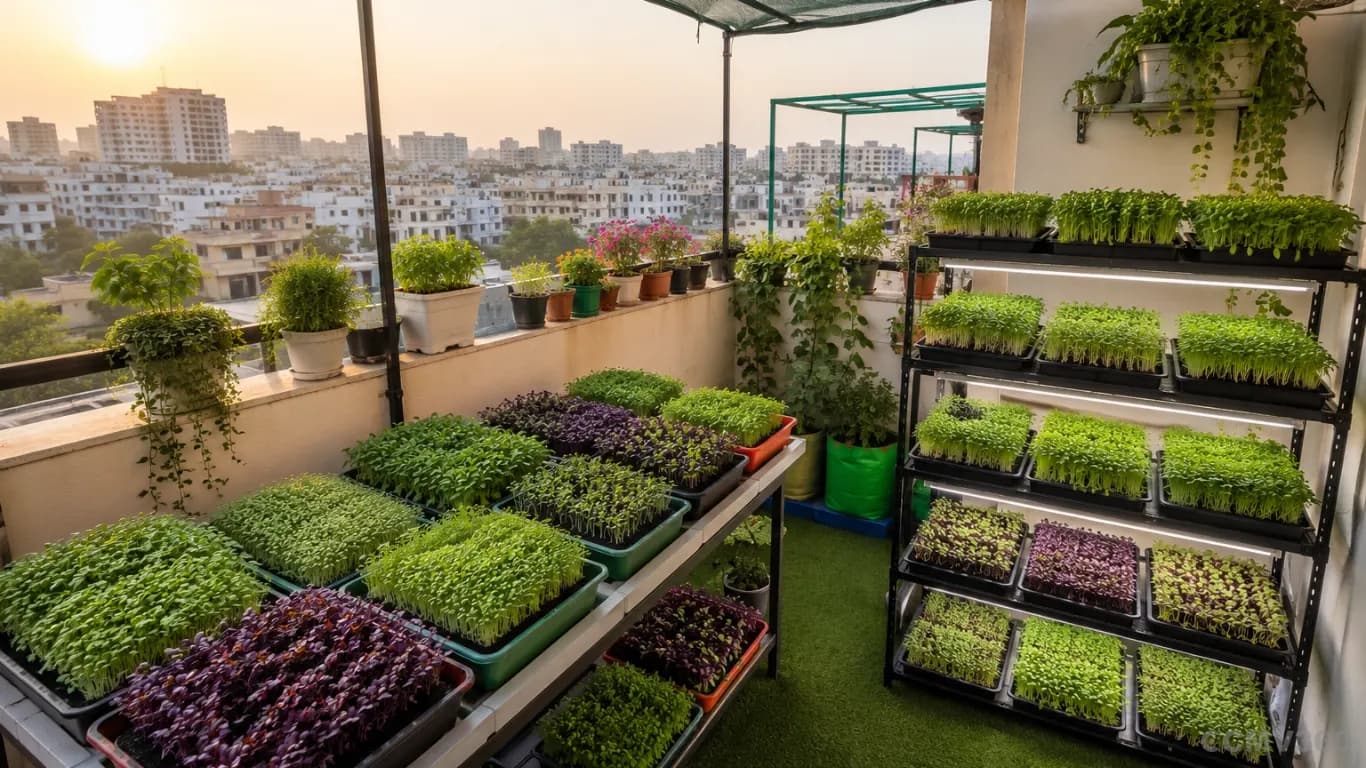
In Indian cities, growers commonly use:
Indoor rooms
Balconies
Rooftops
Shade-net houses
Vertical farming shelves
The good news is that you do not need expensive equipment to begin.
Basic Setup Requirements
Food-grade trays with drainage holes
Cocopeat or potting mix
Spray bottle
High-quality untreated seeds
LED grow lights or sunlight
Clean scissors
Water source
Microgreens are simple to grow, but growers must maintain hygiene and environmental control carefully.
Use Clean Seeds: Always use untreated, food-grade seeds specifically meant for microgreens or sprouting.
Avoid Overwatering: Too much water is the biggest reason behind mold and fungal infections.
Ensure Air Circulation: Good airflow reduces humidity-related diseases.
Maintain Hygiene: Clean trays, tools, and growing media are essential.
Avoid Contaminated Soil: Do not use unsafe manure or chemically contaminated soil.
Harvest at the Right Time: Delayed harvesting reduces tenderness and flavour quality.
Problem | Cause | Solution |
Mold | Excess humidity | Improve ventilation |
Damping-off | Overwatering | Reduce water |
Yellow plants | Lack of light | Increase lighting |
Weak stems | Poor airflow | Use ventilation |
Bad smell | Waterlogging | Improve drainage |
Some organic growers also use neem-based sprays or beneficial fungi like Trichoderma for disease management.
Yes, microgreens farming is considered one of the most profitable forms of urban farming due to:
Fast crop cycles
Premium market pricing
Low land requirement
High demand from restaurants and health-conscious consumers
Yield Estimate
A standard 10×20-inch tray can produce:
150-250 grams per cycle
Crop duration:
Around 10-14 days
Prices vary based on city, quality, packaging, and branding.
Product | Approximate Retail Price |
Basic microgreens | ₹150-₹250 per 100 g |
Premium organic varieties | ₹250-₹300+ per 100 g |
Restaurants and premium cafés often pay higher prices for fresh and speciality varieties.
Microgreens farming has become a serious business opportunity for:
Urban farmers
Rooftop farming startups
Hydroponic businesses
Home entrepreneurs
Restaurant suppliers
Health food brands
A grower managing around 100 trays with proper marketing and regular production cycles can potentially generate significant monthly revenue depending on sales channels and efficiency.
Microgreens are widely used because they:
Improve presentation
Add strong flavours
Offer nutritional benefits
Enhance gourmet dishes
Support farm-to-table concepts
This makes them highly popular among:
Fine-dine restaurants
Health cafés
Salad chains
Luxury hotels
Fitness-focused consumers
India’s urban agriculture sector is evolving rapidly. Government-backed horticulture and hydroponic initiatives are also encouraging controlled-environment farming.
Microgreens fit perfectly into this ecosystem because they:
Require less water
Need very little land
Grow quickly
Suit vertical farming systems
Align with healthy eating trends
With rising awareness around nutrition and sustainable food production, the future of microgreens farming in India looks extremely promising.
Microgreens farming is no longer just a small urban gardening hobby. It has evolved into a modern, profitable, and sustainable farming opportunity that suits both home growers and commercial entrepreneurs. These tiny greens offer massive advantages, fast harvesting, premium pricing, low investment, and exceptional nutrition.
Whether someone wants healthier food for their family, a side business from their terrace, or a full-scale urban farming startup, microgreens provide one of the most practical and future-ready agricultural options available today.
From broccoli and radish to sunflower and basil, the variety of crops, flavours, colours, and business possibilities make microgreens farming one of the most exciting sectors in modern agriculture. The real question now is not whether microgreens farming works, it is how quickly growers can tap into this growing market opportunity.

About the author
Robin Kumar Attri is a content and video professional with 2.7 years of experience in the commercial vehicle domain. At CMV360, he creates news articles and videos covering trucks, tractors, buses, three-wheelers, and infrastructure machines.







 Add CMV360 on Google