Tractors
Trucks
- Find by Budget
- Find by Type

English
 New Delhi
Explore tillage practices in India 2026, including zero, strip, and conventional methods, with benefits, crop usage, costs, and government support for better farming productivity and sustainability.

By Robin Kumar Attri

India’s agriculture in 2026 stands at a critical intersection where tradition meets innovation. For decades, farmers relied heavily on conventional tillage, deep ploughing, repeated soil turning, and intensive land preparation. But today, rising fuel costs, water scarcity, and climate challenges are pushing a gradual shift toward conservation agriculture.
Across the Indo-Gangetic plains, Deccan plateau, and southern rainfed regions, farmers are experimenting with zero tillage, strip tillage, and stubble mulch techniques. These methods are not just alternatives-they are strategic upgrades aimed at improving soil health, reducing input costs, and maintaining yields.
At the same time, trusted tractor brands like Mahindra and Sonalika, along with modern implements such as reversible MB ploughs, rotavators, and strip-till planters, are enabling this transformation on the ground.
So, while conventional tillage still dominates Indian farms, conservation practices are steadily gaining ground, especially in water-stressed and high-intensity cropping systems.
But this raises a crucial question for farmers and agri-entrepreneurs alike:
Which tillage method truly delivers better productivity, lower cost, and long-term sustainability in Indian conditions?
Also Read: Tractor Hydraulics Explained: Functions, Types, Maintenance & Why It Matters for Every Farmer
Let’s explore in detail.
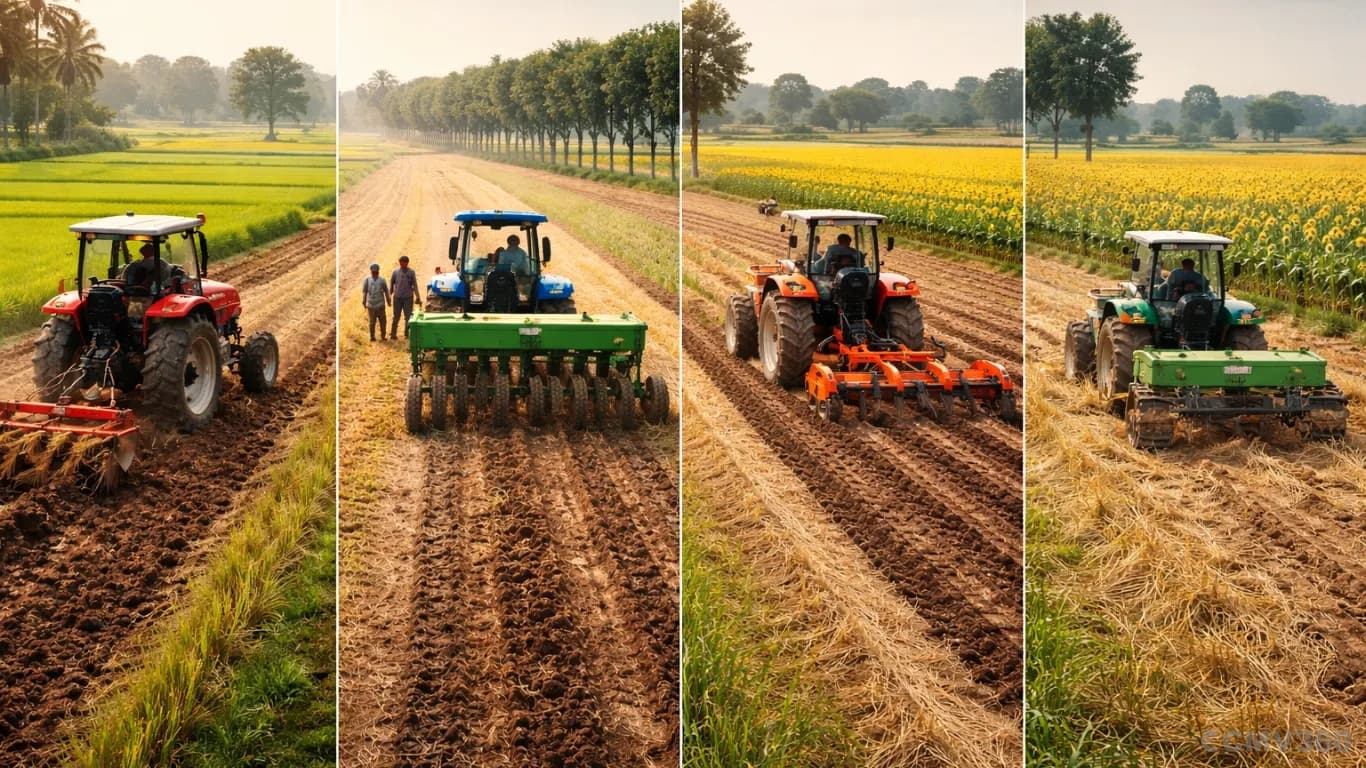
Tillage refers to the mechanical manipulation of soil to create ideal conditions for seed germination, root growth, and crop development. In India, tillage practices are broadly divided into two categories:
This traditional approach involves complete soil inversion and multiple operations before sowing.
Key Types:
Primary Tillage (Ploughing): Initial soil turning using mouldboard ploughs
Deep Tillage (25–30 cm): For deep-rooted crops like pigeonpea
Subsoiling (40–70 cm): Breaks hardpan layers
Secondary Tillage: Harrowing and planking for seedbed preparation
Usage:
Tractor-driven implements such as rotavators, disc harrows, and MB ploughs (20–90 HP tractors) are widely used. Entry-level equipment starts from around ₹11,935 in 2026.
This modern approach reduces soil disturbance while maintaining crop residue on the surface.
Main Types:
Zero Tillage
Reduced Tillage
Strip Tillage
Ridge Tillage
Stubble Mulch
Usage:
Advanced tools like no-till seed drills and strip-till planters allow farmers to sow crops directly without full land preparation.
Full soil inversion before sowing
Multiple passes increase fuel and labor cost
Suitable for weed control and initial land preparation
Direct seeding with minimal soil disturbance
Combines tilling, fertilizing, and sowing in one pass
Saves time, fuel, and water
Modern implements such as chisel ploughs and reversible MB ploughs offer precision and efficiency, especially in dryland and black soil regions.
Strong weed and pest control
Improved soil aeration
Better for deep-rooted crops
Saves up to 25% time and cost
Reduces water use by 15–20%
Improves soil organic matter
Reduces soil erosion
Maintains or increases yields
For example, zero tillage can increase wheat yield by 5–7%, especially in rice-wheat systems.
India’s diverse soil types and climatic zones make tillage a critical farming decision.
Prevents soil compaction
Supports irrigation systems like broadbed-furrow
Helps manage rising fuel and labor costs
Promotes sustainable farming practices
By 2026, conservation tillage has covered nearly 1.5 million hectares, especially in Punjab and surrounding regions.
Type | Pros | Cons | Cost/ha (₹) | Water Savings | Adoption (India 2026) |
Deep Ploughing | Breaks hardpan, improves roots | High fuel use | 2,500–4,000 | Low | 30–40% rainfed |
Zero Tillage | 7–8% yield gain, low cost | Weed issues | 1,000–1,500 | 15–20% | 1.5–2M ha |
Strip Tillage | Moisture retention, precision | Equipment cost | 1,800–2,500 | 10–15% | <0.5M ha |
Stubble Mulch | Soil health, erosion control | Residue issues | 1,200–2,000 | 20–30% | Growing |
Zero tillage is proving highly effective in India’s rice-wheat systems.
Wheat yields are 7–8% higher
Farmers earn up to ₹12,475/ha extra income
Better plant growth due to timely sowing
While conventional tillage is useful initially, it may degrade soil quality over time.
Tractor-mounted planters (3–6 rows)
Compatible with 35–50 HP tractors
Cost: ₹1.5–3 lakh
Soil tilling (20–30 cm strips)
Fertilizer application
Seed placement
All in a single pass-ideal for small and medium farms.
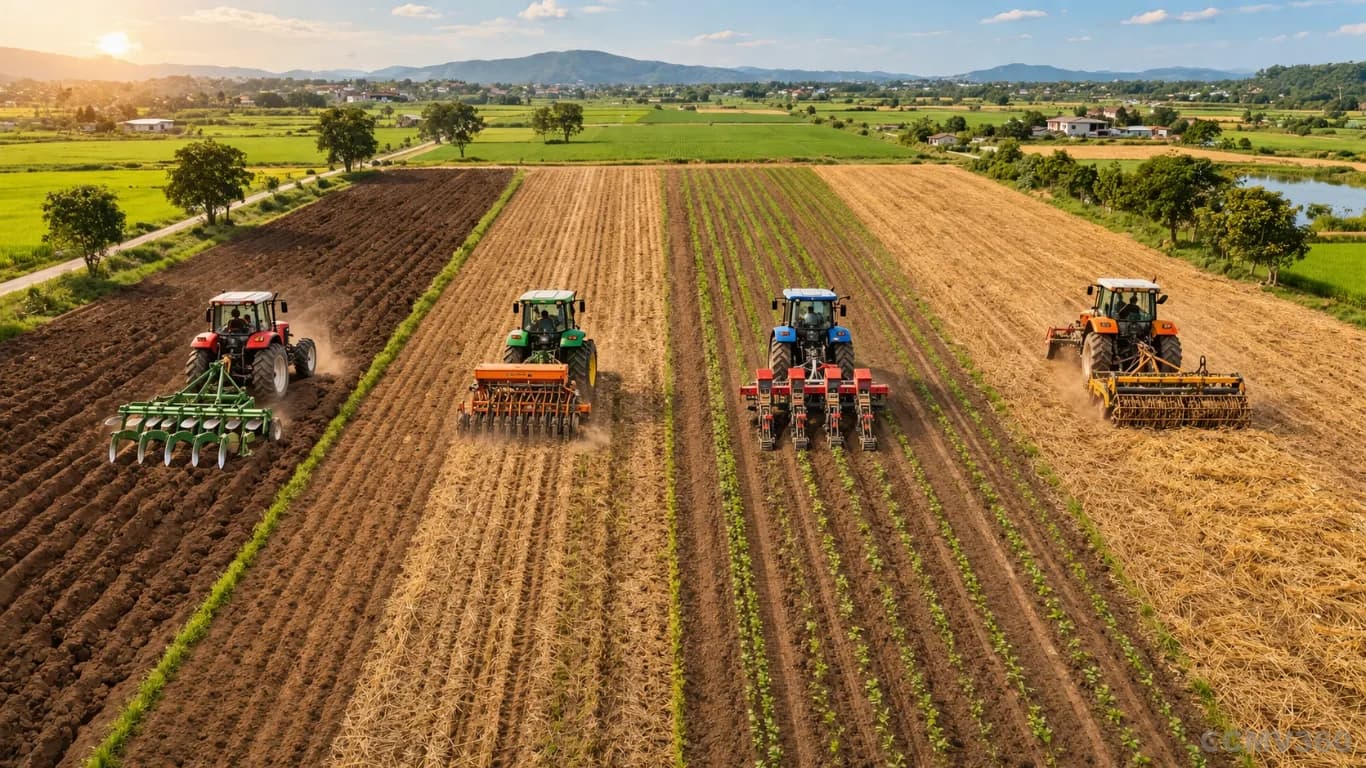
India’s farming system matches tillage types with crops and regions.
Crop | Best Tillage | Key States | Reason |
Wheat | Zero Tillage | Punjab, Haryana | Timely sowing, residue use |
Rice | Conventional | UP, Bihar | Weed control |
Pigeonpea | Deep Tillage | MP, Karnataka | Root growth |
Sugarcane | Subsoiling | Maharashtra | Breaks compaction |
Cotton | Strip/Ridge | Gujarat | Moisture retention |
Used for:
Rice and maize in Uttar Pradesh and Bihar
Sugarcane and cotton in Maharashtra and Tamil Nadu
Pulses in Karnataka and Madhya Pradesh
Wheat after rice in Punjab, Haryana, Western UP
Direct-seeded rice (DSR) gaining popularity
Rabi crops in Rajasthan and Gujarat
Dryland farming in Andhra Pradesh and Telangana
Groundnut and millets in Tamil Nadu and Karnataka
Vegetables in hilly regions like Himachal Pradesh
DSR is transforming farming in Punjab and Haryana.
Key Benefits:
Saves 30% water
Reduces labor cost by ₹3,000/ha
Cuts methane emissions by 16.6%
Yields: 3.15 t/ha vs 2.99 t/ha
Early maturity (10–15 days)
It also helps reduce stubble burning by enabling timely wheat sowing.
Adoption has reached 18% (5.62 lakh hectares) in Punjab.
Deep tillage benefits crops with strong root systems.
Suitable Crops & States:
Pigeonpea – MP, Karnataka
Sugarcane – Maharashtra
Castor & Sorghum – Andhra Pradesh, Telangana
It improves nutrient access and root penetration significantly.
The Indian government is actively promoting conservation tillage.
National Mission on Natural Farming
₹2,481 crore allocation
₹4,000/acre/year support
Punjab DSR Incentive
₹1,500/acre
PM-PRANAM Scheme
50% savings reinvested in equipment
These initiatives are helping farmers transition toward sustainable practices.
Zero tillage covers over 1.76 million hectares
Saves around $100/ha
Improves sowing time and soil structure
Conventional tillage, though still used, may lead to long-term soil hardening.
Despite benefits, conservation tillage faces hurdles:
Key Issues:
Small landholdings
Lack of access to machinery
Crop residue competition (fodder use)
Weed and pest management challenges
Initial yield fluctuations
In dryland areas (68% of arable land), challenges are even higher due to water scarcity and poor soil fertility.
Practice | Advantage | Challenge | Adoption |
DSR | Water saving | Weed control | 18% Punjab |
Deep Tillage | Better roots | High cost | Rainfed areas |
Zero Tillage | Cost saving | Residue management | Growing fast |
Reduced Tillage | Soil health | Yield risk | Limited |
Also Read: Tractor Loan in 2026 - Interest Rates, Banks & How to Get Approval Fast
India’s tillage story in 2026 is not about replacing one system with another-it’s about finding the right balance. Conventional tillage continues to play a role in initial soil preparation and specific crops, while conservation practices are proving their worth in reducing costs and improving sustainability.
The future lies in integrated tillage systems, supported by modern machinery, government policies, and farmer awareness.
As agriculture moves toward precision and sustainability, the real winners will be those farmers who adapt early, choose wisely, and invest in the right tools and practices.
So, the real question remains-will Indian farmers fully embrace conservation tillage, or will conventional methods continue to dominate the fields?

About the author
Robin Kumar Attri is a content and video professional with 2.7 years of experience in the commercial vehicle domain. At CMV360, he creates news articles and videos covering trucks, tractors, buses, three-wheelers, and infrastructure machines.


 Add CMV360 on Google