Organic Farming vs Conventional Farming: Which Method Can Earn Indian Farmers More Profit in 2026?
 Add CMV360 on Google
Compare organic farming and conventional farming in India. Learn differences, benefits, costs, profitability, soil health, yields, government support, and discover which farming method best suits your agricultural goals.

By Robin Kumar Attri

Indian agriculture is undergoing a major transformation. Rising input costs, changing weather patterns, increasing demand for chemical-free food, and growing awareness about sustainable farming have encouraged farmers to rethink traditional cultivation methods. While conventional farming has been the backbone of India's food production for decades, organic farming is steadily gaining attention for its long-term environmental and economic benefits.
Today, farmers across the country are asking an important question: Organic farming vs conventional farming-which farming method is better? The answer is not as straightforward as choosing one over the other. Both systems have their own strengths, limitations, and ideal use cases depending on the crop, region, market access, and farm management practices.
Organic farming has become a preferred choice for farmers looking to improve soil health, reduce dependence on synthetic chemicals, and target premium markets. On the other hand, conventional farming continues to dominate Indian agriculture because of its ability to deliver higher short-term productivity, easier nutrient management, and well-established market infrastructure.
Government initiatives such as Paramparagat Krishi Vikas Yojana (PKVY) and Mission Organic Value Chain Development for North East Region (MOVCD-NER) are promoting organic cultivation, while conventional farming continues to benefit from advanced machinery, high-yield seed varieties, chemical fertilizers, and modern irrigation technologies.
So, which farming method offers better profitability, healthier soil, sustainable production, and long-term success for Indian farmers? Let's compare both systems in detail and understand which approach is better suited to different farming needs.
What is Organic Farming?
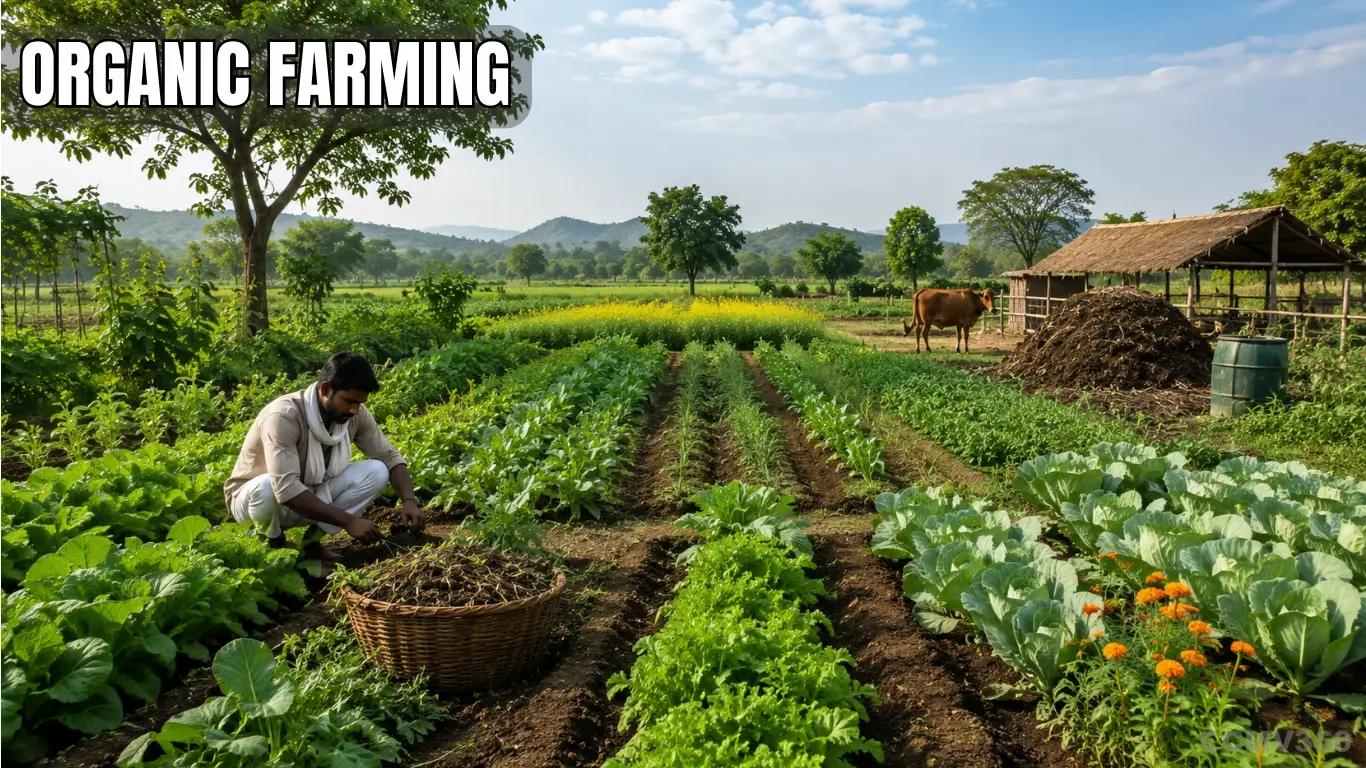
Organic farming is a holistic agricultural system that avoids the use of synthetic fertilizers, chemical pesticides, and genetically modified inputs. Instead, it focuses on maintaining soil fertility and ecological balance through natural resources and biological processes.
Rather than simply being "chemical-free farming," organic farming works as a complete ecosystem where soil microorganisms, crop diversity, livestock, and natural nutrient cycles play an important role in maintaining productivity.
Farmers practicing organic farming commonly rely on:
Compost and farmyard manure
Crop residues
Green manuring
Legume-based crop rotations
Bio-fertilizers and bio-pesticides
Biological pest management
Natural weed control methods
The primary objective is to create a self-sustaining farming system that improves soil fertility while minimizing environmental damage.
What is Conventional Farming?
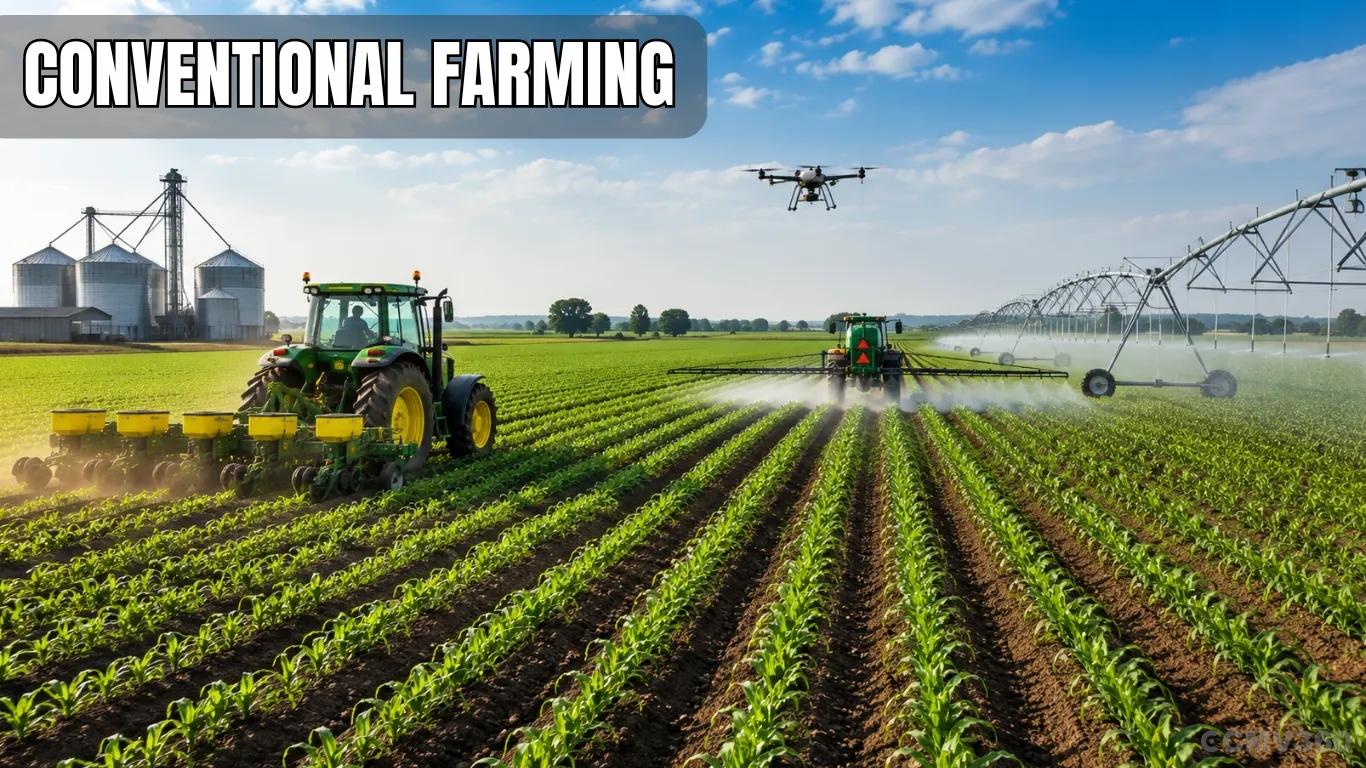
Conventional farming is the most widely adopted agricultural system in India and across the world. It depends heavily on synthetic fertilizers, chemical pesticides, hybrid or high-yielding seed varieties, mechanization, and advanced irrigation practices to maximize crop production.
Its primary goal is to achieve higher yields within a shorter period while simplifying nutrient and pest management.
Modern conventional farming typically includes:
Chemical fertilizers
Synthetic pesticides and herbicides
High-yielding seed varieties
Farm mechanization
Precision farming technologies
Modern irrigation systems
Because of its higher productivity and easier management, conventional farming remains the preferred option for commercial and large-scale agriculture.
Organic Farming in India: Current Scenario
Although awareness is increasing, organic farming still occupies a relatively small share of India's agricultural land.
According to government data synthesized by the Council on Energy, Environment and Water (CEEW), India had approximately 2.78 million hectares under certified organic farming as of March 2020. This accounts for nearly 2% of the country's net sown area.
In addition, nearly 1.49 million hectares were designated as wild-harvest areas under the National Programme for Organic Production (NPOP).
India also had more than 1.9 million registered organic farmers, making it one of the world's largest producers in terms of farmer participation.
Organic farming is now practiced across almost every Indian state, while Sikkim became the country's first 100% organic state in 2016.
Government Support for Organic Farming
Recognizing the growing importance of sustainable agriculture, the Government of India has introduced several schemes to promote organic farming.
The two major initiatives include:
Paramparagat Krishi Vikas Yojana (PKVY): Supports cluster-based organic farming and Participatory Guarantee System (PGS) certification.
Mission Organic Value Chain Development for North East Region (MOVCD-NER): Focuses on developing certified organic value chains across northeastern states.
Organic farming also receives support under:
Rashtriya Krishi Vikas Yojana (RKVY)
Mission for Integrated Development of Horticulture (MIDH)
ICAR's All India Network Programme on Organic Farming
Certification is mainly carried out through:
Participatory Guarantee System (PGS)
Third-party certification under APEDA's National Programme for Organic Production (NPOP)
Organic Farming vs Conventional Farming: Key Differences
Feature | Organic Farming | Conventional Farming |
Fertilizers | Compost, manure, green manure, bio-inputs | Chemical fertilizers |
Pest Control | Biological and natural methods | Chemical pesticides |
Soil Health | Improves gradually | Can decline if chemicals are overused |
Initial Yield | Usually lower during transition | Generally higher |
Long-Term Yield | Can become comparable in many crops | Depends on continuous input use |
Biodiversity | Higher | Lower |
Certification | Required for premium markets | Not required |
Labour Requirement | Higher | Lower |
Environmental Impact | Eco-friendly | Greater pollution risk if mismanaged |
Market Value | Premium pricing possible | Standard market prices |
Soil Health: One of the Biggest Differences
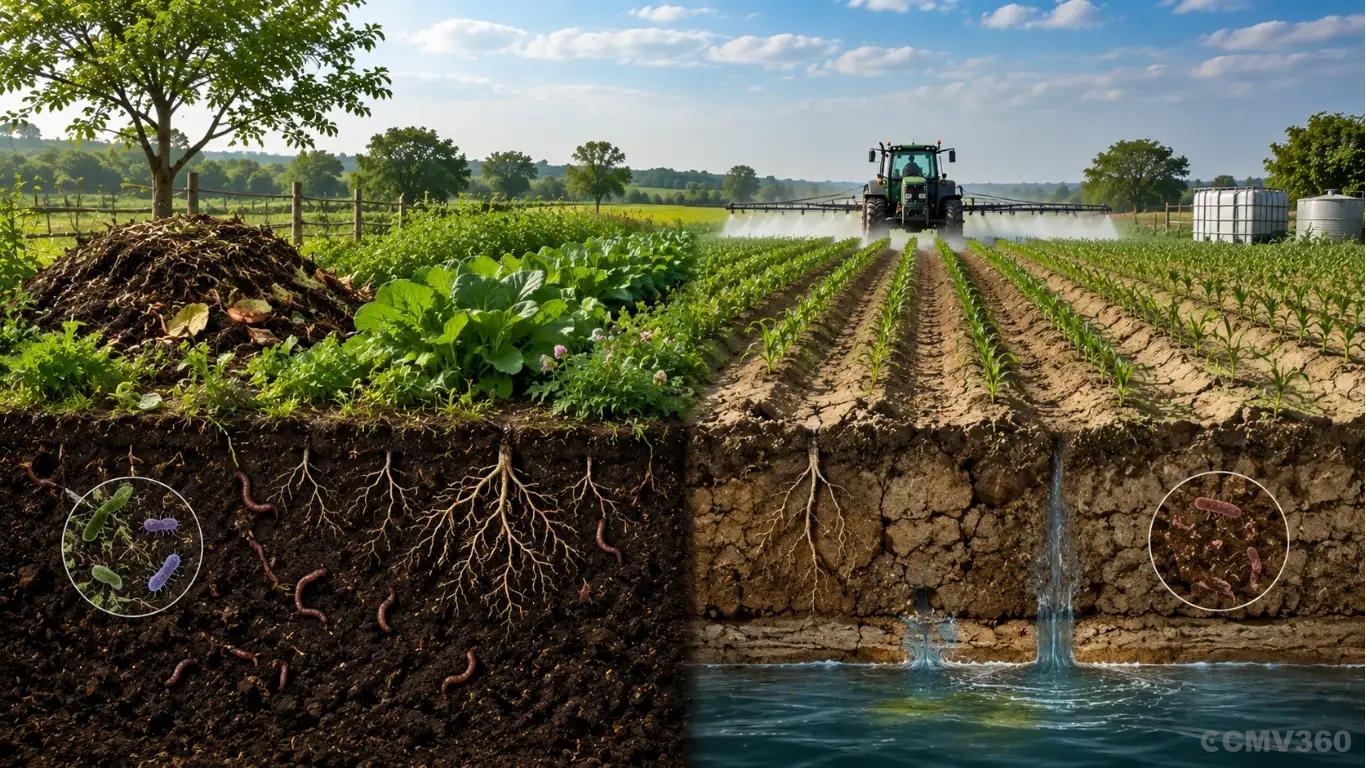
One of organic farming's biggest strengths lies beneath the surface-the soil.
By regularly adding compost, crop residues, legumes, and organic matter, farmers improve soil organic carbon, soil structure, microbial activity, and nutrient cycling. Better soil health also enhances water retention and supports long-term productivity.
Organic farming also helps reduce soil erosion and nutrient runoff because conservation practices maintain better ground cover.
Conventional farming, while highly productive, depends largely on synthetic fertilizers. If used responsibly, these inputs can support good crop production. However, excessive or unbalanced chemical application over long periods may reduce soil quality, increase nutrient runoff, and create environmental concerns.
Yield Comparison: Does Organic Farming Produce Less?
Yield is often the biggest concern for farmers considering organic farming.
Research indicates that organic yields generally decline during the first two to three years after farmers shift away from conventional methods. This transition period occurs because the soil ecosystem requires time to recover and rebuild biological activity.
However, long-term studies suggest the picture is more balanced.
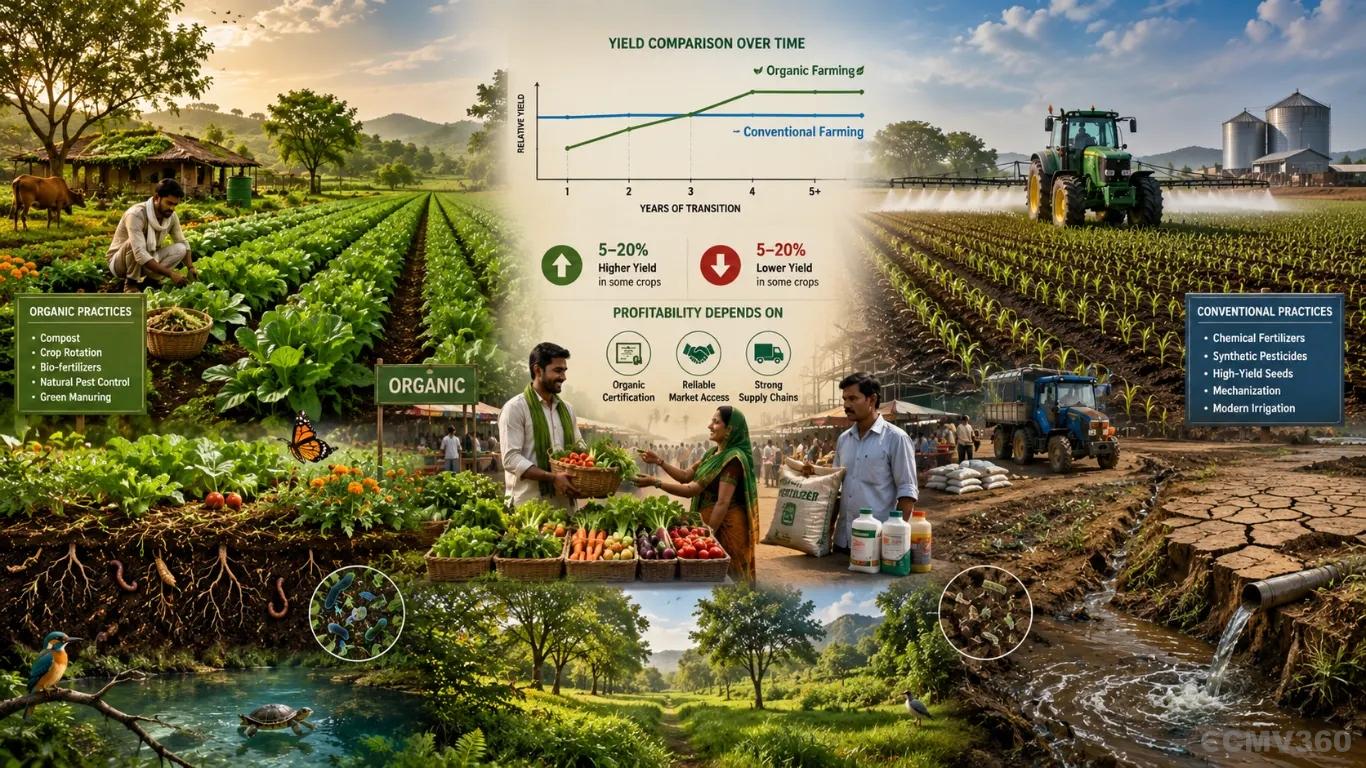
An ICAR study highlighted by CEEW found that:
Some crops recorded 5-20% higher yields under organic farming.
Other crops experienced 5-20% lower yields.
This clearly shows that yield performance depends on crop type, location, soil quality, and management practices rather than farming method alone.
Profitability: Which Farming Method Earns More?
Higher production does not always translate into higher profits.
Organic farming offers the possibility of premium prices because consumers increasingly prefer chemical-free food. However, these higher returns are only possible when farmers have:
Organic certification
Reliable market access
Strong supply chains
Without these factors, farmers may struggle to recover the additional labour and certification costs.
Conventional farming generally provides more stable marketing opportunities because existing agricultural markets are designed around conventional produce. However, rising fertilizer and pesticide prices continue to increase production costs.
Ultimately, profitability depends on both production efficiency and market access rather than farming method alone.
Environmental Impact
Organic farming offers several environmental advantages.
By avoiding synthetic fertilizers and pesticides, it helps reduce water contamination, lowers fertilizer-related emissions, and supports healthier ecosystems. Improved soil management may also contribute to carbon sequestration, although more long-term Indian research is needed to measure these benefits accurately.
Government-supported organic farming resources also indicate that organically managed farms can support approximately 30% more wildlife and plant diversity than conventional systems.
Conventional farming remains highly efficient for food production, but excessive chemical use can contribute to pollution, biodiversity loss, and long-term environmental degradation if not managed carefully.
Advantages of Organic Farming
Organic farming provides several long-term benefits beyond crop production.
Key Benefits
Improves soil fertility naturally.
Enhances microbial activity.
Supports biodiversity.
Reduces environmental pollution.
Lowers dependence on synthetic chemicals.
Can fetch premium market prices.
Promotes long-term agricultural sustainability.
Improves water retention and soil structure.
Advantages of Conventional Farming
Despite growing interest in organic agriculture, conventional farming continues to offer significant practical advantages.
Key Benefits
Higher crop productivity.
Faster nutrient availability.
Better pest control through chemical protection.
Easier large-scale farm management.
Greater mechanization.
Well-developed marketing infrastructure.
Lower transition complexity.
Suitable for commercial farming operations.
Challenges Farmers Should Consider
Organic Farming Challenges
Organic farming requires greater patience and planning.
Some of the biggest challenges include:
Lower yields during transition.
Labour-intensive farming.
Certification expenses.
Limited availability of quality organic inputs.
Market linkage challenges.
Longer learning curve.
Conventional Farming Challenges
Conventional farming also has its own limitations.
Major concerns include:
High dependence on chemical inputs.
Increasing fertilizer and pesticide costs.
Soil degradation from excessive chemical use.
Environmental pollution.
Nutrient runoff into water bodies.
Long-term sustainability concerns.
India's Strength in Organic Farming
Organic farming is particularly suitable for:
Rainfed farming regions
Hilly areas
Low-input agricultural systems
Diversified cropping systems
Farms with livestock integration
India also holds a significant position globally in organic cotton production. According to CEEW, the country contributed nearly 51% of global organic cotton production during 2018-19, demonstrating its strong potential in selected crops and regions.
Which Farming Method is Better?
There is no universal answer because both farming systems serve different objectives.
Farmers looking for maximum short-term productivity, quicker returns, and easier farm management may find conventional farming more practical, especially for large commercial operations.
On the other hand, farmers aiming to improve soil health, reduce chemical dependence, access premium markets, and adopt sustainable agriculture may benefit more from organic farming, provided they have proper certification and market support.
Many progressive farmers are now adopting an integrated approach, combining the strengths of both systems. By using organic inputs to improve soil health while applying modern technologies and balanced nutrient management where necessary, they can achieve better productivity along with improved environmental sustainability.
CMV360 Says
The debate around organic farming vs conventional farming is not about declaring one system superior to the other. Instead, it is about selecting the farming method that best matches a farmer's land, crops, resources, market opportunities, and long-term goals.
Organic farming offers healthier soils, greater biodiversity, and premium market potential but demands patience, careful management, and reliable certification. Conventional farming continues to deliver higher short-term productivity and operational simplicity, making it indispensable for large-scale food production.
As Indian agriculture evolves, the future is likely to be shaped not by choosing one system over the other, but by adopting smarter, balanced farming practices that combine productivity with sustainability. Farmers who make informed decisions based on local conditions, scientific recommendations, and market demand will be better positioned for long-term success in an increasingly competitive agricultural landscape.

Robin Kumar Attri is a content and video professional with 2.7 years of experience in the commercial vehicle d .....