Electric Truck Battery Degradation: How Much Range Can You Lose Over Time?
 Add CMV360 on Google
Learn how electric truck battery degradation affects range, charging, warranties and operating costs, with practical insights for Indian fleet owners and real-world conditions.

By Robin Kumar Attri

Electric trucks are moving from pilot projects to real-world freight operations in India, making battery life and range retention increasingly important for fleet owners. Unlike diesel trucks, where engine wear is usually easier to understand, an electric truck's most expensive component is its battery pack. Its gradual loss of usable capacity can affect range, route planning, resale value and long-term operating costs.
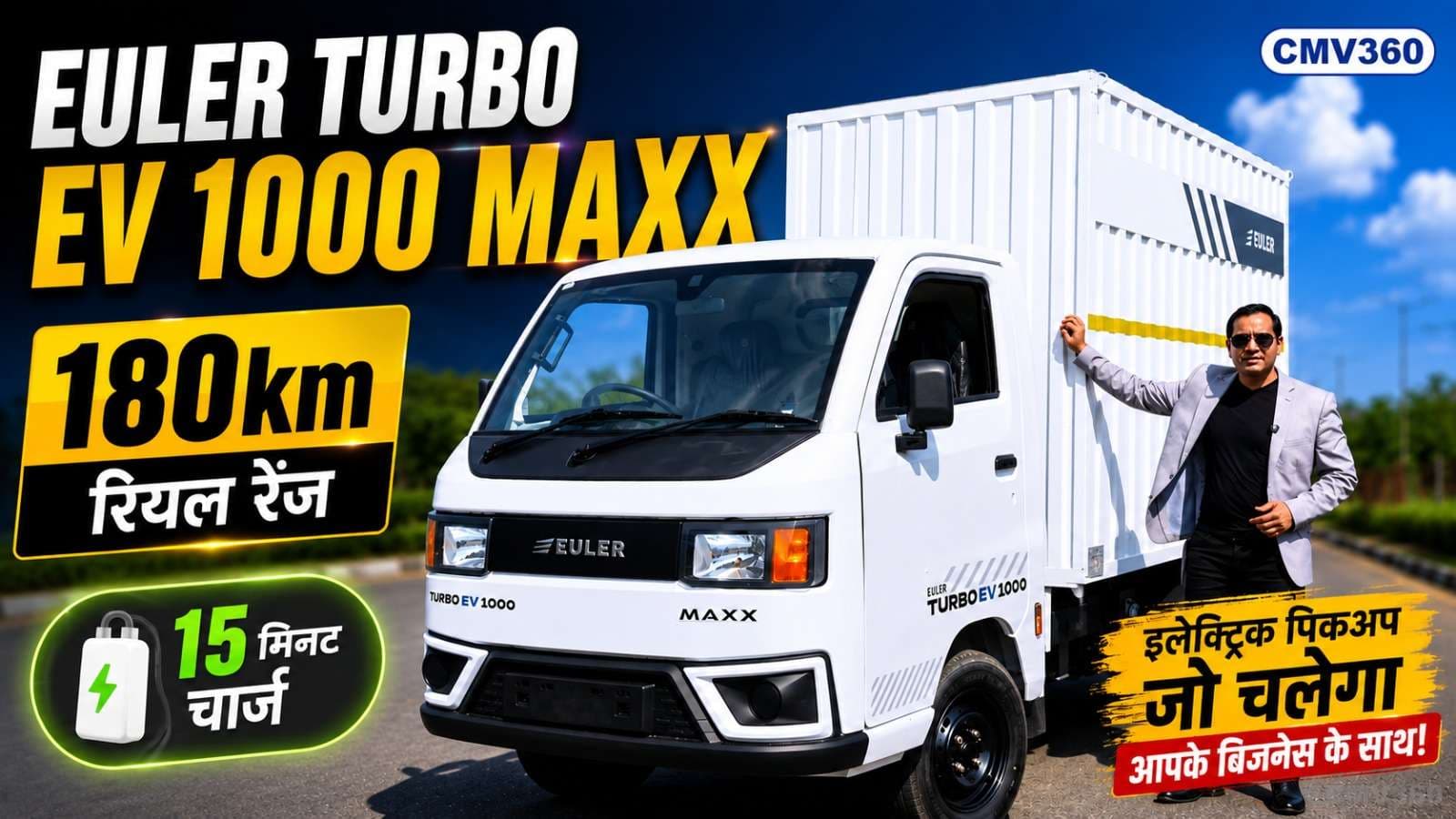
Modern electric commercial vehicles from brands such as Tata Motors, Mahindra, Eicher, Montra Electric and Ashok Leyland are bringing different battery sizes, range claims and warranty packages to the market. Small electric trucks such as the Tata Ace EV 1000 and Mahindra ZEO are focused on urban deliveries, while vehicles such as the Ashok Leyland BOSS EV and Tata Prima E.55S target heavier applications.
But how much range can an electric truck actually lose after five, seven or eight years, and what can fleet operators do to slow that decline?
What Is Battery Degradation in an Electric Truck?
Battery degradation means the permanent reduction in the usable energy capacity of the battery over time. It is commonly expressed through State of Health (SoH).
For example, a battery operating at 90% SoH has approximately 90% of its original usable capacity remaining. If all other conditions remain the same, its theoretical range would also be around 90% of its original range. So, a truck that initially delivers 160 km could theoretically provide about 144 km at 90% SoH.
However, the range displayed on the dashboard should not be treated as a direct battery-health measurement. Payload, speed, traffic, gradients, tyre pressure, air-conditioning use and ambient temperature can reduce range temporarily even when the battery itself is healthy.
Battery ageing mainly comes from two sources:
Calendar ageing: Battery capacity declines with time, even when the truck is parked. High temperatures and prolonged periods at very high charge levels can accelerate it.
Cycle ageing: Repeated charging and discharging gradually reduce capacity. High energy usage, deep cycling, high charging power and heat can increase the effect.
How Much Range Can an Electric Truck Lose?
The most useful large-scale real-world benchmark comes from Geotab's EV battery analysis. Its latest dataset covers more than 22,700 vehicles across 21 models and reports average degradation of around 2.3% per year. Lower-power charging users recorded around 1.5% annual degradation, while vehicles frequently using high-power DC fast charging above 100 kW reached around 3% annually.
These figures are predominantly from light-duty EVs, so they should be treated as a planning benchmark rather than a guaranteed degradation curve for heavy trucks.
Operating pattern | Indicative annual capacity loss | Approx. SoH after 5 years | Approx. SoH after 7 years |
Managed depot/lower-power charging | 1.5% | 92.5% | 89.5% |
Broad fleet-average case | 2.3% | 88.5% | 83.9% |
High-power DC charging/high thermal stress | 3.0% | 85% | 79% |
Actual battery ageing is not perfectly linear. Some batteries lose capacity faster during their early years before the degradation curve becomes more stable.
For a 160 km electric truck, a simplified planning calculation could mean around 142 km after five years at 2.3% annual degradation, or approximately 134 km after seven years. Under a harsher 3% annual case, the corresponding figures could be around 136 km and 126 km.
These are planning estimates, not guaranteed outcomes.
Why Indian Conditions Matter
India presents some specific challenges for electric truck batteries. High ambient temperatures, heavy payloads, long operating hours and increasing use of DC fast charging can put additional thermal and cycling stress on the battery.
Geotab's analysis found that vehicles operating in hotter climates experienced approximately 0.4 percentage points more annual degradation than those in milder conditions. Its data also identified frequent high-power DC charging as the biggest controllable degradation factor. This makes battery thermal management particularly important for Indian trucks.
The major factors affecting battery life include:
High temperatures: Heat accelerates chemical ageing inside lithium-ion cells.
Frequent fast charging: High charging power can increase battery temperature and electrochemical stress.
Long periods at 100% charge: High cell voltage can accelerate calendar ageing.
Repeated near-zero charge: Deep cycling adds stress and leaves little operating reserve.
Heavy payloads and gradients: They increase energy consumption and battery workload.
Poor tyre pressure or alignment: These may not damage the battery directly but increase kWh/km and appear as range loss.
Poor cooling or BMS performance: Thermal-management or battery-management problems can cause abnormal degradation.
For fleet operators, depot-based charging is therefore generally preferable for routine overnight operation, while fast charging should be used where turnaround requirements genuinely demand it.
LFP vs NMC: Does Battery Chemistry Matter?
Battery chemistry also influences durability. LFP (lithium iron phosphate) is increasingly common in Indian commercial EVs because of its thermal stability, cycle-life characteristics and relatively lower cost. It is used in vehicles such as the Tata Ace EV 1000.
NMC (nickel manganese cobalt) generally offers higher energy density, which can help with range and packaging, although thermal management and charging controls remain critical.
However, chemistry alone does not determine battery life. Cell quality, cooling architecture, BMS calibration, usable SoC buffer, charging controls and service support can be equally important.
Electric Truck Models and Battery Warranty
The Indian market already offers electric commercial vehicles across different payload categories. Their range and warranty figures also show why buyers should examine the complete warranty document rather than comparing only battery capacity.
Model | Battery | Published range | Reported battery warranty |
Tata Ace EV 1000 | 21.3 kWh LFP | 161 km certified | 7 years/175,000 km |
Mahindra ZEO | 21.3 kWh | 160 km stated real-world | 7 years/150,000 km |
Eicher Pro X 3.5T | 32/40 kWh | 206/249 km certified | 5 years/150,000 km |
Montra EVIATOR 350 | 32 kWh | Up to 140 km | 5 years/200,000 km |
50 kWh | 200+ km stated real-world | 5 years/175,000 km | |
201.5 kWh | 230 km | Verify model-specific terms | |
201.5 kWh | 194 km | Verify model-specific terms |
Range figures can vary considerably with payload, body configuration, route and testing method. For example, a manufacturer's claimed range and an aggregator's figure may differ, so fleet operators should conduct route trials before finalising a purchase.
Why Heavy Electric Trucks Are Different
One of the biggest limitations in current battery-degradation research is the lack of long-term heavy-truck data. Most large datasets are based on passenger cars and light commercial vehicles. Heavy trucks operate under substantially different conditions, including higher payloads, longer daily operating hours, steep gradients and high energy throughput. This is particularly important in India, where large electric trucks are still relatively young in the market.
As a global benchmark, the Mercedes-Benz eActros 600 uses a 621 kWh LFP battery and has been engineered for up to 1.2 million km over 10 years while retaining more than 80% battery SoH. Its reported launch warranty, however, was 72 months, 720,000 km or 1,800 charging cycles, whichever came first.
This highlights an important distinction: engineering targets and contractual warranties are not necessarily the same thing.
What Should Fleet Owners Check Before Buying?
Battery warranty terms can be more important than headline range.
Before purchasing an electric truck, fleet operators should check:
Battery warranty period and kilometre limit
Minimum SoH threshold for warranty action
Whether the limit is years, kilometres or charging cycles
How battery SoH is measured
Whether the remedy is cell, module or complete-pack replacement
Fast-charging and charging-equipment exclusions
Thermal or water-ingress exclusions
BMS and telematics requirements
Battery warranty transferability during resale
Expected downtime during battery repair
For fleet management, it is also useful to record battery SoH, kWh/km, charging history, payload, route and ambient temperature from the beginning.
How to Reduce Electric Truck Battery Degradation
The most effective strategy is not complicated. It is disciplined operation.
Use depot charging wherever possible and reserve high-power DC charging for operational requirements.
Avoid keeping the battery at 100% for long periods when the truck does not need a full charge.
Do not routinely operate near zero charge.
Protect the truck from excessive heat, using covered or shaded parking where possible.
Maintain the battery cooling system and BMS.
Maintain correct tyre pressure and wheel alignment to reduce energy consumption.
Avoid unnecessary overloading, which increases energy demand and thermal stress.
Monitor actual kWh/km, rather than relying only on the dashboard range estimate.
Get periodic OEM battery-health reports, especially before warranty expiry.
Plan routes with ageing in mind, rather than assuming the original range will remain available throughout the vehicle's life.
Plan for Battery Ageing, Not Just Day-One Range
For a fleet truck, the important question is not simply how far it travels when new. It is whether it can still complete its commercial route several years later.
A practical planning allowance for modern electric trucks is around 1.5% to 2.3% annual battery-capacity loss, with approximately 3% per year representing a more conservative scenario for vehicles exposed to frequent high-power DC charging and high thermal stress.
That means a truck advertised at 160 km should not necessarily be assigned a 155-160 km route throughout its life. Payload, weather, traffic and battery ageing all need to be considered together.
Also Read: AdBlue for Trucks Explained: How It Works, Consumption, Warnings and What Happens When It Runs Out
CMV360 Says
Battery degradation is a normal part of electric-truck ownership, but it does not mean the battery suddenly becomes unusable after a few years. For a well-managed LFP-powered truck, the loss is generally gradual and can be managed through sensible charging, thermal control, payload discipline and route planning.
The bigger challenge for India is the limited amount of long-term, real-world heavy-truck battery data. Therefore, fleet buyers should focus on measurable factors such as battery SoH, actual kWh/km, cooling technology, charging behaviour and, most importantly, the manufacturer's written battery warranty.
For an electric truck, range on day one matters, but range retention over the vehicle's working life matters even more.

Robin Kumar Attri is a content and video professional with 2.7 years of experience in the commercial vehicle d .....