Tractors
Trucks
- Find by Budget
- Find by Type

English
 New Delhi
Government confirms E20 fuel causes negligible performance drop, offers efficiency gains, durability, and environmental benefits, ensuring a sustainable future for India’s commercial vehicle sector.

By Robin Kumar Attri
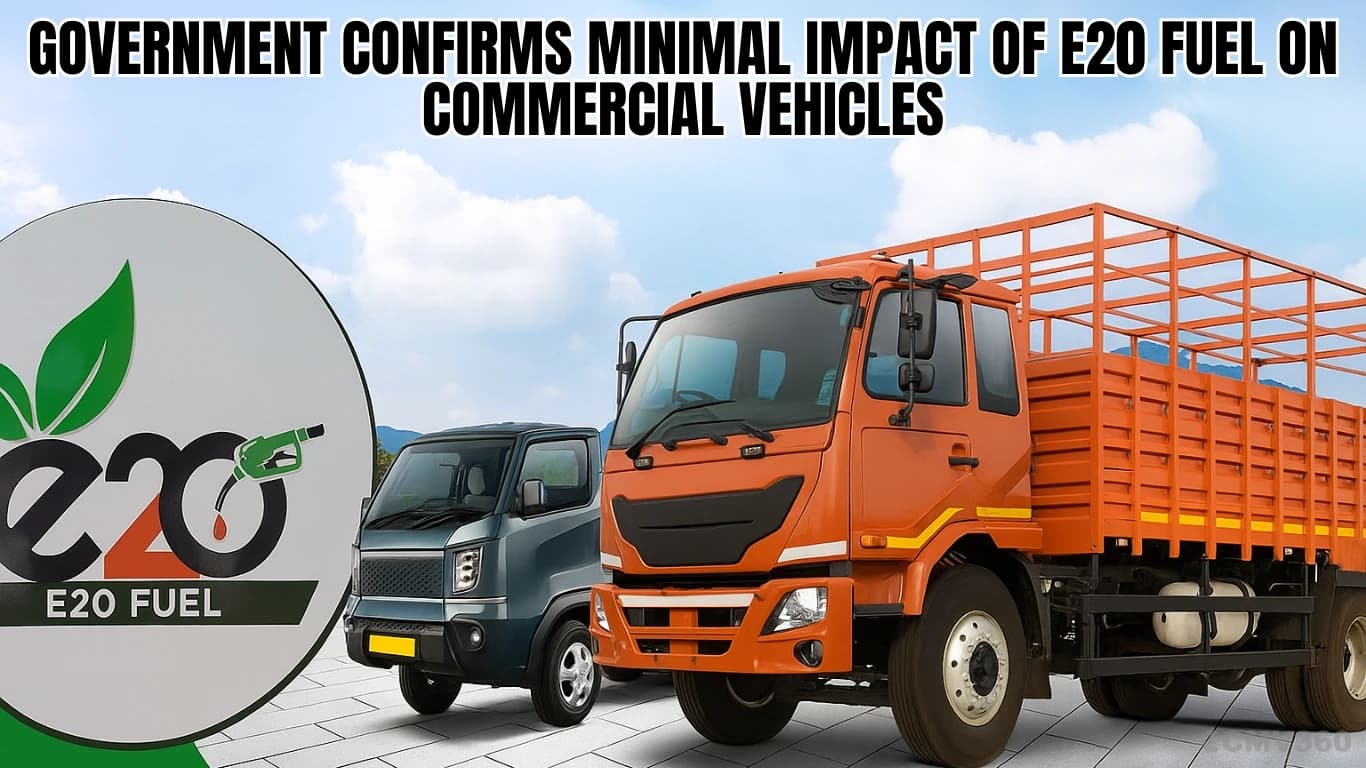
Minimal performance impact confirmed in tests.
Only 2–3% mileage drop in older engines.
Maintenance affects efficiency more than fuel blend.
Modern vehicles have corrosion-resistant components.
Supports energy security and reduces emissions.
As India pushes forward with its ethanol-blending programme, the rollout of petrol containing 20% ethanol (E20) has raised questions in the commercial vehicle sector. Concerns about mileage drop, engine wear, and corrosion have now been addressed by the Ministry of Petroleum and Natural Gas.
According to the ministry, extensive discussions with the Society of Indian Automobile Manufacturers (SIAM) and leading Original Equipment Manufacturers (OEMs) show that many commercial vehicles have been E20-compatible since 2009. For these vehicles, any drop in fuel efficiency is negligible. Even in older E10-compatible models, the difference is minimal and barely noticeable in daily operations.
The ministry’s conclusions are based on both laboratory tests and on-road trials across different commercial vehicle types.
Minimal Performance Impact – Studies by ARAI, Indian Oil, and SIAM confirm no major wear or performance issues when using E20.
Slight Mileage Variation – Older engines tuned for E10 may see only a 2–3% mileage drop, which is minor under normal driving conditions.
Maintenance Matters More – Engine tuning, air filter condition, and tyre pressure influence mileage more than fuel blend changes.
Durable Components – Modern commercial vehicles use corrosion-resistant materials, minimising ethanol-related damage.
Economic & Environmental Gains – Lower crude oil imports, reduced emissions, and support for rural ethanol production.
The government highlighted that E20 fuel improves acceleration, ride quality, and reduces carbon emissions compared to E10. With a higher octane number of about 108.5, E20 supports high-compression commercial vehicle engines, reducing knocking and improving efficiency.
An increase in the Research Octane Number (RON) from 91 to 95 further boosts performance and engine life, particularly in heavy-duty applications.
Some fleet operators expressed worries about warranty claims and fuel system damage in older vehicles. The ministry clarified that E20 use does not affect insurance and that corrosion risks are limited to older models with uncoated metal fuel systems, usually after 8–10 years.
For such vehicles, regular servicing and replacing inexpensive parts like gaskets or rubber seals after 20,000–30,000 km of E20 use can prevent issues.
Rajnath Ram, Adviser (Energy) at NITI Aayog, said commercial vehicles tested on E20 showed no unusual wear even after 100,000 km. A senior ministry official added, “Ethanol blending is a national programme. Any claims of drastic mileage drops are misplaced. Our tests prove E20 is safe, efficient, and supports India’s energy security.”
With India aiming for wider E20 adoption, commercial fleet operators can expect better fuel performance, lower fuel import dependency, and compliance with future emission standards. While older fleets may need small adjustments, the long-term operational and environmental benefits make E20 a strong step towards sustainable freight and passenger transport.
Also Read: Tata Motors Expands into Dominican Republic with Equimax
The government’s findings confirm that E20 fuel has minimal impact on commercial vehicle performance, with only slight mileage variations in older models. Modern vehicles benefit from improved efficiency, durability, and reduced emissions. With proper maintenance, even older fleets can adapt, making E20 a practical step toward sustainable transport, energy security, and economic growth for India’s commercial vehicle sector.

About the author
Robin Kumar Attri is a content and video professional with 2.7 years of experience in the commercial vehicle domain. At CMV360, he creates news articles and videos covering trucks, tractors, buses, three-wheelers, and infrastructure machines.



 Add CMV360 on Google