Mobile Crane vs Tower Crane: Which Crane is Best for Your Construction Project?
 Add CMV360 on Google
Compare mobile cranes and tower cranes based on lifting capacity, height, cost, setup time, and applications. Discover which crane is best suited for your construction project.

By Robin Kumar Attri

The construction industry depends heavily on cranes for lifting, transporting, and positioning materials safely and efficiently. Whether it is a high-rise residential tower, a large commercial complex, a bridge project, or an industrial facility, choosing the right crane can significantly impact project timelines, operational efficiency, and overall costs.
Among the most widely used lifting solutions in the construction sector are mobile cranes and tower cranes. While both are designed to lift heavy loads, they serve very different purposes and are built for different types of projects.
A mobile crane is known for its flexibility, quick deployment, and ability to move easily from one location to another. These cranes are often preferred for short-term projects, infrastructure work, emergency lifting operations, and industrial applications where mobility is essential.
On the other hand, a tower crane is the backbone of modern skyscraper and high-rise construction. With exceptional lifting height, long reach, and the ability to operate continuously for months, tower cranes have become an indispensable part of large-scale construction projects worldwide.
Leading manufacturers such as ACE (Action Construction Equipment), Bronto Skylift, Liebherr, Potain, Terex, Tadano, and XCMG offer a wide range of tower and mobile cranes designed to meet different construction requirements.
But when it comes to choosing between a mobile crane and a tower crane, which one offers better value? Which crane is more suitable for your project? And most importantly, how do they compare in terms of mobility, lifting capacity, setup time, space requirements, and overall costs?
Let's explore the complete comparison.
What Is a Mobile Crane?
A mobile crane is a lifting machine mounted on a truck, crawler tracks, or specialized carriers, allowing it to move easily between different work locations. Unlike fixed cranes, mobile cranes can travel directly to a construction site and begin operations with minimal preparation.
Their biggest advantage is flexibility. Contractors can use the same crane across multiple projects, making mobile cranes a highly practical solution for dynamic construction environments.
Mobile cranes are commonly used for:
Lifting steel structures
Moving heavy machinery
Installing industrial equipment
Bridge construction and repair
Road and highway projects
Pipeline construction
Utility and power line work
Emergency lifting operations
Because of their mobility, these cranes are widely used where lifting requirements change frequently.
Major Types of Mobile Cranes
Mobile Crane Type | Key Application |
General construction and lifting | |
Rough Terrain Crane | Off-road construction sites |
All-Terrain Crane | Highway and rough terrain operations |
Crawler Crane | Heavy-duty lifting on challenging surfaces |
What Is a Tower Crane?
A tower crane is a fixed lifting machine installed on a concrete foundation. These cranes are specifically designed for large-scale and long-duration construction projects where materials need to be lifted to significant heights.
Unlike mobile cranes, tower cranes remain stationary throughout the project. Their design includes a vertical mast and a horizontal jib, enabling them to move materials across a large construction area with precision.
Tower cranes are especially valuable for projects where continuous vertical lifting is required.
Common applications include:
High-rise residential towers
Commercial skyscrapers
Mixed-use developments
Stadium construction
Large bridges
Industrial plants
Long-term infrastructure projects
The primary advantage of a tower crane is its ability to lift heavy loads at substantial heights while maintaining excellent stability and accuracy.
Mobile Crane vs Tower Crane: Quick Comparison
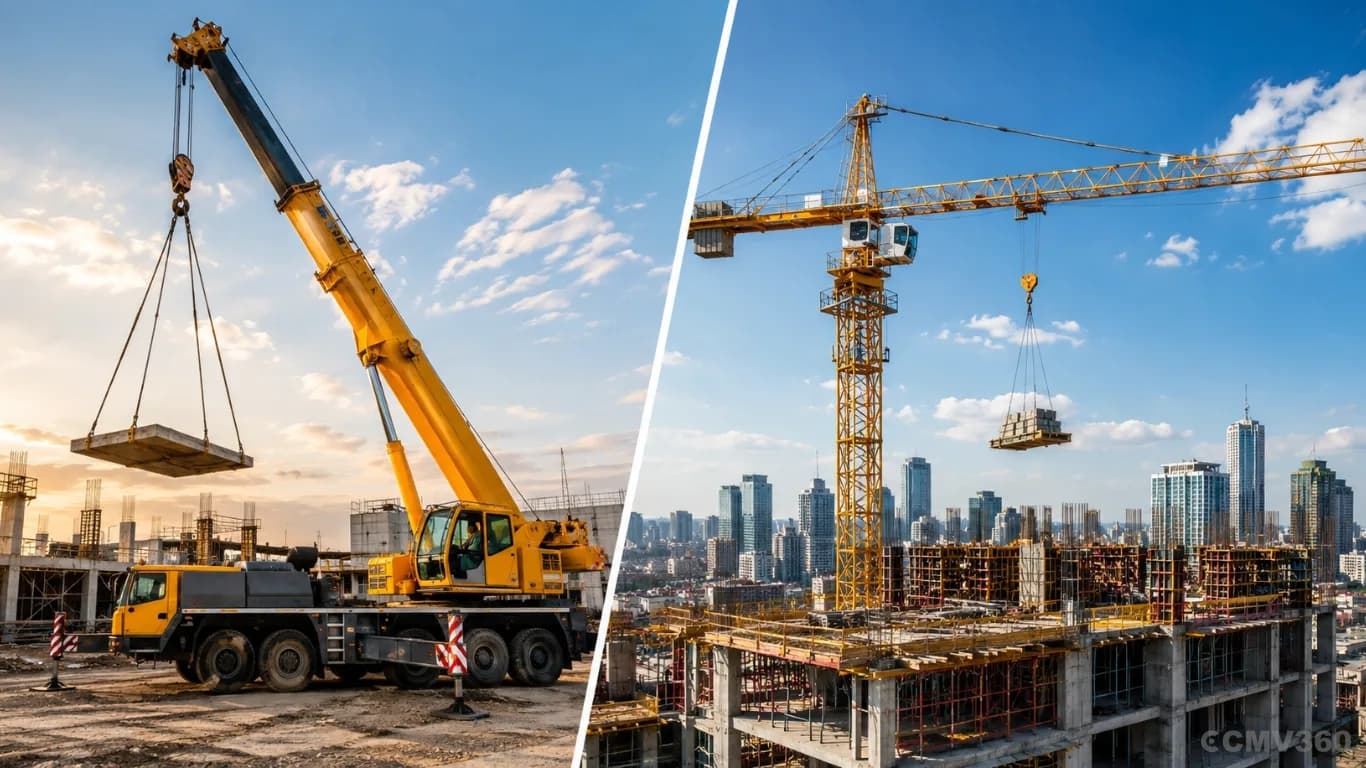
Before diving into the detailed comparison, here's a quick overview of the major differences.
Feature | Mobile Crane | Tower Crane |
Mobility | Highly mobile | Fixed position |
Setup Time | Minimal | Several days |
Installation | Not required | Requires concrete foundation |
Lifting Height | Moderate | Very high |
Reach | Limited | Extensive horizontal reach |
Project Duration | Short-term | Long-term |
Space Requirement | More ground space | Less ground space after installation |
Best For | Infrastructure and industrial projects | High-rise construction |
Relocation | Easy | Difficult and costly |
Operating Flexibility | High | Moderate |
Mobility and Setup: The Biggest Difference
One of the most important factors separating these two crane types is mobility.
A mobile crane arrives at the site ready for operation. Since it is mounted on a vehicle or tracks, contractors can deploy it quickly and start lifting almost immediately.
This saves significant time and reduces project delays.
For projects involving multiple locations, mobile cranes become even more beneficial because they can easily move between sites without requiring extensive dismantling.
Tower cranes, however, follow a completely different approach.
Before operations begin, a tower crane must be installed on a specially prepared concrete foundation. The erection process involves multiple components and often requires specialist teams and additional lifting equipment.
Depending on the project size, installation can take several days.
Once erected, the crane remains in one location until the project is completed.
Mobility Advantage
Winner: Mobile Crane
For projects requiring flexibility, quick deployment, and movement between locations, mobile cranes are clearly the better option.
Lifting Height and Reach
Height is where tower cranes truly dominate.
Modern tower cranes are engineered specifically for vertical construction. Their towering mast structures allow them to lift materials hundreds of meters above ground level.
For example, the ACE TC 7074 Tower Crane can reach lifting heights of up to 275 metres, making it suitable for multi-storey developments and skyscraper projects.
The long horizontal jib further enhances its capability by allowing materials to be moved across large sections of a construction site.
Mobile cranes are impressive in their own right but generally offer lower lifting heights.
A good example is the Bronto S62 MDT Mobile Crane, which provides a maximum working height of approximately 62 metres.
While this is more than sufficient for many construction and industrial applications, it is considerably lower than what tower cranes can achieve.
Height Advantage
Winner: Tower Crane
For high-rise construction and projects requiring exceptional vertical reach, tower cranes remain unmatched.
Lifting Capacity: Which Crane Can Lift More?
Lifting capacity is another crucial factor when selecting construction equipment.
Tower cranes are designed to handle substantial loads while working at great heights.
Models such as the ACE TC 7074 can lift up to 25 tonnes, making them highly effective for transporting construction materials to upper floors.
However, mobile cranes often outperform tower cranes when it comes to pure lifting power.
The Bronto S62 MDT, for instance, can lift up to 48 tonnes, making it one of the highest-capacity machines in its category.
This makes mobile cranes ideal for:
Heavy machinery installation
Industrial equipment handling
Cargo container unloading
Large structural component placement
Capacity Advantage
Winner: Mobile Crane
For lifting extremely heavy loads at moderate heights, mobile cranes often provide superior capacity.
Cost Comparison: Which Crane Offers Better Value?
Cost is usually one of the first considerations for contractors and project managers.
Tower Crane Pricing
Tower cranes generally cost between:
₹1 lakh to ₹81 lakh
However, the purchase price is only part of the overall investment.
Additional expenses include:
Foundation construction
Installation costs
Assembly labour
Dismantling charges
Transportation of components
These costs can significantly increase the total project expenditure.
Mobile Crane Pricing
Mobile cranes typically range between:
₹9 lakh and ₹71 lakh
Their lower setup requirements reduce overall ownership and operational costs.
Since contractors can bring mobile cranes only when needed, they avoid many of the fixed expenses associated with tower crane installation.
Cost Advantage
For short-duration projects, mobile cranes generally provide better value.
For long-term, high-rise developments, tower cranes often become more economical due to their productivity and continuous lifting capabilities.
Also Read: Can Electric and Hybrid Construction Equipment Replace Diesel Machines in India?
Space Requirements and Site Constraints
Construction sites often face space limitations, particularly in urban areas.
Mobile cranes require a larger operational footprint because they need sufficient ground space for positioning, stabilizers, and safe maneuvering.
This can create challenges on crowded construction sites.
Tower cranes offer a significant advantage here.
Although they require a concrete foundation, their footprint remains relatively small once installed.
Most of the crane's structure extends vertically, allowing valuable ground space to remain available for construction activities.
Space Advantage
Winner: Tower Crane
For city-based developments and high-rise projects with limited space, tower cranes are often the preferred choice.
When Should You Choose a Mobile Crane?
A mobile crane is usually the right choice when:
The project is short-term.
Equipment needs to move between sites.
Heavy machinery installation is required.
Quick setup is important.
Infrastructure projects are involved.
Emergency lifting operations are expected.
Budget constraints make tower crane installation impractical.
Ideal Mobile Crane Applications
Road construction
Pipeline projects
Bridge maintenance
Industrial facilities
Power plants
Equipment relocation
When Should You Choose a Tower Crane?
A tower crane becomes the better option when:
The project involves high-rise construction.
Long-term lifting operations are required.
Materials must be transported to great heights.
Ground space is limited.
Continuous lifting is needed throughout the project.
Large-scale commercial developments are being built.
Ideal Tower Crane Applications
Residential towers
Commercial skyscrapers
Stadiums
Mega infrastructure projects
Large mixed-use developments
Key Factors to Consider Before Making a Decision
Before selecting a crane, contractors should evaluate:
✔ Project duration
✔ Building height
✔ Lifting capacity requirements
✔ Site accessibility
✔ Ground conditions
✔ Available space
✔ Transportation requirements
✔ Installation budget
✔ Future project requirements
A careful assessment of these factors helps ensure the right investment and maximum productivity.
CMV360 Says
The choice between a mobile crane and a tower crane ultimately depends on the nature of the project.
Mobile cranes excel in flexibility, quick deployment, and heavy-load handling. Their ability to move between sites and begin work almost immediately makes them ideal for infrastructure, industrial, and short-term construction projects.
Tower cranes, meanwhile, remain the undisputed leaders in high-rise construction. Their superior lifting height, extensive reach, and efficient material handling capabilities make them essential for skyscrapers, commercial towers, and long-duration developments.
Rather than asking which crane is better, contractors should focus on which crane is better suited to their specific project requirements. Selecting the right equipment not only improves productivity but also reduces operational costs and ensures smoother project execution from start to finish.
As construction projects continue to grow in scale and complexity, both mobile cranes and tower cranes will remain critical machines powering the future of infrastructure development.

Robin Kumar Attri is a content and video professional with 2.7 years of experience in the commercial vehicle d .....