Top 10 Types of Farming Practiced in India 2026: Explained with Crops, Benefits and Schemes
 Add CMV360 on Google
Explore the top 10 types of farming in India with meaning, benefits, crops grown, modern methods, key factors, and government schemes supporting sustainable and profitable agriculture.

By Robin Kumar Attri

India is known as an agricultural nation, where farming forms the backbone of rural life and the economy. Nearly two-thirds of Indian farmers depend on agriculture for their livelihood. Due to India’s vast geography, diverse climates, varied soil types, distinct rainfall patterns, and varying socio-economic conditions, multiple types of farming have evolved in India over time.
From traditional subsistence farming, practised for centuries, to modern methods like vertical and greenhouse farming, Indian agriculture exhibits a perfect blend of tradition and innovation. Today, government schemes, subsidies, and yojanas play a crucial role in supporting Indian farmers and promoting sustainable and profitable farming practices.
This article provides a complete and detailed explanation of the top 10 types of farming in India, along with:
Benefits and uses
Crops grown
State-wise practices
Additional modern farming methods
Factors affecting agriculture
Government schemes and subsidies
What is Farming?
Farming is the systematic practice of growing crops and rearing animals to produce food, fodder, fiber, fuel, and raw materials. It is the foundation of Indian agriculture and ensures food security for the nation.
Major Objectives of Farming
Food production
Income generation for farmers
Supply of raw materials to industries
Employment generation
Rural development
Key Factors That Decide the Type of Farming
Factor | Importance |
Soil Fertility | Determines crop suitability |
Climate | Controls crop growth cycle |
Rainfall & Irrigation | Affects productivity |
Farm Size | Influences the scale of farming |
Technology | Improves yield and efficiency |
Market Demand | Decides crop choice |
Government Support | Encourages specific farming types |
Understanding these factors helps Indian farmers choose the right method of farming and increase their income.
Also Read: Top 10 Proven Methods to Boost Agricultural Productivity
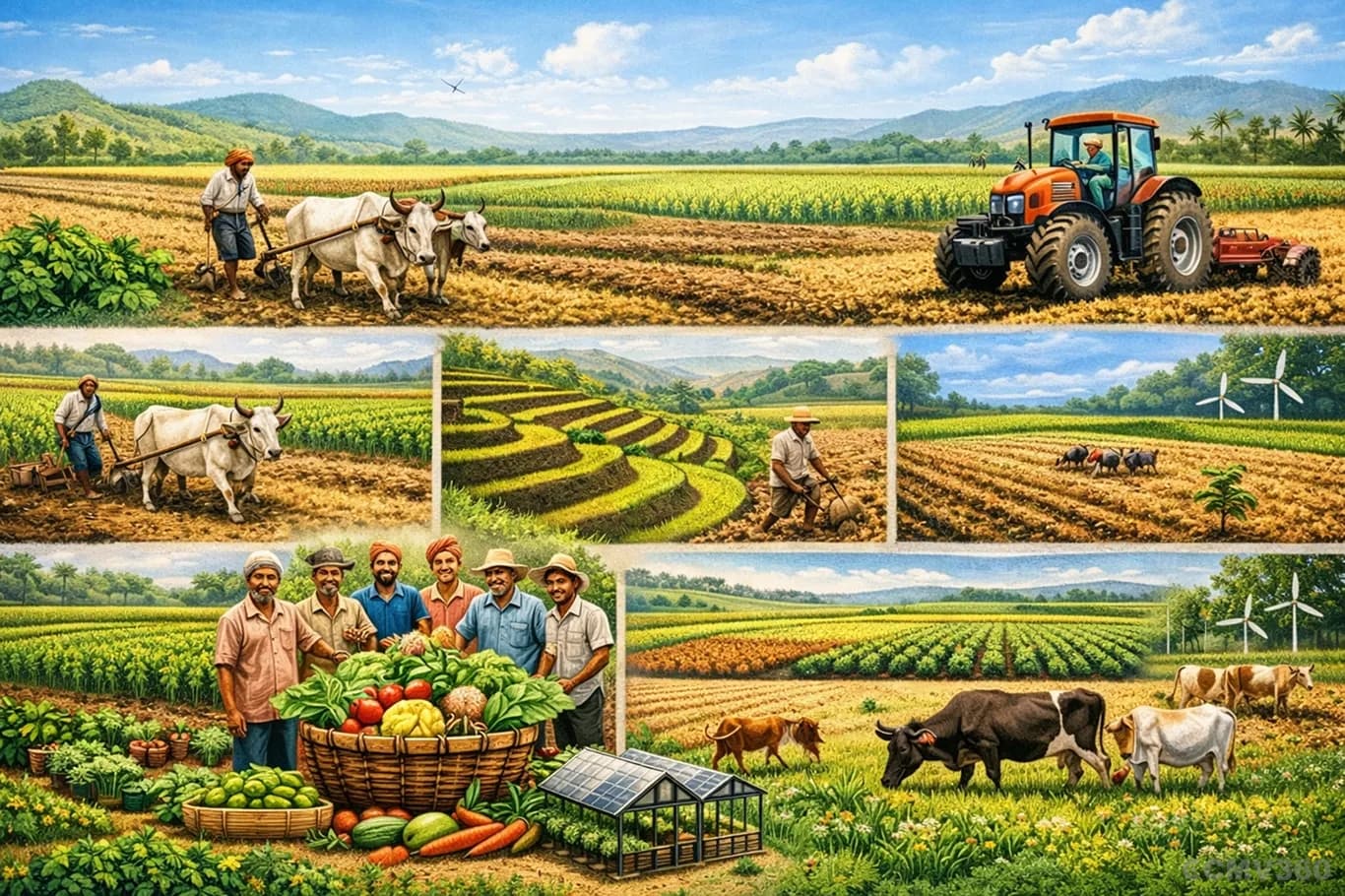
Top 10 Types of Farming in India
India practices different farming types based on purpose, land use, and production method. Below is a detailed explanation of the top 10 farming types in India.
1. Subsistence Farming
Subsistence farming is the most traditional type of farming in India. Farmers grow crops mainly to meet the food needs of their own families.
How It Is Done
Small land holdings
Traditional tools like ploughs and bullocks
Very little use of fertilizers or machines
Benefits
Low cost of cultivation
Ensures household food security
Suitable for poor and marginal farmers
Importance in India
Subsistence farming supports rural survival, especially in tribal and backward regions.
Crops Grown: Rice, wheat, maize, pulses
Major States: Jharkhand, Odisha, Chhattisgarh, Madhya Pradesh
2. Commercial Farming
Commercial farming focuses on producing crops for sale and profit. It is market-oriented and technology-driven.
How It Is Done
Large land areas
Modern machines and irrigation
HYV seeds, fertilizers, pesticides
Benefits
High productivity
Better farmer income
Strong link with agro-industries
Economic Role
Commercial farming boosts exports, employment, and GDP contribution.
Crops Grown: Cotton, sugarcane, rice, wheat, vegetables
Major States: Punjab, Haryana, Maharashtra, Andhra Pradesh
3. Terrace Farming
Terrace farming is practiced in hilly and mountainous regions where flat land is limited.
How It Is Done
Steps are cut into hill slopes
Prevents water runoff
Benefits
Controls soil erosion
Conserves moisture
Makes farming possible on hills
Regional Importance
Essential for Himalayan and North-Eastern agriculture.
Crops Grown: Rice, tea, fruits, vegetables
Major States: Himachal Pradesh, Uttarakhand, Assam, Meghalaya
4. Dry Land Farming
Dry land farming is used in areas with low and uncertain rainfall.
How It Is Done
Drought-resistant crops
Mulching and deep ploughing
Rainwater conservation
Benefits
Suitable for arid regions
Efficient use of limited water
Improves climate resilience
Role
Supports food security in drought-prone regions.
Crops Grown: Millets, pulses, oilseeds
Major States: Rajasthan, Telangana, Karnataka, Maharashtra
5. Wetland Farming
Wetland farming is practiced in regions with high rainfall and good water availability.
How It Is Done
Fields remain flooded
Controlled irrigation
Benefits
High yield potential
Improved soil fertility
Importance
Crucial for India’s rice production.
Crops Grown: Rice, jute, sugarcane
Major States: West Bengal, Assam, Kerala, Tamil Nadu
6. Organic Farming
Organic farming avoids chemical fertilizers and pesticides and focuses on natural inputs.
How It Is Done
Compost and green manure
Crop rotation
Biological pest control
Benefits
Healthy and chemical-free food
Improves soil health
Environment-friendly
Growing Demand
Organic farming is gaining popularity due to health awareness.
Crops Grown: Fruits, vegetables, millets, spices
Major States: Sikkim, Uttarakhand, Kerala
7. Cooperative Farming
In cooperative farming, farmers work together by pooling land and resources.
How It Is Done
Shared machinery and inputs
Democratic decision-making
Benefits
Reduced costs
Better access to technology
Higher bargaining power
Importance
Ideal for small and marginal farmers.
Crops Grown: Sugarcane, vegetables, grains
Major States: Gujarat, Maharashtra, Karnataka
8. Crop Rotation Farming
Crop rotation involves growing different crops in sequence on the same land.
How It Is Done
Legumes followed by cereals
Planned seasonal cropping
Benefits
Maintains soil fertility
Reduces pest attacks
Improves yield naturally
Importance
Key practice for sustainable agriculture.
Crops Grown: Pulses, cereals, oilseeds
Practiced In: All over India
9. Sustainable Farming
Sustainable farming focuses on long-term productivity without harming nature.
How It Is Done
Integrated pest management
Conservation tillage
Efficient water use
Benefits
Protects environment
Conserves natural resources
Ensures stable income
Role
Essential for future food security.
Crops: Mixed crops
Regions: Across India
10. Ley Farming
Ley farming alternates crop cultivation with pasture farming.
How It Is Done
Crops and grasses are grown alternately
Benefits
Improves soil nutrients
Provides fodder
Prevents erosion
Importance
Useful in mixed farming systems.
Crops: Fodder crops, legumes
Regions: All over India
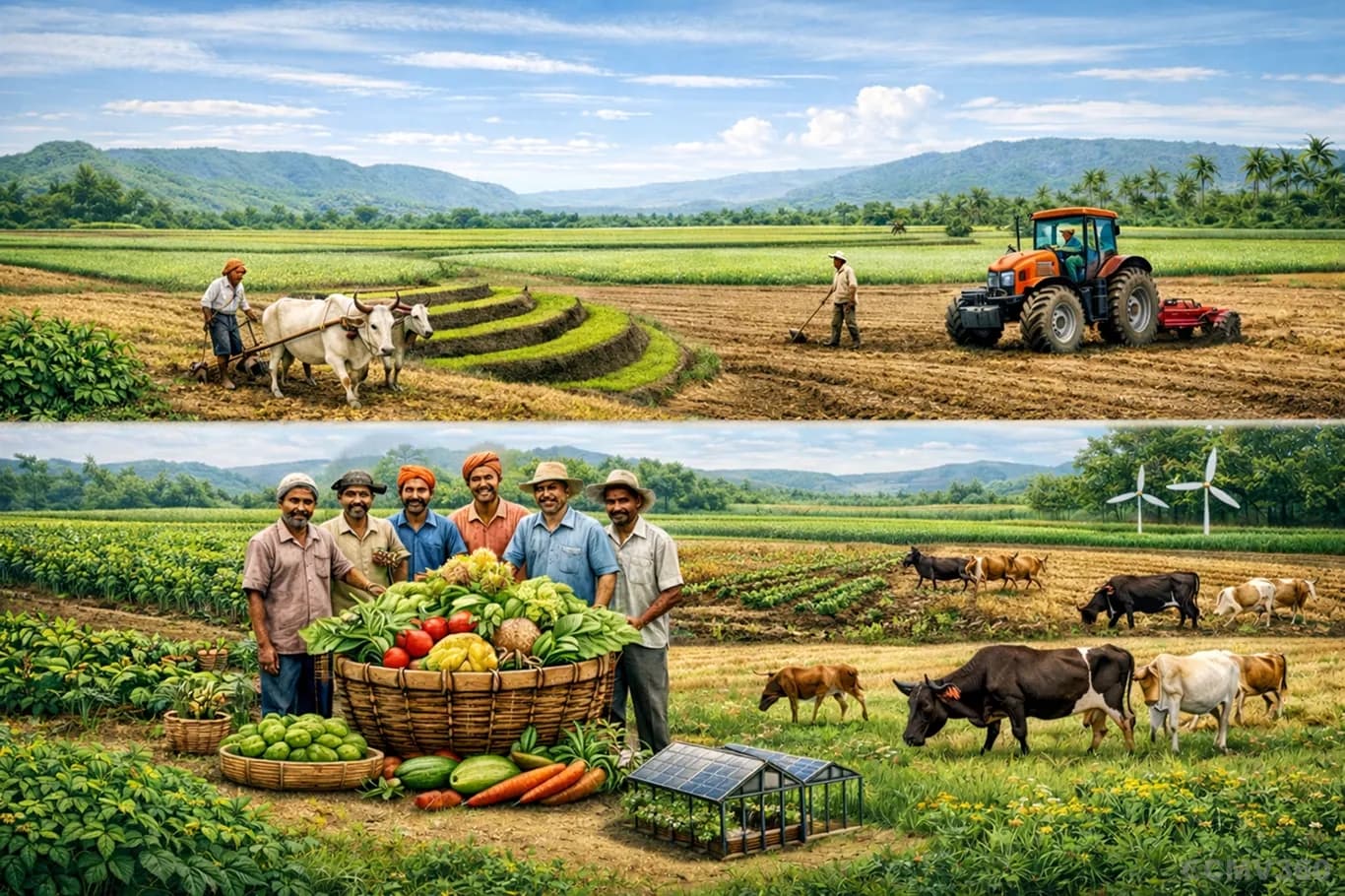
Additional Modern & Specialized Farming Types
Farming Type | Key Benefit |
Horticulture | High income & nutrition |
Aquaculture | Profitable fish production |
Poultry Farming | Quick income |
Dairy Farming | Regular cash flow |
Agroforestry | Ecological balance |
Greenhouse Farming | Year-round crops |
Vertical Farming | Less land, high output |
Container Farming | Ideal for urban areas |
Factors Affecting Farming in India
Major Factors
Soil quality
Climate and rainfall
Technology adoption
Market access
Government policies
Supporting Factors
Farmer education
Credit availability
Transport facilities
Cultural practices
Improving these factors directly improves farming in India.
Government Schemes & Subsidies for Indian Farmers
Top Government Yojanas Supporting Agriculture
Scheme | Benefit |
₹6,000 yearly income support | |
Crop insurance | |
Kisan Credit Card | Low-interest loans |
SMAM | Subsidy on machinery |
PM-KUSUM | Solar irrigation |
AIF | Storage & processing loans |
These schemes strengthen agriculture and governmental support for Indian farmers.
Also Read: Top 5 Wheat Varieties for January Sowing to Get Better Yield
CMV360 Says
India’s farming system is diverse, dynamic, and deeply rooted in its culture. From subsistence farming to modern vertical farming, each method plays a vital role in food production and rural development. With strong government schemes, subsidies, and modern technology, Indian farmers can improve productivity, income, and sustainability. Choosing the right farming type is the key to a secure agricultural future.

Robin Kumar Attri is a content and video professional with 2.7 years of experience in the commercial vehicle d .....