India's first 100% DME-powered tractor for both on- and off-road operations.
 Add CMV360 on Google
IIT Kanpur researchers created a 100% DME-fueled engine with a mechanical fuel injection mechanism.

By Priya Singh
IIT Kanpur researchers created a 100% DME-fueled engine with a mechanical fuel injection mechanism.
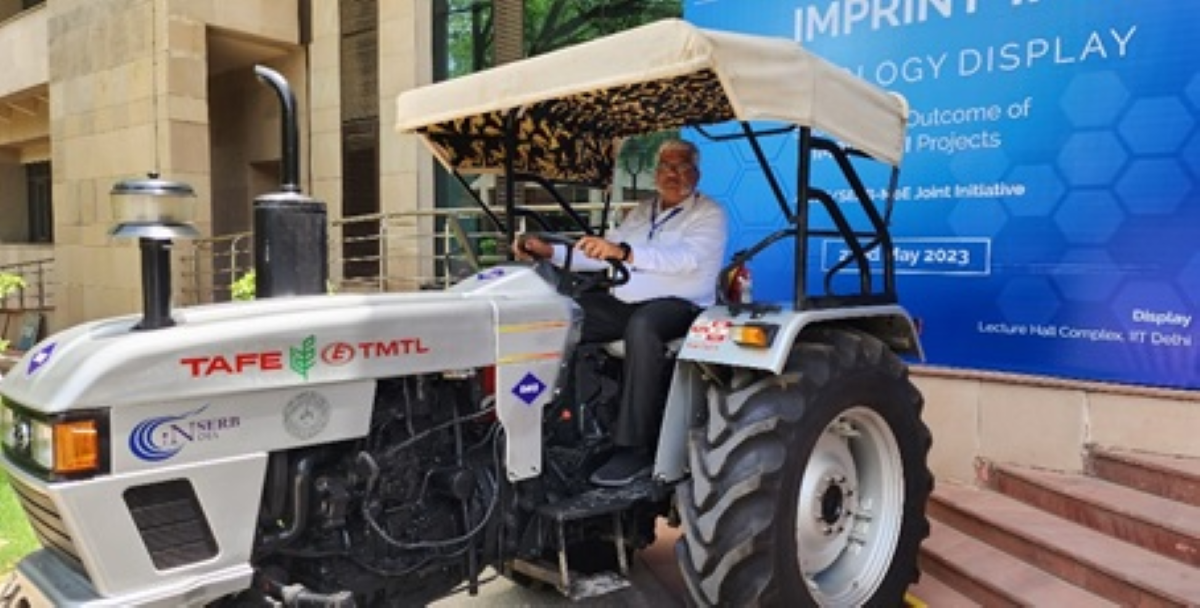
Researchers at IIT Kanpur have successfully created India's first 100% Dimethyl Ether (DME)-fueled tractor for both on- and off-road operations. This shows a significant step toward a sustainable and renewable fuel-based transportation system. This discovery opens a new chapter in the country's search for alternative fuels in order to minimize reliance on imported crude oil and promote a greener future.
DME, a renewable and indigenous fuel, has been used for vehicle power by a number of countries, including Japan, the United States, China, Sweden, Denmark, and Korea. However, until today, the application of DME in internal combustion (IC) engines has remained unexplored in India.
To address the need for renewable energy sources, IIT Kanpur researchers created a 100% DME-fueled engine with a mechanical fuel injection mechanism. This engine outperformed the diesel engine in terms of thermal efficiency and emissions.
Also Read: Swaraj Tractor Introduces the 'Target' Series of Compact Lightweight Tractors
One of the most notable characteristics of the DME-powered engine is it produces fewer particles, as well as approx no smoke generation. It does not need costly exhaust gas after-treatment systems or complex engine technologies. As a result, it is a viable alternative fuel and engine technology to traditional diesel engines used in agriculture and transportation.
The Science and Engineering Research Board (SERB), an institution under the Department of Science and Technology (DST), funded the research, which was connected with NITI Ayog's 'Methanol Economy' program. This ground-breaking research has the potential to reduce India's oil import bill and GHG emissions by converting abundant domestic coal reserves, low-value agricultural biomass waste, and municipal solid waste into methanol and DME for a variety of applications, including powering tractors and vehicles.
To address issues linked to DME's lower calorific value and increased compressibility when compared to diesel, the researchers created a tailored high-pressure mechanical fuel pump capable of higher pressurisation. They also utilised modified mechanical injectors with wider nozzle hole diameters to allow DME adaption and diesel-equivalent power output.
Lubricity additives were used to improve DME lubricity and DME-compatible materials. These were used in the fuel injection equipment (FIE). In addition, customized DME tanks were created for efficient fuel storage.
Also Read: MS Dhoni becomes a brand ambassador for Swaraj Tractors.
The researchers used 3D computer modeling to establish the best fuel injection system design. They used high-speed photography and phase Doppler interferometry (PDI) to investigate the macroscopic and microscopic spray properties of DME.
Based on the findings, a specific FIE was designed for the DME-fuelled engine prototype, which was tested at IIT Kanpur's engine research laboratory under full throttle performance (FTP) and part throttle and part load (PTPL) circumstances.
The DME-powered engine produced fewer particles while lowering HC, CO, and CO2 emissions significantly. The findings of this study have been published in prestigious journals such as 'Energy Conversion and Management' and 'Fuel'. The engine prototype that was built was successfully mounted in a tractor and operated by the industrial partner, TAFE TMTL, Alwar.
The tractor powered by DME is projected to be a low-cost, environmentally friendly choice for agricultural applications. Its streamlined engine technology, which is free of costly and difficult-to-maintain pollution control equipment, makes it user-friendly and compliant with the most strict emission rules currently in effect and in the future.
Furthermore, the DME-powered tractor's smokeless exhaust enhances ambient air quality in rural areas and the agricultural industry as a whole.

Hi there! I'm Priya. From trucks to vans and everything in between, I'm here to provide you with up-to-date in .....