Import Duty Cuts on Wheat and Chana: What It Means for Domestic Supplies?
 Add CMV360 on Google
Find out how the government’s decision to cut import duties on wheat and chana can affect the domestic supplies and prices of these essential commodities in India.

By Ayushi Gupta
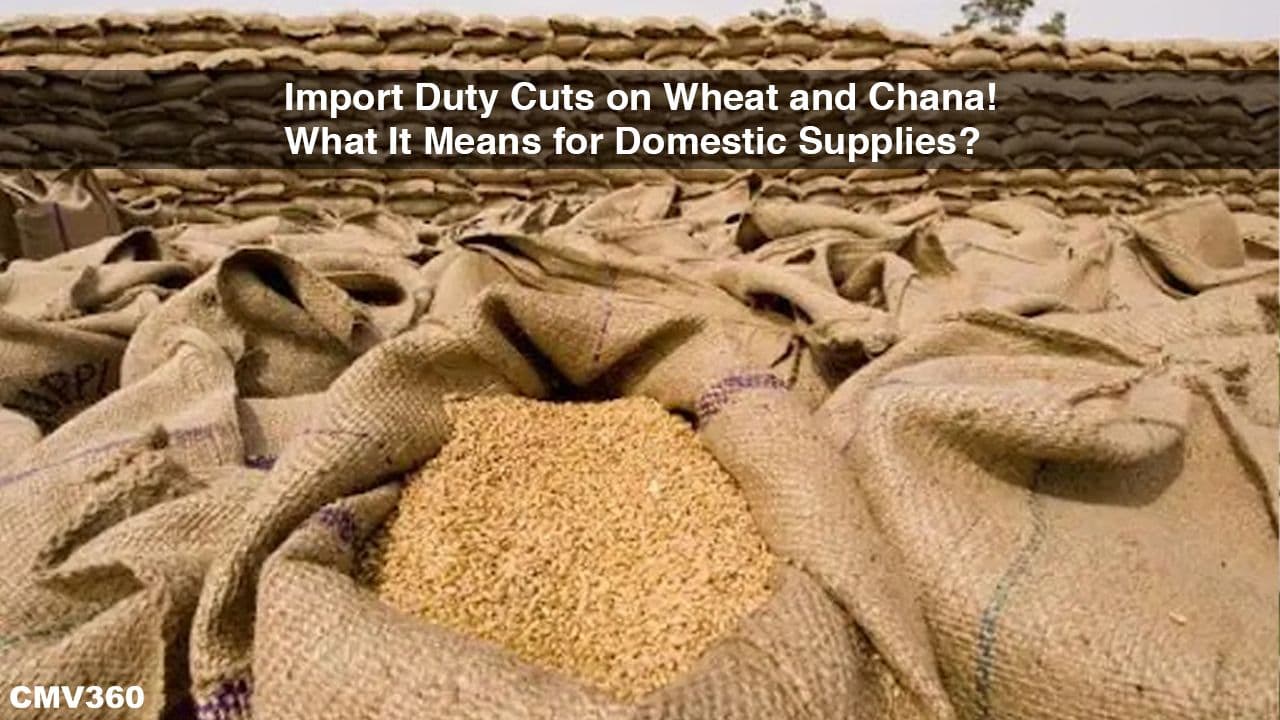
The sowing of chana, a key pulse crop, has declined by 10% this season (2023-224) compared to the same period last year, as per the latest data from the agriculture ministry.
The area under chana cultivation was 8.18 million hectare (mh) against 9.09 mh reported during the same period previous season. The average chana sowing area for the last five years is 10.09 mh.
The lower sowing is attributed to the El Nino conditions that are likely to persist till next year, affecting the rainfall and crop prospects.
To augment domestic supplies, trade sources have suggested that the government should reduce the current import duty of 40% on kabuli chana, which can be sourced from Russia.
Currently, there is a 66% import duty on chana sourced from Australia, while the import duty on pulses from the least developed countries (LDCs) such as Tanzania, Mozambique and Malawi has been abolished.
The government has also announced duty-free imports of yellow peas, which are used as a substitute for chana, until March 31 next year to cool prices of pulses.
The farmers’ cooperative Nafed has about 2 MT of buffer stock of chana, which would be sufficient to carry out selling chana under Bharat Dal initiative and offloading the pulses variety in the open market for purchase by bulk buyers till new crops arrive in the market by April next year.
In December, 2019, the government had imposed a minimum import price of Rs 200/kg of all varieties of peas – yellow, green, dun and kaspa – and had fixed an annual quota of 0.15 MT for curbing cheaper imports and boosting domestic prices.
Retail inflation in pulses category rose to 20.23% in November, while that of chana reported at 13.05%.
Meanwhile, the government is also keeping a close watch on the wheat prices and considering various measures to bring them down.
Sources told FE that the government is not in favour of reducing the import duty of 40% on wheat, which was imposed in April, 2019, as the Food Corporation of India (FCI) has enough stocks to carry out open market sale scheme (OMSS) for bulk buyers till the end of current fiscal.
The government has allocated an additional 2 MT of wheat to be sold in open market ‘if needed’ besides 10 MT already allocated for the current fiscal. So far, 4.4 MT of wheat has been sold from FCI stocks.
Traders have said that the government should allow private players to buy wheat from the global market, as the prices have softened.
Inflation in wheat declined to 6.36% last month from 7.6% in October.
The government has taken a number of measures to rein in food inflation recently, which has been a major concern for the economy.

With over 5 years of experience, I craft engaging content on commercial vehicles, blending expertise and creat .....