Sharp Decline in Bus Ridership Despite Modernization: CSE Report
 Add CMV360 on Google
Delhi sees a drastic 48.5% drop in bus ridership despite increased fleet and modernization, according to a study by the Centre for Science and Environment.

By Priya Singh
Key Highlights:
• Delhi sees a sharp 48.5% decline in bus ridership despite fleet modernization.
• The CSE report shows this decline, using Delhi's Economic Survey data.
• Despite the drop, Delhi's bus fleet has grown from 5,695 to 7,072, including 1,600 electric buses.
• Urgent need to boost public transport as private options are taking over.
• Nearly one-third of Delhi's population can't afford modern public transport.
Despite the implementation of newer and modern buses, Delhi has witnessed a significant decline in bus ridership, as reported by a study conducted by the Centre for Science and Environment (CSE).
A recent study conducted by the Centre for Science and Environment (CSE) has highlighted a significant decline in bus ridership in Delhi, despite the introduction of more modern and new buses. According to CSE’s Annual State of India’s Environment 2024 report, there has been a staggering drop of 48.5% in bus ridership in Delhi since the fiscal year 2017-18.
Data Analysis
The observations made by CSE are based on comprehensive data sourced from the Economic Survey of Delhi and other records. Remarkably, the decline in bus ridership in Delhi surpasses that of 13 other major cities, including Mumbai and Chennai.
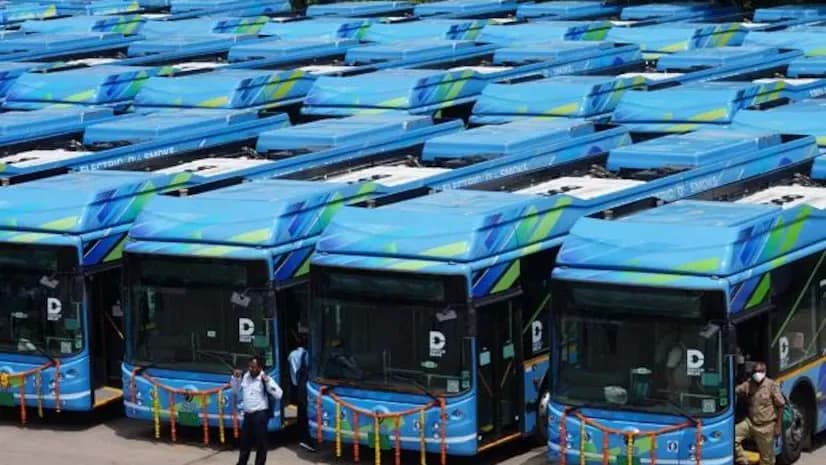
While the bus fleet in Delhi has increased from 5,695 in 2017-18 to 7,072 in 2021-22, with the induction of 1,600 electric buses, the ridership has seen a sharp decline, contrary to expectations.
The report highlights several reasons why riding a bus has become less attractive to people:
1. Waiting Time: Less than 1% of bus stops have an under 10-minute waiting time, and 50% of bus stops in Delhi have a high waiting time of more than 15 minutes.
2. Affordability: The modern public transport system has made travel unaffordable for a significant portion of Delhi’s population. Nearly one-third, or 34%, of Delhi's population, is deprived of access to basic non-AC bus services due to a lack of affordability, as they exceed the recommended limit of 10-15% of income that can be spent on transportation.
The report also predicts that private transport is likely to overtake public transport by 2040 across the country.
In the context of Delhi, the report states that public transport still accounts for 50.8% of daily ridership, with the Delhi Transport Corporation (DTC) contributing 14.4%, the Cluster Scheme accounting for 9.1%, and the Delhi Metro comprising 27.2%.
Also Read: January 2024 Sales Report: JBM Auto Emerges as Top Choice for E-Buses
Anumita Roychowdhury, the executive director of CSE, suggests improvements in the public transport system. She emphasizes the need for transformative changes, including:
1. Integration: Seamless integration between the Delhi Metro and buses to facilitate easy transfers.
2. Scaling Up: Overall scaling up of transport infrastructure to make it affordable for commuters.
3. Cost Considerations: Addressing the cost associated with interchanges in public transport to encourage more people to use buses.
CMV360 Says
Despite the modernization efforts in Delhi's bus fleet, the sharp drop in ridership indicates persistent challenges in making bus travel attractive and accessible to the public.
Urgent measures are needed to improve waiting times, affordability, and overall convenience to encourage greater utilization of public transport and alleviate pressure on private vehicles.

Hi there! I'm Priya. From trucks to vans and everything in between, I'm here to provide you with up-to-date in .....