PM Modi Highlights Need for More Batteries Production to Support EV Market
 Add CMV360 on Google
The government is also offering production-linked incentive schemes for advanced chemistry cells to encourage domestic manufacturing.

By Priya Singh
Key Highlights:
- PM Modi said India must increase battery production to support the demand for booming electric vehicles.
- Electric vehicle sales in India grew by 27% in 2024.
- India mainly imports batteries from China, Japan, and South Korea.
- The government is reducing taxes on battery components to boost local manufacturing.
- Many big companies are setting up factories in India to make batteries.
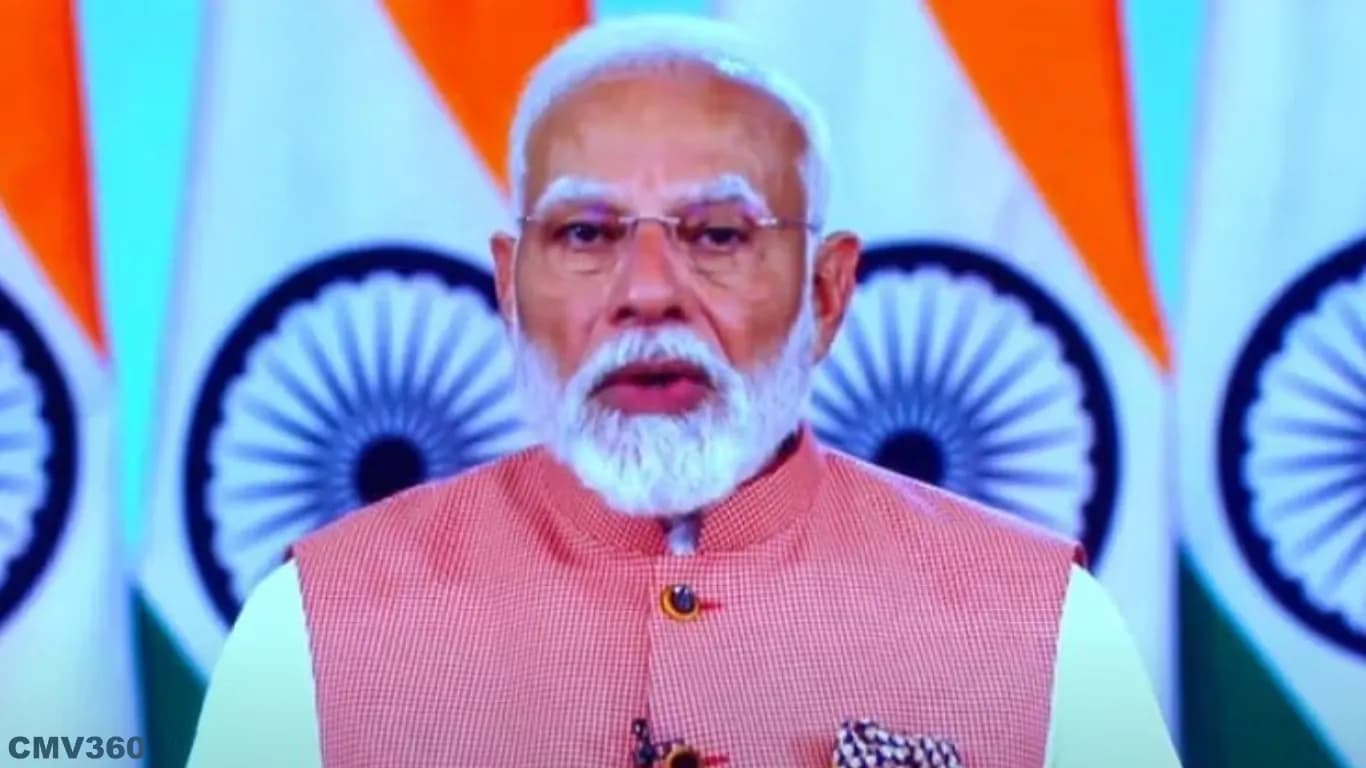
Prime Minister Narendra Modi recently emphasized the need to expand battery production and storage capacity to support India’s growing electric vehicle (EV) adoption. Speaking at the India Energy Storage Week event, he highlighted that electric mobility is expanding rapidly in the country, and enhancing battery production is important to meet the increasing demand.
In the present era, EV adoption in India is in its early stages, with two-wheelers and three-wheelers leading the charge. In 2024, electric vehicle sales grew by about 27%, reaching approximately 1.95 million units.
However, at present, India heavily depends on imported batteries from China, Japan, and South Korea. To reduce this dependency on other countries, there is a need for local manufacturing of lithium-ion batteries. This step could accelerate EV adoption in India.
Challenges for lithium-ion battery manufacturing in India
The challenge for lithium-ion battery manufacturing in India is the lack of significant raw materials like lithium, cobalt, nickel, and graphite in India. This is the reason why India is more reliant on import for manufacturing of batteries. Despite this, the government has taken steps to encourage local manufacturing. In the recent Union Budget 2025, the Indian government has exempted several components used in EV and mobile phone batteries from basic customs duties.
Additionally, the Indian government launched the National Critical Minerals Mission with a budget of Rs 34,300 crore to reduce dependence on imports and promote the exploration of essential minerals.
NITI Aayog and the Rocky Mountain Institute
In the accelerated scenario, India's annual battery industry might grow to $15 billion by 2030, up from $1 billion now, with about $12 billion coming from cells and the rest coming from pack assembly and integration.
Battery demand in India is predicted to increase to 260 GWh during the same time period. To achieve this demand, India will need five gigafactories in 2025 and 26 gigafactories by 2030.
Production-Linked Incentive Schemes
The government is also offering production-linked incentive schemes for advanced chemistry cells to encourage domestic manufacturing. Several major companies like Ola Electric, Reliance Industries, Tata Group, and JSW Group are setting up large-scale lithium-ion battery manufacturing facilities to meet the growing demand.
Also Read: Tata Motors Opens New Vehicle Scrapping Facility in Guwahati
CMV360 Says
Manufacturing batteries in India is important for the future of electric vehicles. It can help lower costs and reduce our need to buy from other countries. This will also create more jobs and make EVs more affordable for people. With government support and more companies making batteries, India can grow faster in electric vehicle technology.

Hi there! I'm Priya. From trucks to vans and everything in between, I'm here to provide you with up-to-date in .....