Celebi India deploys electric air conditioning coaches at Delhi international airport
 Add CMV360 on Google
Celebi introduced Taxi Bots in Indian aviation in 2019, with Air India becoming the world's first commercial airline to use them.

By Priya Singh
Celebi introduced Taxi Bots in Indian aviation in 2019, with Air India becoming the world's first commercial airline to use them.
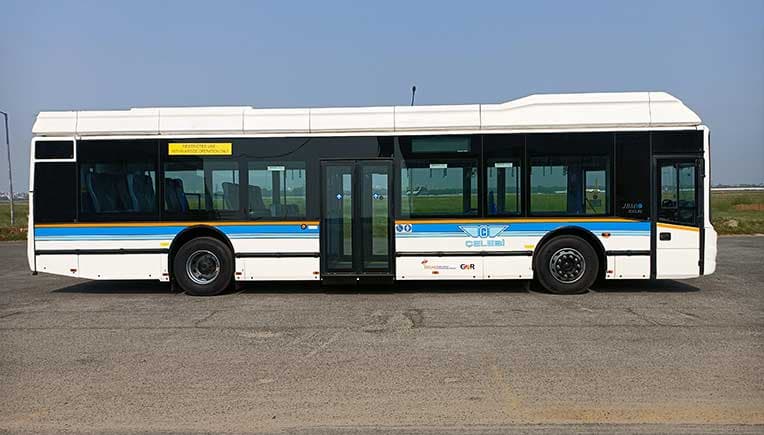
Celebi India has taken a significant step forward by introducing the first 100% electric air-conditioned tarmac coaches in India at Delhi International Airport. This is a significant step taken by the company in line with the Indian aviation ministry's goal of decarbonizing the aviation sector by 2030.
The JBM Group's Eco-Life Zero Emission Vehicle (ZEV) is an aesthetically designed tarmac coach for air passengers. These buses, which are powered by fast plug-in charging lithium-ion batteries, run on highly efficient PSPM electric motors, providing passengers with a silent and seamless ride.
The buses are built with high-strength monocoque structures for long durability and best-in-class comfort. The buses are outfitted with modern features such as Intelligent Transportation System, CCTV cameras, mobile charging USB sockets, Emergency safe stop buttons, and so on, with safety as a top priority
Mr. Murali Ramachandran, CEO of Celebi India, stated on the occasion, "We are a responsible organization with a strong focus on building sustainability as the main pillar of our operation. We applaud the government's decision to reduce carbon emissions in the aviation industry. We have previously implemented solutions such as Taxi bots and Bridge-mounted equipment under this vision of sustainable aviation. With the addition of 12 Made in India 100% Electric Air-Conditioned Tarmac Coaches, we are committing our support to the aviation sector and the government across the country through accelerated efficiency measures, energy transition, and innovation."
"These newly inducted low-entry ECOLIFE buses facilitate ease of boarding and de-boarding and are equipped with a wheel-chair ramp for the specially-abled, elderly, and people who are ill with a designated space for docking the wheelchair," he added.
Celebi has always been motivated and drawn to technological advancements, particularly those that have a positive impact on the environment and make the workplace a better place for our employees. Demand for sustainable technology is increasing, which has accelerated the pace of innovation in the aviation industry.
Celebi introduced Taxi Bots in Indian aviation in 2019, with Air India becoming the world's first commercial airline to use them. Taxi bots help save fuel by towing narrow-body aircraft from the terminal gate to the take-off point while the planes' engines are turned off; they also reduce foreign object damage by 50%.
Another environmentally friendly service offered by Celebi at Delhi, Mumbai, and Bangalore airports is bridge-mounted equipment (BME) services, which provide cooling and power to parked aircraft. BME services reduce CO2 emissions and noise pollution by approximately 80-85%.
Celebi is one of the world's leading ground-handling companies, with over 60 years of industry experience. It has been instrumental in the transformation of aviation landscapes in the countries where it operates, including Tanzania, Germany, Hungary, India, and Turkey.
Celebi Aviation brings more than 60 years of international ground-handling experience to the Indian aviation industry. They provide ground handling services at several Indian airports, including Delhi, Mumbai, Bengaluru, Hyderabad, Cochin, Ahmedabad, Kannur, and, soon, the New Goa Airport at MOPA, and have plans to expand operations to other cities. Celebi's services stand out in the aviation ground handling services industry due to sustainable practices, innovation, advanced technology, and process standardization.
CMV360 always keeps you up to date on the latest government schemes, sales reports, and other relevant news. So, if you're looking for a platform where you can get relevant information about commercial vehicles, this is the place to be. Stay tuned for new updates.

Hi there! I'm Priya. From trucks to vans and everything in between, I'm here to provide you with up-to-date in .....