Drones Used for Sowing Seeds in Kerala for the First Time
 Add CMV360 on Google
The drone used by KVK costs Rs 10 lakh. It operates using two batteries, which typically last about half an hour each.

By Priya Singh
Key Highlights:
- Drones were used for the first time to sow seeds in a paddy field in Kerala.
- Krishi Vigyan Kendra conducted the trial at Chakkinkari paddy field in Kuttanad.
- Drones can save time, reduce labor costs, and improve seed distribution.
- Drones also help overcome challenges like soil quality and saline water intrusion.
- The initiative aims to attract youth to farming by creating tech-based job opportunities.
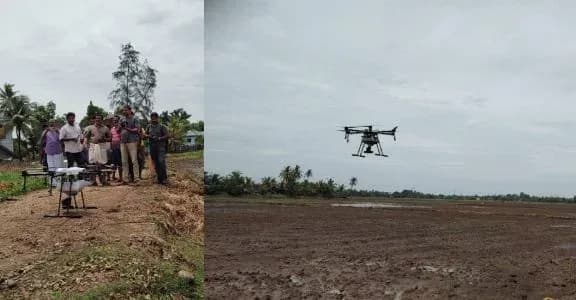
Drones were employed for the first time in Kerala to spread seeds in a paddy field near Kuttanad. The Krishi Vigyan Kendra (KVK) of the Kerala Agricultural University in Kumarakom achieved this milestone in the agricultural industry during a trial run at Chakkinkari paddy field in Champakulam, Kuttanad.
Dr Jayalakshmi G, Head Scientist at KVK Kumarakom, feels that this is a significant step forward for the state's agricultural economy. The kind of revolutionary change seen with the introduction of tractors can be expected with the use of drones in seed distribution.
"Then we decided to alter the drone and utilise it to spread seeds. This was done for a variety of reasons, the most important of which was to address the sector's lack of competent workers, which resulted in decreased productivity and losses for farmers," stated Dr Jayalakshmi.
The idea of employing drones in agriculture is not new. In 2022, the KVK bought a drone with support from the Indian Council of Agricultural Research. The Centre also successfully utilized it to spray medications over crops last year, resulting in a significant increase in production.
Trial Run in Kuttanad
Kuttanad was chosen for the trial run because of the specific issues that farmers experience in the region.
"The soil here is acidic. It is also susceptible to saline water incursion. When farmers walk through the soil to physically sow the seeds, the soil loses quality. All of this may be avoided by a drone. It also reduces time and labor costs. During the trial, we discovered that the drone distributed the seeds more evenly, resulting in a higher yield," Dr Jayalakshmi explained.
While it takes a normal laborer nearly a full day to spread seeds across a one-acre plot of land, a drone just needs 20 minutes. The most significant impact, however, would be the transformation of farming as a source of employment brought about by drones.
Manuel Alex, an Assistant Professor at KVK, piloted the drone during the broadcasting procedure.
"Not everybody can fly a drone. One must undergo training and obtain a license from the Directorate General of Civil Aviation. So, in future, it won't be labourers tilling the land, but it may be pilots flying drones who would be broadcasting seeds over the farmland," explains Manuel.
According to Manuel, the going pricing for renting drones is between Rs 700 and Rs 800 per acre. With adequate training and speed, a person can easily cover 30 acres every day. The drone utilized by KVK flies at a height of 5 meters and a speed of 5 meters per second, which may be adjusted.
"This is an excellent opportunity for the youth to find work. They no longer have to cultivate the ground under the blazing sun. Instead, they may be pilots spreading seeds and treatments throughout farms," Manuel states.
The drone used by KVK costs Rs 10 lakh. It operates using two batteries, which typically last about half an hour each. It can distribute approximately 35 kilograms of seed in one flight. To use the drone continuously, at least five sets of batteries would be required.
Also Read: VEDIC-Mahindra Skill Development Centre Inaugurated in Ambajhari
CMV360 Says
The use of drones in agriculture represents a promising advancement for Kerala's farming sector. This technology addresses the labor shortage and enhances efficiency and productivity. Encouraging youth to take up these tech-savvy roles could breathe new life into the agricultural industry, ensuring its sustainability and growth for the future.

Hi there! I'm Priya. From trucks to vans and everything in between, I'm here to provide you with up-to-date in .....