Analog Devices and Seeing Machines have announced a partnership to create sophisticated ADAS
 Add CMV360 on Google
Sophisticated Advanced Driver Assistance Systems (ADAS) are rapidly evolving to support safety across increasing and diverse levels of autonomous capability.

By Priya Singh
Semi-autonomous driving systems, for example, rely on in-cabin DMS and OMS to detect and address driver fatigue and distraction.
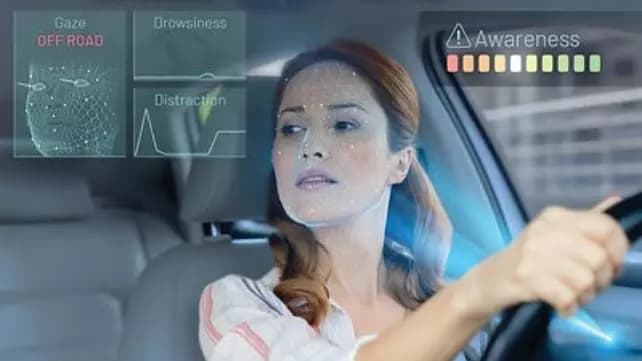
Long-distance driving and congested traffic are two scenarios in which driver fatigue and distraction are common and frequently result in accidents that result in injury or worse. New and sophisticated advanced driver assistance systems (ADAS) are rapidly evolving to support safety at increasing and varying levels of autonomy.
Sophisticated Advanced Driver Assistance Systems (ADAS) are rapidly evolving to support safety across increasing and diverse levels of autonomous capability. Semi-autonomous driving systems, for example, rely on in-cabin DMS and OMS to detect and address driver fatigue and distraction. These systems must operate in all lighting conditions and require proper infrared lighting to ensure the image quality required for real-time eye tracking.
The ADI-Seeing Machines solution leverages ADI's industry-first infrared driver for DMS and OMS, which is capable of delivering up to 100W of peak power in a compact and functionally safe package. This enables a smaller camera module to be installed in a vehicle's cabin.
The partnership combines ADI's advanced infrared driver and high-speed Gigabit Multimedia Serial Link (GMSL) camera connectivity solutions with Seeing Machines' artificial intelligence (AI) DMS and OMS software to support powerful eye gaze, eyelid, head, and body-pose tracking system technology that monitors driver fatigue and distraction more accurately.
The system is also conducive to future occupant monitoring features and a variety of in-cabin camera placement options that were previously unworkable due to issues with power efficiency, functional safety, hardware footprint, and image quality.
The ADI/Seeing Machines solution leverages ADI's industry-first infrared driver for DMS and OMS, which is capable of delivering up to 100W of peak power in a compact and functionally safe package. According to the company, this allows for a non-intrusive, smaller camera module in the vehicle's cabin.
Seeing Machines' AI software, on the other hand, interprets signals from optical hardware, monitors and diagnoses the problem, and combines with ADAS features to enable output signals to warn drivers and vehicle occupants when necessary.
According to Yin Wu, Director of Automotive Product Line Management at Analog Devices, cabin monitoring is complex and requires careful integration of infrared illumination, image capture, data processing, and algorithm layers to achieve a real-time response.
CMV360 always keeps you up to date on the latest government schemes, sales reports, and other relevant news. So, if you're looking for a platform where you can get relevant information about commercial vehicles, this is the place to be. Stay tuned for new updates.

Hi there! I'm Priya. From trucks to vans and everything in between, I'm here to provide you with up-to-date in .....